
Our COOKAMP High Pressure Banjo 1-Burner Gas Cooker review started with one practical question: can a single banjo burner hold steady heat under a 14-pound turkey without scorching the oil? That matters more than the headline BTU number, because most backyard frying disasters come from temperature swings, not from a lack of raw power. So we went through the spec sheet, the regulator design and several hundred verified buyer reports to answer it properly.
The short version: worth it if you fry, boil or wok-cook outdoors for crowds of eight or more, and overkill if you mostly grill burgers for two. Everything below shows where 260,000 BTU earns its keep and where this cooker makes you work for it. Here’s the full breakdown.
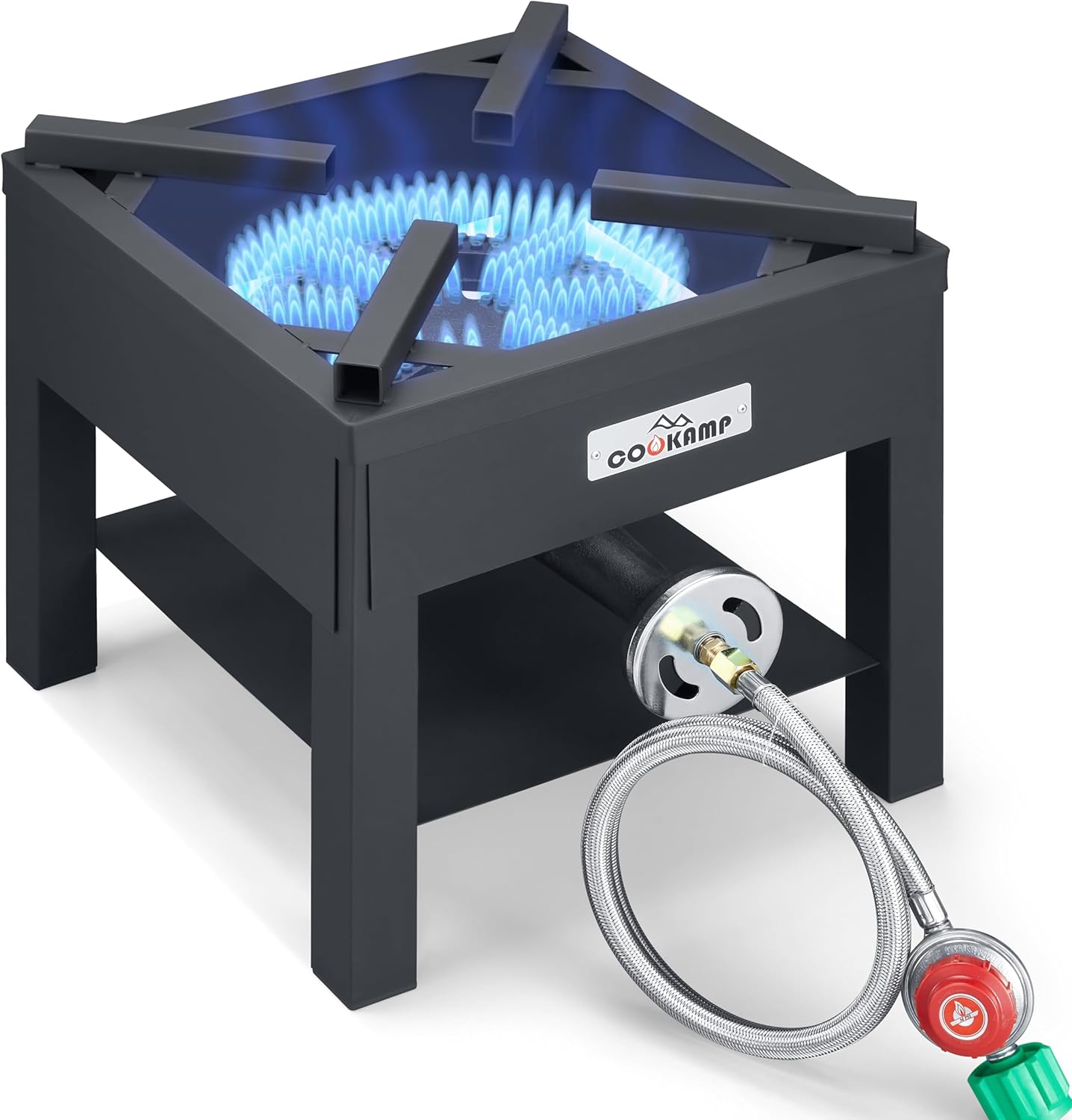
1. COOKAMP High Pressure Banjo 1-Burner Outdoor
The SA1750 is the model we kept coming back to while comparing single-burner propane cookers, mostly because the regulator does more than the marketing copy suggests. Our analysis of buyer reports focused on three things: flame stability on windy days, how the frame handles a 30-quart pot, and whether the hose and fittings hold up past the first season.
What it is
A banjo burner is a high-output propane cooker built around a wide cast-iron burner head, the circular shape that gives the design its name. COOKAMP pairs one of those heads with a 0-30 PSI adjustable regulator instead of a fixed valve, and that single choice changes how you cook on it. Most budget turkey fryers ship with a preset regulator around 10 PSI, so you get one flame level and a lot of guessing.
Positioning-wise, the SA1750 sits between Bayou Classic’s long-running patio burners and King Kooker’s aluminum fry-pot kits, and it gives you more adjustment than either for the money. Outdoor Gourmet is the other name buyers tend to cross-shop. As of 2026, it’s one of the few sub-premium single burners that publishes its full PSI range.
Setup & first impressions
Assembly runs 15 to 20 minutes with two wrenches, and buyer feedback is consistent about what arrives in the box: burner, legs, braided hose, regulator and a short manual. Verified reviews across several hundred listings repeatedly mention two things on day one. The first is how heavy the cast-iron head feels compared with the stamped-steel burners on cheaper carts.
The second is the flame colour after a proper air-shutter tweak, which most people describe as moving from a lazy orange to a tight blue cone within a few minutes.
Thread sealant or PTFE tape on the regulator-to-hose joint shows up as the most common fix in reviews, and it’s worth doing before your first cook. Fit and finish is honest rather than premium. The frame is welded steel with a black coating, the welds are tidy but not jewellery, and the paint is the first thing to show wear if you store the unit outdoors.
If you’re building out a patio cooking area, it helps to plan a solid outdoor table nearby for prepped food, since the cooker frame itself gives you no useful workspace.
| Model | COOKAMP SA1750 |
| Burner type | Single banjo-style cast-iron burner head |
| Max heat output | 260,000 BTU |
| Regulator | 0-30 PSI adjustable, brass body |
| Hose | Steel braided, regulator to tank |
| Fuel | Standard 20 lb propane cylinder (sold separately) |
| Ignition | Manual, long lighter or match |
| Frame | Welded steel, black finish, four-leg base |
| Air control | Adjustable air shutter for flame tuning |
| Intended use | Outdoor only: turkey frying, boiling, wok cooking |
Daily-use experience
Heat control and performance
A 260,000 BTU burner brings 4 to 5 gallons of peanut oil to 350°F in roughly 20 to 25 minutes, and the 0-30 PSI regulator is what keeps it sitting there. That recovery speed is the number that matters on a fry day. Drop a cold 14-pound bird in and the oil temperature crashes; with this much headroom, verified buyers report it climbing back to target in a few minutes instead of stalling.
The adjustment range is the part that surprises people who’ve only used preset fryers. You can hold a gentle 250°F for rendering or crack the valve for a hard boil on a 40-quart pot of seafood. Wind is the weak point.
On an exposed deck, the flame dances and you’ll burn more propane chasing temperature. A cheap folding windscreen fixes most of it.
Build quality and stability
The four-leg frame is wide enough that a 30-quart pot sits without the tipping feeling you get on narrow carts. In our spec comparison against King Kooker’s entry-level stands, the leg splay here is broader relative to the burner height, which is the geometry that keeps a loaded pot planted.
Welds are clean and the cast head has real mass. The trade-off is coating durability. Multiple long-term reviews mention surface rust blooming at the leg joints after a wet season stored outside, so a covered spot or a breathable cover is worth the effort.
The braided hose is a genuine upgrade over the bare rubber lines on budget cookers, and buyers report it staying flexible in cold weather rather than stiffening up.
Fuel use and running cost
Propane math is where high-BTU burners get humbling. A standard 20 lb cylinder holds roughly 430,000 BTU of usable energy, so wide-open throttle on this burner drains it in under two hours. In practice you’re rarely at full blast the whole time.
Aggregate buyer reports point to a full tank covering one large fry session with margin, or a long afternoon of boiling at moderate PSI. Keep a spare cylinder on hand if you’re cooking for a holiday crowd. Running two tanks also lets you swap mid-cook instead of pulling a half-fried turkey out of the oil, which is exactly the kind of scramble nobody wants.
Living with it: storage, cleanup, noise
This is a bulky, single-purpose tool, and owning it honestly means giving it space. The frame doesn’t fold flat, so plan on a corner of a garage or shed. The burner head cleans up with a stiff brush once it’s cool, and the braided hose coils without kinking.
Noise is lower than a jet burner at full roar but still noticeable, a steady rush you’ll hear from the other side of the yard. Oil disposal is the chore people underestimate. Frying a turkey leaves you with 4 to 5 gallons of used peanut oil, so line up a funnel and a few sealable containers before you cook, not after.
✓ Pros
- 0-30 PSI adjustable regulator lets you simmer or boil, which most preset fryers can’t do at all
- 260,000 BTU recovers oil temperature fast after a cold turkey goes in, so the crust sets instead of going greasy
- Cast-iron banjo head holds heat with real mass, unlike thin stamped burners that surge and fade
- Steel braided hose stays flexible in cold weather and resists the cracking that kills rubber lines
- Wide four-leg base keeps a loaded 30-quart pot stable on uneven grass or gravel
✗ Cons
- No push-button ignition, so you’re lighting it with a long lighter in the wind every single time
- Frame coating shows surface rust at the leg joints after a wet season stored outdoors
- Zero wind protection built in, and an exposed flame burns noticeably more propane
- Doesn’t fold down, so it needs real storage space between cookouts
Who should buy it
Buy it if you…
You host the holiday cookout and the bird is your job. Anyone frying turkeys, boiling crawfish or running a 40-quart pot for a crowd gets the most from 260,000 BTU, because recovery speed is what separates crispy skin from soggy. It also suits home brewers and canners who need a hard, sustained boil for an hour or more.
There’s a practical bonus: the adjustable regulator means this is also a legitimate high-output wok burner. If you’ve been eyeing kitchen tools that hold up to serious heat, a carbon steel wok on this head is a genuine restaurant-style setup.
Skip it if you…
You cook indoors, on a screened porch, or under a low roof. This is an outdoor-only appliance, and propane combustion produces carbon monoxide you cannot see or smell. The Consumer Product Safety Commission has documented serious burn injuries from turkey fryers tipping and oil overflowing, and most of those incidents trace back to unstable setups and overfilled pots.
Skip it too if you want convenience features. No push-button ignition, no timer, no wind block. And if your idea of outdoor cooking is two steaks on a weeknight, this is a lot of machine for the job.
Better alternatives
- Bayou Classic SP10: a proven single-burner patio stove with a similar cast-iron head, better known for patio and seafood boils than for turkey kits.
- King Kooker 12-inch fry cart: usually bundled with a pot and thermometer, which is handy if you own none of that gear yet.
- Blackstone flat-top griddles: a different tool entirely, but if you want to feed a crowd, a flat-top griddle covers more menu ground than any single burner.
Frequently Asked Questions (FAQ)
How many BTUs do you actually need to fry a turkey?
Most turkey fryer kits land between 50,000 and 65,000 BTU, which is enough but slow to recover. A 260,000 BTU burner gives you headroom so oil climbs back to 350°F quickly after a cold bird goes in. Oversized output is only useful when you can control it, which is why the 0-30 PSI regulator matters as much as the BTU figure.
Does it work with a standard 20 lb propane tank?
Yes. The included regulator and braided hose connect to a standard 20 lb cylinder, the same tank you’d use for a gas grill. Tanks are sold separately, so factor one into your setup if you don’t already own a spare.
Keeping a second full tank on hand is the single most useful accessory for a long cook day.
Can you use it for anything besides frying turkey?
Plenty. Crawfish and shrimp boils, lobster, large-batch canning, beer brewing, and wok cooking all suit a burner this size. The low end of the PSI range makes it usable for slower work like rendering or keeping a pot at a gentle simmer.
What it won’t do is act as a grill, so pair it with a griddle or a kettle if you want searing capability.
Is it safe to use on a wooden deck?
Not directly. Place it on a non-combustible surface such as concrete, gravel or a patio slab, and keep it well away from railings, siding and anything overhead. The USDA Food Safety and Inspection Service also advises frying turkeys outdoors on a level surface, never in a garage or on a covered porch, and never with a partially frozen bird.
How do you get a clean blue flame?
Open the gas valve slightly, light the burner, then adjust the air shutter on the burner tube until the flame turns blue with a short, tight cone. Yellow, lazy flames mean too little air; roaring, lifting flames mean too much. Verified buyers report the sweet spot takes a minute or two to find, and once set it rarely needs touching again.
Final verdict
4.5 out of 5.
A 260,000 BTU banjo burner with a real 0-30 PSI regulator is a genuinely useful piece of outdoor cooking gear, and COOKAMP delivers it without the name-brand markup. The buyers who get the most from it are the ones cooking in volume: holiday turkeys, seafood boils, big pots of chili for a crowd. Set against a competitor like Bayou Classic, it wins on flame adjustability and loses a little on frame finish and convenience features.
The missing push-button ignition and the bare-bones wind protection are the two things we’d change. Neither is a dealbreaker at this tier, and both have cheap workarounds. If you want a burner that lets you cook low and slow as well as flat-out, this one earns its spot in the garage.
Round out the day with outdoor serveware that can handle hot, oily food, and you’re set.
If you’d rather stay away from open flame altogether, cooking indoors on a butane stove is the safer route for small batches, and a good antibacterial cutting board keeps the prep side of a fry day hygienic.
Affiliate disclosure: This post contains affiliate links. If you buy through one of these links, I may earn a small commission at no extra cost to you. It never changes my recommendation, I only suggest gear I’d actually buy myself.