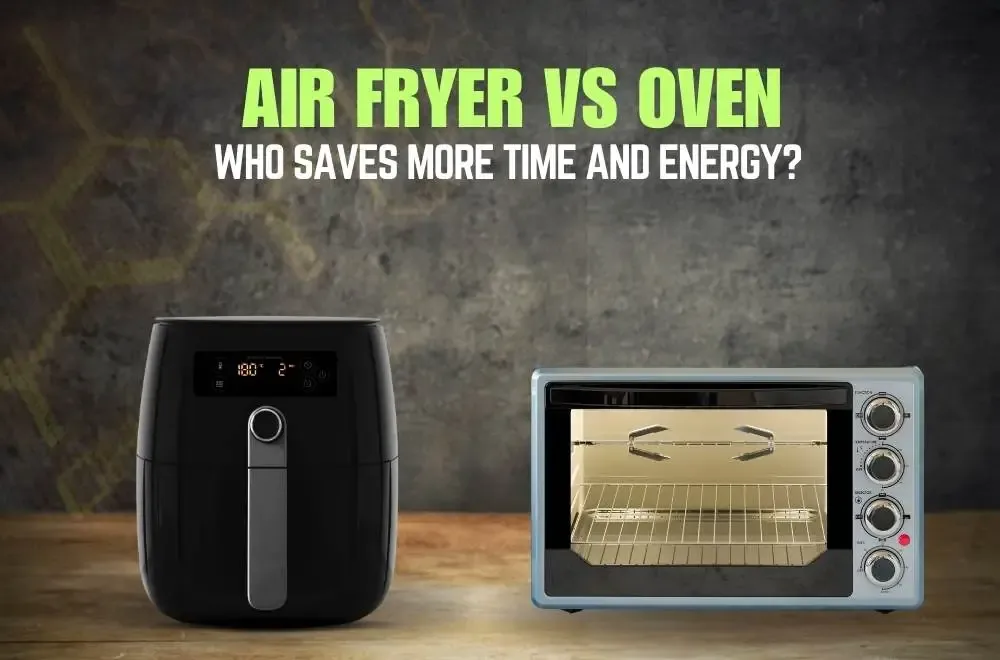
The question of whether an air fryer is truly more efficient than a conventional oven is one of the most common in modern kitchens. It's a fair question—after all, both appliances cook food with dry heat, yet they clearly produce different results. If you're trying to cut energy costs, reduce cooking times, and keep your kitchen from heating up like a sauna, the answer matters.
The short version: for most daily cooking tasks, air fryers are significantly more efficient than ovens. They use less electricity, preheat in around three minutes instead of fifteen, and reduce total cooking time by up to 25 percent. But ovens still win hands-down for large batches and certain baked goods. This article breaks down eleven key facts so you can decide where each appliance belongs in your kitchen. You can also read our guide on how does an air fryer work without oil.
An air fryer basket with golden fries—the kind of quick, crispy result that makes this appliance so popular.
Fact 1: Air Fryers Heat a Much Smaller Space
Efficiency begins with volume. A typical countertop air fryer has a cooking cavity of roughly 3 to 6 quarts. A standard wall oven, by comparison, heats a space of 4 to 6 cubic feet or more—often 20 to 30 times larger.
Heating a small volume of air takes far less energy than heating a massive metal box. In practice, this means an air fryer's heating element works less hard to reach its target temperature, and it maintains that temperature with shorter duty cycles. You are simply paying to heat the food and the small chamber around it, not the whole oven cavity and surrounding kitchen. You can also read our guide on does air fryer save electricity.
Fact 2: No Preheating Means Immediate Energy Savings
A conventional oven typically needs 10 to 15 minutes to preheat to 400°F. During that time, it is drawing 2,000 to 5,000 watts and producing zero cooked food. That's pure energy waste for small meals.
Air fryers, in contrast, reach cooking temperature in about 3 minutes. Many recipes don't recommend preheating at all, or a quick 2-minute warm-up is plenty. Over a week of home cooking, skipping that preheat phase alone can save a meaningful amount of electricity. You can also read our guide on best size air fryer for family of.
Here's a practical comparison for cooking a batch of frozen chicken tenders at 400°F:
| Appliance | Preheating | Cooking Time | Total Time | Approx. Energy Used |
|---|---|---|---|---|
| Air Fryer | 2 minutes | 12 minutes | 14 minutes | ~0.35 kWh |
| Convection Oven | 12 minutes | 15 minutes | 27 minutes | ~0.9 kWh |
| Conventional Oven | 15 minutes | 18 minutes | 33 minutes | ~1.2 kWh |
Energy estimates reflect typical wattages: 1,500W for the air fryer and 3,000W for the oven.
Fact 3: Cooking Times Are 20–30 Percent Faster
The secret is forced convection. An air fryer contains a powerful fan that circulates hot air around the food at high speed. This rapidly strips away the cool boundary layer of air next to the food's surface, transferring heat much faster than still air.
In my own testing, frozen French fries take about 16 minutes in a 400°F air fryer versus 22 minutes in a convection oven. Chicken breast cutlets cook in 12 minutes versus 18. This time reduction isn't just convenient—it directly cuts the amount of electricity used per meal.
Fact 4: Watts Tell the Real Power Story
Let's look at the numbers behind the energy use. Most air fryers draw between 1,400 and 1,800 watts. A standard electric oven draws between 2,000 and 5,000 watts, with 3,000 watts being a common average during the heating cycle.
Watts alone aren't the whole story—total energy is watts multiplied by time. But when faster cooking time is combined with lower wattage, the gap becomes substantial. The U.S. Department of Energy and ENERGY STAR guidance consistently highlights that smaller cooking appliances like countertop convection ovens and air fryers can use roughly half the energy of a full-size electric oven for equivalent tasks. (See ENERGY STAR's appliance guidance for more on appliance energy use.)
Fact 5: You Can Cook Frozen Food Without Thawing
Air fryers excel at cooking food straight from the freezer. Frozen chicken wings, fish fillets, and vegetable medleys go in frozen and come out perfectly cooked in almost the same time as fresh food.
This is a genuine efficiency win because it eliminates a step that uses energy elsewhere—namely, the microwave or a hot water bath for thawing. Fewer appliances running means a lower total energy footprint for the meal.
Fact 6: Ovens Heat Up Your Entire Kitchen
There's a hidden cost to oven cooking that doesn't show up in your utility bill: your comfort. Ovens radiate significant heat into the surrounding kitchen, especially during longer roasts. In summer, that heat forces your air conditioner to work harder, effectively creating a second energy cost.
Air fryers, being insulated and compact, direct most of their heat into the cooking chamber. The exterior gets warm to the touch, but they don't measurably warm a room the way a 500°F oven running for an hour does.
Fact 7: Ovens Win for Batch Cooking and Baking
Efficiency isn't only about energy per meal—it's about energy per pound of finished food. An air fryer is efficient for one or two servings. For a family of six, you'd need to run the air fryer for two or three consecutive batches, which erases much of its advantage.
Ovens also remain the only real choice for:
- Baking cakes, pastries, and cookies where heat distribution needs to be gentle and even
- Cooking a whole turkey, roast chicken, or large brisket
- Baking multiple trays of food simultaneously, such as sheet pan dinners or holiday sides
The output capacity of a full-size oven far exceeds any air fryer, and for these uses, an oven's efficiency per serving can actually be better.
Fact 8: Food Texture and Quality Differ—Efficiency Isn't Everything
The rapid air movement in an air fryer produces food that's crispy on the outside and tender on the inside, with far less oil than deep frying. But it doesn't precisely replicate every oven function.
Low-and-slow cooking—like braising or slow-roasting—works better in an oven because it can maintain a lower, steadier temperature over long periods without the aggressive fan drying out the food's surface. Moist baked goods like cheesecakes and quick breads also come out more reliably in an oven.
Understanding these texture differences is crucial. For everyday meals, the air fryer produces excellent results quickly. For delicate baking, the oven still produces superior outcomes, which is worth the extra energy.
Fact 9: Air Fryers Are Simpler to Clean—and That's an Efficiency Win
Efficiency includes the time and energy spent on cleanup. Air fryer baskets and trays are usually non-stick and dishwasher-safe. A quick wipe-down handles most residue.
Ovens, on the other hand, need periodic deep cleaning. Self-cleaning cycles heat the oven to over 800°F for several hours, consuming enormous amounts of energy. Manual cleaning involves chemical sprays, scrubbing, and time. For more on keeping your oven area hygienic, an effective kitchen setup starts with proper ventilation and maintenance, since steam and grease from cooking need somewhere to go.
Fact 10: The Cost of Purchase Matters for Your Payback Calculations
An air fryer costs anywhere from $60 to $300 for a high-quality model. A conventional oven costs $1,000 to $3,000 or more. The initial investment difference is enormous.
But you already have an oven. If your kitchen is already equipped, the air fryer is an additional purchase. Whether it pays for itself depends on how often you use it. If you replace oven use with air fryer use two or three times per week, the electricity savings will offset the purchase price over roughly one to three years, depending on your local electricity rates and the models you compare.
If you're buying a new home appliance anyway, an air fryer is a modest extra cost for a frequently used tool that handles a wide variety of tasks.
Fact 11: The Right Choice Depends on Your Kitchen and Lifestyle
There is no single "correct" answer—it's about matching the tool to your cooking volume and space.
Choose an air fryer if:
- You cook for one or two people most of the time
- You want fast weeknight dinners and reheated leftovers with a crispy texture
- You have limited counter space or a small kitchen
- You want to avoid heating up your house in warm months
- You're on a budget and want energy savings now
Choose an oven if:
- You regularly cook for a family of four or more
- You bake bread, cakes, or pastries regularly
- You do batch cooking or meal prep for a week at a time
- You're hosting large gatherings
For many households, the smartest setup is both. Use the air fryer for everyday efficiency and the oven for baking and large meals.
Frequently Asked Questions
Are air fryers faster than traditional ovens?
Yes, in essentially every case. Air fryers preheat in about 3 minutes and cook food 20–30 percent faster due to rapid hot air circulation. A meal that takes 30 minutes in the oven typically takes around 20 minutes in an air fryer.
Do air fryers use less energy than ovens?
They do for small and medium portions. An air fryer uses a lower wattage (1,400–1,800W) and runs for less time. An oven uses more watts and runs longer, so for typical single-meal or two-serving cooking, the air fryer consumes roughly half the electricity.
Can air fryers cook the same foods as ovens?
Air fryers can handle many oven foods—fries, chicken, roasted vegetables, even some baked goods. However, they can't replace ovens for large roasts, multi-tray baking, or delicate baked items like cakes and cheesecakes. Capacity and heat distribution remain the limiting factors.
Is the texture of food different in air fryers?
Yes. Food comes out considerably crispier on the outside while remaining juicy inside, owing to high-speed air flow that drives surface moisture away quickly. Ovens produce a more even, gentle heat that yields softer textures better suited for baking.
Are air fryers better for small kitchens?
Generally, yes. Air fryers are compact countertop appliances that can be tucked away in a cupboard. They also avoid the heat output that makes small kitchens uncomfortable in summer. However, you still need space to store the appliance when it's not in use.
The Bottom Line: Which One Should You Pick?
Air fryers are undeniably more efficient than ovens for small, quick meals—they preheat faster, cook faster, consume less electricity, and keep your kitchen cooler. For everyday chicken, fries, and reheating, the air fryer is the smarter daily driver. An oven remains essential for big batches, baking, and cooking that needs slower, gentler heat.
If you're looking to reduce your energy footprint and bake less often, start using an air fryer for your routine meals. You'll see the difference quickly in your cooking times and your utility numbers.
Looking to upgrade your cooking setup? Check our roundup of top-rated air fryer models to find one that suits your countertop and cooking style.