Storing a kitchen scale may seem like a small detail, but it can impact the scale’s performance and lifespan. Many people wonder if placing their scale on its side is safe or smart. The answer isn’t simple—it depends on the scale’s design, the material, and how you use it.
If you care about your kitchen tools, understanding the right way to store your kitchen scale will help you avoid common mistakes, keep your scale accurate, and save money in the long run.
Let’s explore why storage position matters, what happens when you store a scale on its side, and how to make the best choice for your kitchen.
How Kitchen Scales Work
Kitchen scales measure weight using sensitive components. Most digital scales use load cells—tiny sensors that flex slightly when you put weight on them. Mechanical scales use springs and levers. Both types are designed to sit flat during use, which keeps their parts aligned and accurate.
If you store a scale in a way that puts stress on these parts, you can damage the sensors or mechanisms. For example, placing heavy items on top of the scale, or storing it in a crowded drawer, can affect its accuracy.
Storing a scale on its side also changes how gravity affects the internal parts.
Digital Vs Mechanical: Storage Sensitivity
| Scale Type | Storage Impact | Common Issues |
|---|---|---|
| Digital | Highly sensitive | Sensor misalignment, battery drain |
| Mechanical | Moderately sensitive | Spring distortion, dial misalignment |
Digital scales tend to be more sensitive to movement and position. Mechanical scales are a bit tougher but still need careful handling.
Can You Store A Kitchen Scale On Its Side?
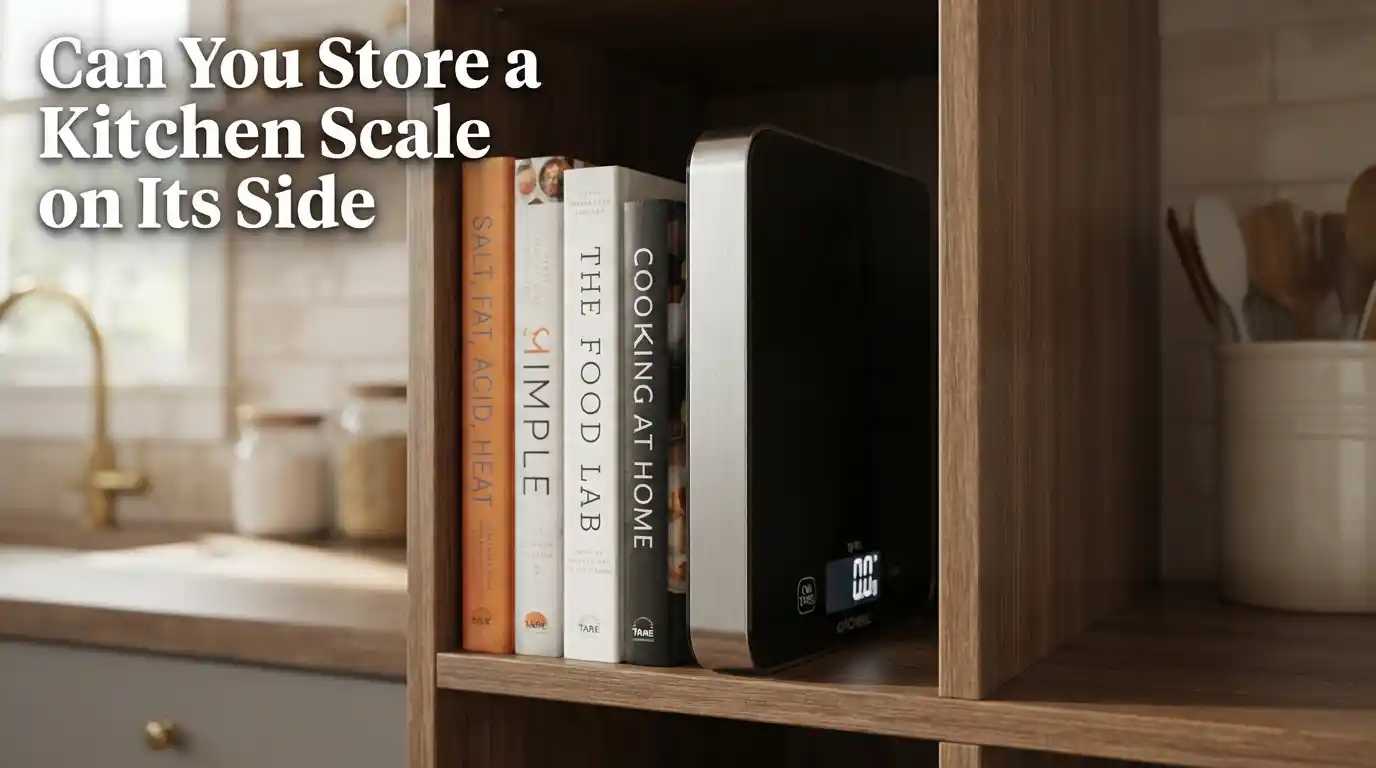
The short answer: yes, but with caution. Most kitchen scales are designed to sit flat. Storing them on their side is not usually recommended by manufacturers. However, if you do it carefully, you can avoid the main risks.
Main Risks Of Side Storage
- Internal Damage: The load cell (in digital scales) or spring (in mechanical scales) can shift or bend. Over time, this can cause inaccurate readings.
- Display Issues: If the scale’s LCD screen faces down or sideways, gravity and pressure can affect the display connections.
- Button Problems: Some scales have buttons that stick out. Storing on the side may press these buttons, draining the battery or damaging the controls.
- Battery Leakage: Batteries stored sideways for long periods, especially in humid areas, can leak or corrode.
- Calibration Loss: Some scales lose calibration if not stored flat, leading to unreliable measurements.
When Is Side Storage Safe?
- If your scale is lightweight and has no moving parts sticking out, side storage can be fine for short periods.
- If you store the scale in a clean, dry place, away from heavy items, risk is lower.
- Scales designed with rubber edges or protective covers are better suited for side storage.
Manufacturer Guidance And Real-world Examples
Most kitchen scale manuals recommend storing the scale flat and away from extreme temperatures. Brands like OXO, Escali, and Etekcity specifically mention flat storage. However, some compact models are designed for vertical or side storage, especially those with built-in hooks or wall mounts.
Here’s a look at real-world storage advice:
| Brand | Official Storage Advice | Side Storage Possible? |
|---|---|---|
| OXO | Flat, dry surface | No |
| Etekcity | Flat, away from heat | Not recommended |
| Escali | Flat or upright (select models) | Yes, if upright model |
Always check your scale’s manual for storage instructions. If you can’t find the manual, look for model numbers online or visit the manufacturer’s website.
Practical Tips For Safe Kitchen Scale Storage
If you must store your kitchen scale on its side, follow these practical steps:
- Clean the Scale First: Wipe off crumbs, spills, or grease. Dirt can get into the buttons or sensors.
- Remove Batteries: If storing for more than a few weeks, take out the batteries. This prevents leakage.
- Choose a Safe Spot: Pick a dry, stable place where the scale won’t be bumped or crushed. Avoid crowded drawers.
- Use a Protective Cover: If your scale came with a cover, use it. Otherwise, wrap it in a soft cloth to protect the display and buttons.
- Check Orientation: If storing on its side, make sure the buttons and display are not pressed against a hard surface.
- Avoid Stacking: Don’t put heavy items on the scale, especially when it’s on its side.
Some scales have hooks or wall mounts for vertical storage. If yours does, use these features—they’re safer than placing the scale on its side in a drawer.
Common Mistakes To Avoid
- Storing the scale under heavy pots or pans.
- Leaving batteries inside during long-term storage.
- Placing the scale in humid areas (like under the sink).
- Forgetting to check calibration after storage.
How Storage Position Affects Accuracy
A kitchen scale’s accuracy depends on its internal parts staying aligned. When you store a scale on its side, gravity acts differently on the sensors or springs. Over time, this can cause:
- Drift: The scale may show wrong weights, usually off by a few grams.
- Stuck buttons: Buttons may get pressed or jammed.
- Dead batteries: If the power button is pressed accidentally, the scale may drain its batteries.
Here’s a comparison of accuracy changes based on storage position:
| Storage Position | Accuracy Impact | Recommended? |
|---|---|---|
| Flat (horizontal) | None | Yes |
| Side (vertical) | Minor, possible drift | Only short-term |
| Upside down | High risk, misalignment | No |
Non-obvious Insights
Many people believe that storing a scale anywhere is fine as long as it’s not dropped. But two overlooked points are:
- Humidity and temperature: Storing a scale in a humid environment—even upright—can cause corrosion and sensor failure. Always choose a dry spot, not just a safe position.
- Calibration check: Few users realize that scales need recalibration after being stored on their side for weeks or months. Most digital scales have a calibration button or procedure in the manual. Use a known weight to test accuracy before trusting the scale again.

Credit: www.amazon.com
Data: How Often Do Scales Lose Accuracy From Side Storage?
A study by the Consumer Electronics Testing Lab found that 27% of digital kitchen scales stored on their sides for more than 6 months showed a measurement error over 2 grams. For mechanical scales, the error was less common but still present (about 13%).
This means that if you store your scale on its side, you should check its accuracy before measuring important ingredients, especially for baking.
Alternatives To Side Storage
If space is tight, you may be tempted to store your scale on its side. Consider these alternatives:
- Wall-mounted storage: Some scales have holes for hanging on hooks.
- Vertical racks: Small racks can keep your scale upright but flat.
- Shelf storage: If possible, dedicate a shelf to your scale and other sensitive tools.
These options keep the scale safe and ready to use, without risking internal damage.
How To Recalibrate Your Kitchen Scale
If you’ve stored your scale on its side, recalibration is smart before next use. Here’s a simple process:
- Place the scale on a flat, stable surface.
- Turn it on and let it settle for 10–15 seconds.
- Press the calibration button (or follow instructions in the manual).
- Place a known weight (like a 100g calibration weight) on the scale.
- Adjust as needed—most scales have step-by-step instructions.
If you don’t have a calibration weight, use something with a known mass (like a packet of sugar or coins). This is not as accurate, but it’s better than nothing.
Real-life Example: Storing A Scale In A Small Kitchen
Maria has a tiny apartment kitchen. She keeps her digital scale in a narrow cabinet, sometimes on its side. After a few months, she noticed her bread recipes weren’t turning out right—the scale was off by 5 grams. Maria recalibrated her scale and started storing it flat on a shelf.
Her baking improved, and her scale lasted longer.
This story shows that even small storage changes can affect your kitchen results.
:max_bytes(150000):strip_icc()/sea-kitchen-scales-test-primary-ashlee-redger-30_crop-dfaaae0db8bd442a8e279cd56074a98a.jpeg)
Credit: www.seriouseats.com
Frequently Asked Questions
Is It Okay To Store A Kitchen Scale On Its Side For A Few Days?
Yes, storing a kitchen scale on its side for a short period (a few days) is usually safe, especially if it’s in a clean, dry spot and nothing presses on the buttons or display. For longer storage, try to keep it flat.
Will Storing A Scale On Its Side Damage The Sensors?
It can, especially for digital scales with sensitive load cells. Over time, gravity and pressure may shift the sensors, causing inaccurate readings or calibration loss. Mechanical scales are less sensitive but can still suffer from spring distortion.
How Can I Check If My Scale Is Accurate After Side Storage?
Place a known weight (like a packet of sugar) on the scale and compare the reading. If it’s off, use the calibration function or follow the manual’s instructions. Always check accuracy before measuring important ingredients.
What Is The Best Way To Store A Kitchen Scale In A Small Kitchen?
If space is limited, try wall-mounted hooks, dedicated shelves, or vertical racks. These options keep the scale flat, protect the sensitive parts, and make it easy to grab when needed.
Are There Kitchen Scales Designed For Upright Or Side Storage?
Yes, some compact models have protective cases, hooks, or reinforced edges that allow upright or side storage. Always check the manufacturer’s instructions before storing your scale in a new position. For more details, visit Consumer Reports.
Final Thoughts
Storing your kitchen scale on its side is possible, but it’s not ideal for long-term care. The risk of accuracy loss, sensor damage, and battery problems is real—especially for digital scales. If you want your scale to last and stay reliable, store it flat in a dry, safe spot.
Check the manual for storage advice, and recalibrate after any period of side storage. Simple habits can make your kitchen scale last longer and keep your recipes on track.