Many beginners find that getting baked goods just right in an air fryer can be tricky. You might follow a recipe perfectly, but the results aren’t always what you expect. This is often because air fryer temperatures can vary, and they don’t always match the dial or digital display.
But don’t worry! Figuring out How to calibrate air fryer temperature for precision baking is simpler than you think. We’ll walk you through it step by step so you can bake with confidence.
Key Takeaways
- You will learn why air fryer temperatures can be inaccurate.
- You will discover easy ways to test your air fryer’s true temperature.
- You will find out how to adjust baking times and temperatures for better results.
- You will gain confidence in baking cakes, cookies, and other treats in your air fryer.
- You will learn to achieve perfectly baked goods every time.
Why Air Fryer Temperatures Vary
Air fryers are amazing kitchen gadgets that cook food quickly and make it crispy. They work by circulating hot air very fast around your food. However, like any appliance, they aren’t always perfect.
The temperature you set on the control panel might not be the actual temperature inside the cooking basket. This difference is called calibration. For everyday frying, a slight temperature difference might not matter much.
But when you want to bake things like cakes or cookies, where exact temperatures are super important, these small differences can lead to burnt edges and undercooked centers.
Several things can make an air fryer’s temperature run hot or cold. The thermostat inside the machine might not be perfectly set from the factory. Over time, the thermostat can also drift.
The way air circulates inside the basket can affect how heat is distributed, too. Even the material of your baking pan can play a role. Because of these variations, recipes might not turn out as planned.
This is why knowing How to calibrate air fryer temperature for precision baking is so helpful for anyone who loves to bake.
The Thermostat’s Role
At its core, an air fryer relies on a thermostat to maintain the desired temperature. When you set your air fryer to, say, 350°F (175°C), the thermostat is supposed to signal the heating element to turn on until that temperature is reached. Once the target temperature is hit, it should signal the heating element to turn off.
Then, as the air inside cools, the thermostat will detect this drop and turn the heating element back on to maintain the set temperature. This cycle repeats to keep the cooking environment stable.
However, the accuracy of this thermostat can be compromised by several factors. Manufacturing tolerances mean that not every thermostat is perfectly calibrated from the start. Think of it like a measuring tape that’s slightly off; it will consistently measure incorrectly.
Over time, even a well-made thermostat can lose its accuracy due to the constant heating and cooling cycles. This drift means your air fryer might actually be running hotter or cooler than what the display shows. This inaccuracy is a primary reason why How to calibrate air fryer temperature for precision baking becomes a necessary skill.
Airflow Dynamics
The powerful fan in an air fryer is what makes it so effective at cooking food quickly and evenly. This fan creates a rapid flow of hot air that surrounds the food from all sides. While this is great for crisping up fries, it also means that temperature distribution can be uneven if not managed properly.
Different air fryer models have different fan speeds and designs, which can influence how consistently the hot air moves throughout the basket. This can lead to hot spots and cooler zones within the same cooking chamber.
For baking, consistent heat is key. If one part of your cake batter is in a hot spot, it might cook much faster than the rest, leading to a burnt exterior while the inside is still raw. Conversely, a cooler zone might result in uneven baking or a pale, undercooked finish.
The design of the air fryer basket and any accessories you use can also impact airflow. For example, placing a baking pan that’s too large might obstruct the air circulation needed for even cooking. Understanding these airflow dynamics is a small but important part of mastering How to calibrate air fryer temperature for precision baking.
Impact of Accessories
When you start baking in your air fryer, you’ll likely use various accessories. These can include baking pans, silicone molds, racks, and parchment paper liners. While these items are helpful for baking, they can also change how your air fryer heats.
A thick metal baking pan might absorb more heat and slow down the cooking process compared to a thin silicone mold. Similarly, a lid on a baking dish can trap steam, which might be good for some recipes but not for others that need a dry heat to crisp up.
Parchment paper liners, while great for easy cleanup, can sometimes shift during cooking due to the strong airflow, potentially blocking vents or creating uneven heat. If you use a rack to elevate your baked goods, it changes the distance from the heating element, which can affect the cooking time and temperature. Therefore, it is important to consider how your chosen accessories might alter the internal temperature of the air fryer.
This awareness is a practical aspect of learning How to calibrate air fryer temperature for precision baking effectively.
How to Test Your Air Fryer’s True Temperature
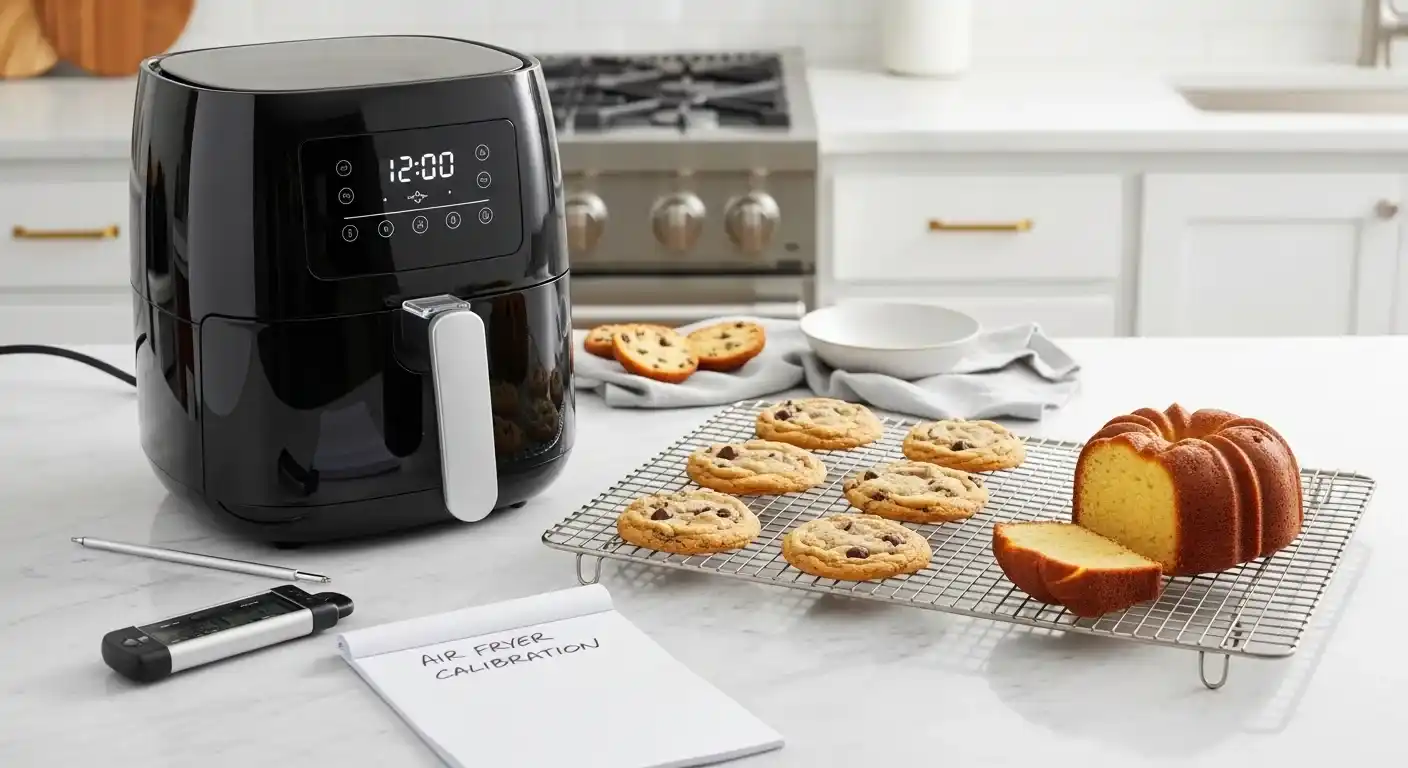
The most reliable way to know your air fryer’s real temperature is to test it. This sounds complicated, but it’s actually quite simple. All you need is an oven-safe thermometer.
You can buy these at most kitchen stores or online. Make sure it’s designed to be used in high heat environments like ovens. Place the thermometer inside the air fryer basket.
Set your air fryer to the temperature you want to test, usually a common baking temperature like 350°F (175°C).
Let the air fryer run for at least 5-10 minutes. This gives the thermostat time to cycle on and off and for the temperature to stabilize. Then, carefully open the basket and check the reading on the thermometer.
Write down the temperature it shows. Do this for a few different common baking temperatures, like 300°F (150°C), 350°F (175°C), and 400°F (200°C). This will give you a good idea of how your air fryer’s actual temperature compares to the setting.
This simple testing is the first step in mastering How to calibrate air fryer temperature for precision baking.
Using an Oven Thermometer
An oven thermometer is a small, durable device that measures heat. It usually has a dial or digital display and is built to withstand high temperatures found in ovens and air fryers. When you are testing your air fryer, you need to place this thermometer inside the cooking basket.
It’s important that the thermometer isn’t touching the heating element directly, as this can give a false high reading or even damage the thermometer. Most thermometers come with a hook or stand to help position them safely within the basket.
To get accurate results, you must allow the air fryer to preheat fully. This means running it for at least 5-10 minutes at the target temperature before taking a reading. Air fryers heat up quickly, but the thermostat needs time to reach a stable cycle.
Check the thermometer’s reading after the preheat period. Repeat this process for several different temperature settings that you commonly use for baking. This data is crucial for understanding your specific air fryer’s performance and is a core part of learning How to calibrate air fryer temperature for precision baking.
Common Temperature Discrepancies
It’s quite common for air fryers to run hotter than their set temperature. For instance, you might set your air fryer to 350°F (175°C), but your oven thermometer reads 375°F (190°C) or even 400°F (200°C). Some air fryers might run cooler, though this is less frequent.
A discrepancy of 10-20°F (5-10°C) is often considered within a normal range for many appliances. However, larger differences can significantly impact your baking results.
For example, if your air fryer is consistently 25°F (14°C) hotter than the dial shows, a recipe calling for 350°F (175°C) will actually be baking at 375°F (190°C). This can cause cookies to spread too much and brown too quickly, or cakes to develop a hard crust before the inside is cooked. Recognizing these discrepancies is fundamental.
It’s not about your air fryer being “broken,” but rather about understanding its unique heating characteristics. This knowledge is what allows you to adapt and succeed when you’re trying to figure out How to calibrate air fryer temperature for precision baking.
Preheating is Key
Just like with a traditional oven, preheating your air fryer is a vital step before you start baking. Preheating ensures that the cooking chamber reaches and stabilizes at the desired temperature. Without proper preheating, you might be placing your delicate baked goods into a temperature that is still fluctuating, leading to inconsistent cooking.
This is especially true for air fryers because of their rapid heating and intense airflow. The thermostat needs time to establish its cycle of heating and resting to maintain a steady temperature.
When you preheat your air fryer, you’re giving the heating element and thermostat a chance to work together to reach the set point and then maintain it. This stabilization period is critical for accurate temperature control. For testing your air fryer’s temperature, it’s best to let it preheat for at least 5 to 10 minutes.
This ensures that the internal temperature you measure is representative of the temperature the air fryer will maintain during the actual cooking process. Proper preheating is a cornerstone of learning How to calibrate air fryer temperature for precision baking.
Adjusting Recipes for Your Air Fryer
Once you know how your air fryer’s temperature differs from the dial, you can make adjustments to your recipes. If your air fryer runs hotter, you’ll need to lower the set temperature. For example, if your air fryer is consistently 25°F (14°C) hotter than what you set, and a recipe calls for 350°F (175°C), you should set your air fryer to 325°F (160°C).
This simple adjustment can make a big difference in your baking success.
You might also need to adjust the baking time. If your air fryer cooks faster because it’s hotter, you’ll want to check your baked goods earlier than the recipe suggests. Start checking about 5-10 minutes before the recipe’s minimum time.
Use a toothpick inserted into the center to see if it comes out clean for cakes and muffins. For cookies, look for golden-brown edges and a center that looks set. Mastering these adjustments is key to achieving perfect results when you’re figuring out How to calibrate air fryer temperature for precision baking.
Lowering the Temperature
If your temperature tests show that your air fryer runs hotter than the set temperature, the simplest adjustment is to lower the temperature on the dial or digital display. This is a direct compensation for the appliance’s inaccuracy. For instance, if your oven thermometer consistently reads 375°F (190°C) when you set your air fryer to 400°F (200°C), you know your air fryer runs about 25°F (14°C) hotter.
To bake something at the recipe’s intended 400°F (200°C), you would set your air fryer to 375°F (190°C).
It’s helpful to keep a small chart or notes for your air fryer. You can write down the temperature discrepancy and then note the adjusted temperature for common recipe settings. For example: “350°F recipe = set air fryer to 325°F.” This makes it easy to quickly reference and apply the correct setting without having to recalculate each time.
This systematic approach is a practical aspect of understanding How to calibrate air fryer temperature for precision baking for consistent outcomes.
Reducing Baking Time
Faster cooking times are a common result of an air fryer running hotter than expected. If your air fryer is consistently 25°F (14°C) hotter, your baked goods might brown or cook through significantly faster than the recipe indicates. This means you need to start checking for doneness earlier than the recipe suggests.
For a cake that’s supposed to bake for 30 minutes at 350°F (175°C), if your air fryer runs hot, you might want to check it at the 20-25 minute mark.
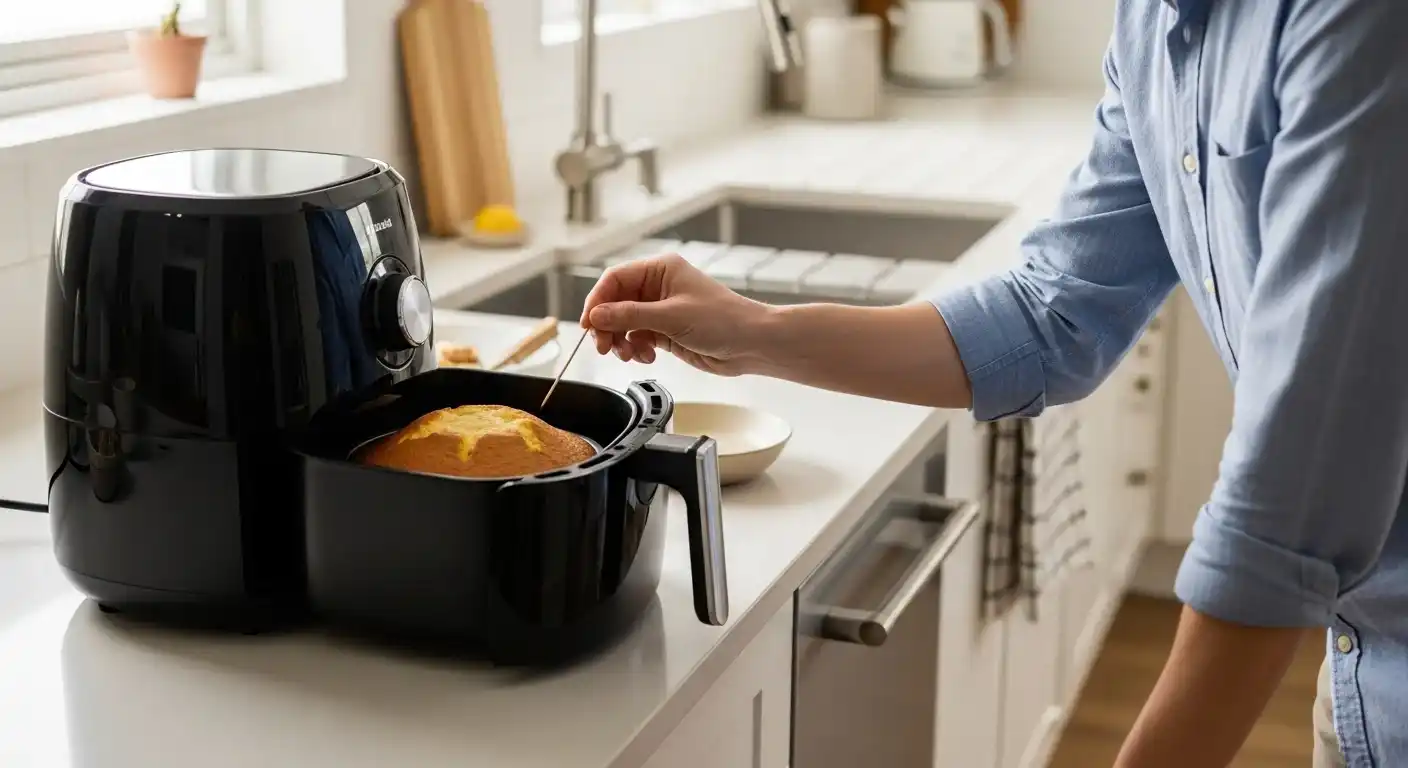
The best way to check for doneness is visually and with a test. For cakes, a toothpick inserted into the center should come out clean. For cookies, look for edges that are lightly golden brown and centers that appear set.
Muffins and cupcakes should spring back when lightly touched. By reducing the baking time and checking frequently, you can prevent your baked goods from overcooking or burning, especially when you’re learning How to calibrate air fryer temperature for precision baking. It’s always better to check a bit early and add a few more minutes if needed than to ruin a whole batch.
Visual Cues and Doneness Tests
Recipes provide time guidelines, but visual cues are often the most reliable indicators of doneness, especially when dealing with temperature variations. For cakes and muffins, the edges should be pulling away slightly from the sides of the pan. The top should look set and lightly golden.
A simple way to test is to gently press the top of the baked item; it should spring back. If it leaves an indentation, it needs more time.
For cookies, the edges should be firm and lightly browned, while the centers might still look a little soft. They will continue to set as they cool. A toothpick test is also very useful for many baked goods.
Insert a toothpick or a thin knife into the center of the item. If it comes out clean, it’s likely done. If it has wet batter on it, it needs more baking time.
Learning to trust your eyes and these simple tests will greatly improve your results when you’re figuring out How to calibrate air fryer temperature for precision baking.
Baking Success with Calibrated Air Fryers
Once you’ve tested your air fryer and understand its temperature quirks, baking becomes much more predictable. You can confidently adapt your favorite cake, cookie, or muffin recipes for the air fryer. It’s about working with your appliance, not against it.
By making small temperature and time adjustments, you can achieve the same delicious results you’d expect from a conventional oven.
This process not only makes baking easier but also more enjoyable. You’ll spend less time troubleshooting and more time savoring your homemade treats. Remember that practice makes perfect.
Each time you bake, you’ll learn a little more about how your specific air fryer performs. This hands-on experience is invaluable when you’re aiming for consistent, perfect bakes every time. Mastering How to calibrate air fryer temperature for precision baking opens up a whole new world of air fryer possibilities.
Perfect Cookies Every Time
Achieving perfectly chewy or crisp cookies depends heavily on precise temperature control. If your air fryer runs hot, your cookies might spread too thin and burn quickly on the edges before the center is cooked. By lowering the temperature by 25°F (14°C) and checking them a few minutes earlier than the recipe suggests, you can prevent this.
Look for cookies that are golden brown around the edges and still slightly soft in the center. They will firm up beautifully as they cool on the wire rack.
For recipes that tend to spread a lot, consider using slightly less butter or chilling your cookie dough for longer before baking. This helps the cookies maintain their shape. Using parchment paper liners designed for air fryers can also help prevent excessive spreading.
With a calibrated air fryer, you can consistently produce bakery-quality cookies right from your kitchen, proving that How to calibrate air fryer temperature for precision baking leads to sweet success.
Moist and Fluffy Cakes
Baking cakes in an air fryer can be a revelation, but it requires attention to temperature. If the air fryer is too hot, the outside of the cake can cook too quickly, forming a tough crust, while the inside remains dense or undercooked. Reducing the temperature by 25°F (14°C) and keeping a close eye on the cake, especially in the last 10-15 minutes of baking, is crucial.
A toothpick inserted into the thickest part of the cake should come out clean or with a few moist crumbs attached, not wet batter.
Using smaller cake pans or molds that fit comfortably in your air fryer basket will also ensure better air circulation. This helps the cake bake more evenly. Some people even find that placing a small, oven-safe dish of water in the air fryer can help add a bit of moisture to the environment, which is beneficial for cakes.
With careful calibration, your air fryer can produce wonderfully moist and fluffy cakes, demonstrating the power of understanding How to calibrate air fryer temperature for precision baking.
You might find this helpful: Best Air Fryers for Baking Cakes
Evenly Cooked Muffins and Cupcakes
Muffins and cupcakes are baked goods that benefit greatly from consistent temperatures. If your air fryer runs hotter, you’ll want to lower the set temperature by about 25°F (14°C) and start checking for doneness a few minutes before the recipe’s suggested time. The tops of muffins should be golden brown and spring back when lightly touched.
For cupcakes, the frosting might melt if they are left in too long after baking, so it’s important to remove them promptly once they are done.
Ensure your muffin liners are secured in the tin so they don’t fly around with the strong air circulation. Using a baking tin that fits well in your air fryer basket is important for optimal airflow. By paying attention to these details and adjusting based on your air fryer’s calibration, you can achieve beautifully risen, evenly cooked muffins and cupcakes every time.
This practical knowledge is what How to calibrate air fryer temperature for precision baking is all about.
Troubleshooting Common Baking Issues
Even with calibration, baking in an air fryer can sometimes present challenges. The most common issue is uneven cooking, where parts of your baked item are done while others are not. This can be due to uneven airflow, or the food being placed too close to the heating element.
Another issue might be a dry texture, which can happen if the cooking time is too long or the temperature is too high, causing moisture to escape too quickly.
Understanding the root cause of these problems is key to solving them. For example, if your cakes are consistently dry, you might need to slightly reduce the baking time or temperature, or even add a tablespoon of liquid to your batter. If one side of your cookies always browns faster, try rotating the baking pan halfway through.
These small adjustments, informed by your air fryer’s calibration, will help you overcome common baking hurdles and improve your results.
Uneven Browning
Uneven browning is a frequent complaint when air frying, and it’s often linked to airflow patterns within the appliance. If one side of your food consistently gets darker than the other, it suggests a hot spot or an area where the hot air is more concentrated. To combat this, periodically rotating your baking pan or the basket itself can help ensure more even exposure to the heat.
For baked goods like cookies, even rotating the tray halfway through the baking process can make a significant difference.
If you’re using accessories like parchment paper or silicone liners, make sure they aren’t blocking essential air vents. Sometimes, overfilling the basket can also lead to uneven cooking because the hot air can’t circulate freely around all the items. Using smaller batches or ensuring there’s space between your baked goods can promote more uniform browning.
This attention to detail is vital when learning How to calibrate air fryer temperature for precision baking and aiming for professional-looking results.
Dry Baked Goods
Dryness in baked goods is often a sign that they have been overcooked, or that the cooking temperature was too high, causing moisture to evaporate too quickly. Since air fryers cook faster and more intensely than conventional ovens, it’s easy to accidentally overdo it. If you find your cakes, cookies, or muffins are consistently dry, consider reducing the baking time by a few minutes or lowering the temperature by 25°F (14°C).
It can also be helpful to use recipes that are known to produce moist results. For example, recipes that include ingredients like sour cream, yogurt, applesauce, or oil tend to yield moister baked goods. Checking for doneness earlier than the recipe suggests is a proactive approach.
A toothpick test is your best friend here; removing your baked goods as soon as the toothpick comes out mostly clean, rather than waiting for it to be bone dry, will retain more moisture. This practice is a key part of successful How to calibrate air fryer temperature for precision baking.
Food Sticking to Pans
Food sticking to baking pans is a common kitchen frustration. While it might not seem directly related to temperature calibration, it can impact the outcome of your baked goods. If food sticks, it can tear when you try to remove it, ruining its appearance.
To prevent this, always ensure your baking pans are properly greased and floured, or lined with parchment paper. For delicate items like cakes, using baking spray with flour can be very effective.
Sometimes, sticking can also be a result of the food not being fully cooked when removed from the oven. If a cake or muffin is still a little undercooked in the center, it might stick more easily. This is another reason why accurate temperature and correct baking times are important.
By following proper pan preparation techniques and ensuring your air fryer is calibrated for accurate cooking, you can minimize sticking issues and enjoy perfectly baked items. This is a practical benefit of understanding How to calibrate air fryer temperature for precision baking.
Frequently Asked Questions
Question: How often do I need to calibrate my air fryer
Answer: You don’t need to calibrate your air fryer constantly. A one-time test to understand its general temperature discrepancy is usually enough for most users. If you notice your baking results are consistently off, or if you’ve moved the air fryer or had it for many years, re-testing can be helpful.
Question: Can I bake bread in an air fryer
Answer: Yes, you can bake smaller loaves or rolls in an air fryer. The key is to use a bread recipe designed for smaller batch sizes and to ensure your bread pan fits comfortably in the basket, allowing for good air circulation. You’ll likely need to adjust temperature and time based on your air fryer’s calibration.
Question: What size baking pans fit in most air fryers
Answer: This varies greatly by air fryer model. Typically, 6-inch or 7-inch round cake pans, small loaf pans, or standard muffin tins fit well in most basket-style air fryers. Always measure the inside dimensions of your air fryer basket before purchasing accessories.
Question: Do air fryer temperatures fluctuate a lot
Answer: Yes, air fryer temperatures can fluctuate. They cycle on and off to maintain the set temperature. While this is normal, the degree of fluctuation and the accuracy of the thermostat can vary between models and over time.
Testing your air fryer helps you understand its specific cycling behavior.
Question: Can I use regular oven recipes in my air fryer
Answer: You can adapt most conventional oven recipes for your air fryer, but adjustments are usually necessary. You’ll need to consider temperature, time, and pan size. Learning how to calibrate your air fryer’s temperature is the most important step in successfully converting recipes.
Summary
Learning How to calibrate air fryer temperature for precision baking makes a big difference. Testing your air fryer with an oven thermometer reveals its true temperature. Adjusting recipes by lowering the temperature and checking baking times earlier leads to success.
You can bake perfect cookies, cakes, and muffins. Enjoy your air fryer baking adventures with confidence.