If you’ve ever paid store prices for a tiny bag of dried strawberries, you already know the appeal of making your own. Dehydrating strawberries in an air fryer turns fresh, seasonal fruit into a chewy, naturally sweet snack that lasts for months — no added sugar, no preservatives, and no special equipment required.
The process is simpler than most people expect. With the right prep, a low temperature, and a little patience, you can produce perfectly dried strawberry slices that rival anything from a specialty food shop. This guide walks you through every step: selecting fruit, prepping it correctly, dialing in the right temperature and timing, storing your finished batch, and even troubleshooting when things go wrong.

Photo: Strawberry slices arranged in a single layer, the key to even dehydration.
Why Dehydrate Strawberries in an Air Fryer?
Most homes already own an air fryer, which makes it the most accessible tool for fruit dehydration. Unlike a dedicated food dehydrator, an air fryer takes up less counter space, heats up faster, and completes small batches in a fraction of the time.
The benefits go beyond convenience:
- No added ingredients — you control exactly what goes on your fruit.
- Concentrated flavor — removing water intensifies the natural sweetness.
- Long shelf life — properly dried strawberries keep for 6–12 months.
- Portable snacks — lightweight and non-perishable, ideal for hikes, lunchboxes, and travel.
- Reduced waste — rescue berries that are slightly overripe before they spoil.
The main trade-off is batch size. A standard air fryer basket holds roughly one to two cups of sliced strawberries, so this method suits smaller households or people who prefer to dry in frequent, fresh batches.
Choosing the Best Strawberries for Drying
Not every strawberry dries equally well. The fruit you pick determines both the texture and the flavor of the finished snack.
Look For These Qualities
| Quality | What to Look For |
|---|---|
| Color | Deep, uniform red — pale berries are underripe |
| Firmness | Slightly firm flesh that resists gentle pressure |
| Aroma | Sweet, fragrant smell at the stem |
| Surface | Dry, shiny skin without bruises or soft spots |
In practice, smaller to medium berries dry faster and more evenly than jumbo ones because their flesh is denser and contains less water. If you’re buying from a farmers’ market, ask for a variety like Seascape or Albion, which hold up well during dehydration.
Avoid berries that are mushy, moldy, or leaking juice. Overripe fruit produces soggy, bland results and can harbor bacteria that survive the drying process if temperatures aren’t high enough.
Washing and Prepping Fresh Berries
Rinse strawberries under cool running water, gently rubbing each berry to remove surface dirt. Don’t soak them — berries are porous and will absorb excess water, which extends drying time significantly.
After washing, remove the green caps and any bruised spots. Pat the berries dry with a clean kitchen towel or paper towels. This step matters more than most people realize: surface moisture is the biggest single cause of extended drying times and uneven results.
What You’ll Need
You likely already own everything required. The full list is short:
- An air fryer with a dehydrate function, or one that can be set to its lowest temperature (typically 135–160°F / 57–71°C)
- A sharp knife or a quality peeler for uniform slicing
- A cutting board
- Paper towels for patting dry
- Parchment paper or a silicone liner (optional, to prevent sticking)
- Airtight glass jars or resealable bags for storage
Slice strawberries with a sharp reliable knife — a dull blade crushes the flesh and releases juice, which ruins the texture of the finished slices. If you prefer precision and speed, a quality peeler can produce consistently thin slices across a whole batch.
Step 1: Slice for Even Drying
Uniform slice thickness is the single most important variable in dehydration. Slices that vary in thickness dry at different rates, leaving some pieces brittle while others remain chewy or damp.
Aim for slices about ¼ inch (6 mm) thick. This is the sweet spot: thin enough to dry within a reasonable timeframe, thick enough to retain a pleasant, chewy texture.
- Thinner than ⅛ inch → dries quickly but turns brittle and shatters easily
- Thicker than ⅜ inch → prolongs drying time and risks a moist, dense center
For consistent slices, use a mandoline if you have one. Otherwise, steady your hand and cut vertically through the berry from cap to tip. Halved or quartered berries work too, but they take longer and dry less evenly than flat slices.
Step 2: Load the Basket Correctly
This step is where many first attempts go wrong. Overlapping slices trap moisture and create steamed, soggy patches.
Arrange strawberry slices in a single layer across the air fryer basket or tray. Leave a small gap between slices so hot air can circulate around each piece. If your basket is smaller than your batch, dry in multiple rounds rather than stacking.
A sheet of parchment paper cut to fit the basket base prevents sticking and makes cleanup easier — but avoid covering the entire basket, since this blocks airflow. The same principle applies to silicone liners: cut them to leave the edges exposed.
Step 3: Set the Temperature and Time
Air fryers vary widely in how accurately they hold low temperatures. Set yours to 135°F (57°C) — the ideal balance for removing moisture without cooking or caramelizing the fruit.
| Setting | Result |
|---|---|
| Below 120°F | Unnecessarily slow; increases food-safety risk |
| 135°F | Optimal — gentle, even drying |
| Above 160°F | Cooks rather than dries; berries become tough and lose color |
Drying time ranges from 2 to 5 hours, depending on slice thickness, berry variety, and your specific air fryer. Thin slices of small berries in a well-ventilated basket may finish in under 3 hours; thick slices of large, watery berries can take closer to 5.
Check the strawberries every 30–45 minutes after the 2-hour mark. Rotate the basket or turn the slices with a dependable spatula to promote even drying. Remove individual slices as they finish rather than waiting for the whole batch.
How to Tell When Strawberries Are Fully Dehydrated
The finished texture should be leathery, pliable, and dry to the touch — not brittle, not tacky, and never moist inside.
Here’s how to test:
- Press a slice between your fingers. No moisture should transfer.
- Bend a slice in half. It should flex without cracking, like a fruit leather.
- Tear a slice in half. The interior should look dry and fibrous, not glossy or wet.
- Let a slice cool for a minute before testing — warm slices can feel softer than they actually are.
If slices snap cleanly, they’re over-dried. That’s not a food-safety problem, but the texture becomes crisp rather than chewy, which some people prefer anyway. If slices feel damp or sticky, return them to the air fryer for another 30–45 minutes.
Storing Dehydrated Strawberries
Proper storage is what separates a 3-month snack from a 12-month one. The enemy is moisture — both in the air and remaining inside the fruit.
Best Practices
- Cool completely first. Warm berries inside a sealed container create condensation, which leads to mold.
- Use airtight containers. Glass jars with rubber gaskets or vacuum-sealed bags work best.
- Keep them in a cool, dark place. A pantry or cupboard away from the stove and sink is ideal.
- Add a desiccant pack. A food-grade silica gel packet absorbs residual moisture and dramatically extends shelf life.
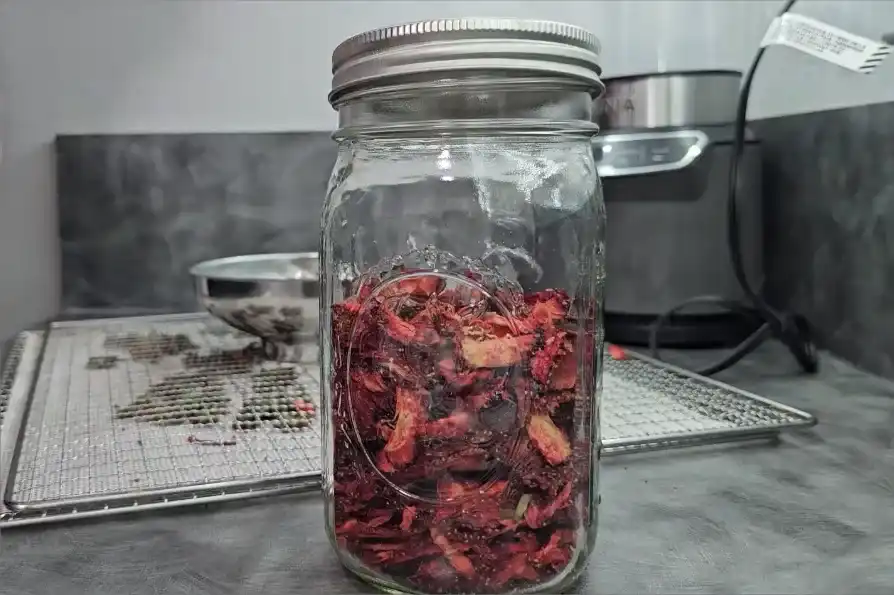
Photo: Properly sealed dried strawberries stay crisp for months when stored away from heat and light.
Under these conditions, dehydrated strawberries remain safe and flavorful for 6 to 12 months. Check them periodically — if you notice softness, discoloration, or an off smell, discard the batch.
Creative Ways to Use Dried Strawberries
Once you have a jar of homemade dried strawberries, you’ll find uses everywhere:
- Snacking — straight from the jar, or mixed into trail mix with nuts and dark chocolate.
- Breakfast — sprinkle over oatmeal, yogurt, or cereal for natural sweetness and texture.
- Baking — chop and fold into muffin batter, cookie dough, or scone mixtures. They rehydrate during baking and distribute flavor throughout. Use them with safe muffin pans, or bake without a tin using silicone cups.
- Smoothies — toss a handful into the blender; they add concentrated strawberry flavor without watering down the drink.
- Salads — rehydrated slices add a sweet-tart contrast to bitter greens and goat cheese.
- Cheese boards — pair with brie, camembert, or a simple baked cheese for an elegant, sweet-savory bite.
- Hot tea and infusions — steep a few slices in hot water for naturally fruity tea.
Rehydrating Dried Strawberries
Rehydration is simple and opens up more uses:
- Hot water method: Place slices in a bowl, cover with hot (not boiling) water, and let sit 10–15 minutes. Drain and pat dry.
- Cold soak: Cover with cold water and refrigerate for 30–60 minutes for a gentler rehydration that preserves texture.
- In cooking: Add dried slices directly to sauces, compotes, or oatmeal while they simmer — they absorb liquid naturally.
Rehydrated strawberries won’t return to their original fresh texture, but they work beautifully in cooked dishes, sauces, and baked goods.
Air Fryer vs. Oven vs. Food Dehydrator
The air fryer isn’t the only way to dry strawberries — but it is often the most practical.
| Factor | Air Fryer | Oven | Food Dehydrator |
|---|---|---|---|
| Time | 2–5 hours | 3–6 hours | 8–12 hours |
| Energy use | Low | Moderate | Low |
| Batch size | Small (1–2 cups) | Large | Large |
| Temperature control | Good | Poor at low temps | Excellent |
| Counter space | Small | None extra | Large |
| Best for | Small batches | Family-sized | Bulk preserving |
The oven’s main drawback is that most ovens can’t hold temperatures below 170°F, which risks cooking rather than drying the fruit. A food dehydrator is excellent for large, regular batches, but the air fryer wins for occasional, small-quantity drying — which covers most home cooks.
Troubleshooting Common Problems
Soggy or Sticky Slices
This is almost always a moisture issue. Causes and fixes:
- Slices too thick — re-cut to ¼ inch or thinner.
- Not enough surface drying — pat slices dry thoroughly before loading.
- Overlapping slices — dry in single layers only.
- Temperature too low — bump the heat to 140°F for the first hour, then drop back to 135°F.
- Humid kitchen — run the air fryer near a window or fan to help moisture escape.
Unevenly Dried Batches
When some slices finish hours before others, the culprit is inconsistent slicing. Sort slices by size before loading, or check frequently and remove finished pieces early.
Berries Turning Brown or Tough
Your temperature is too high. If the fruit looks cooked or caramelized instead of dried, lower the setting and extend the time.
Air Fryer Won’t Go Below 160°F
Some entry-level models lack a dehydrate preset. You can still make it work: run the air fryer at its lowest setting, crack the basket slightly open with a wooden spoon to release steam, and check frequently. Results will be less consistent but still usable.
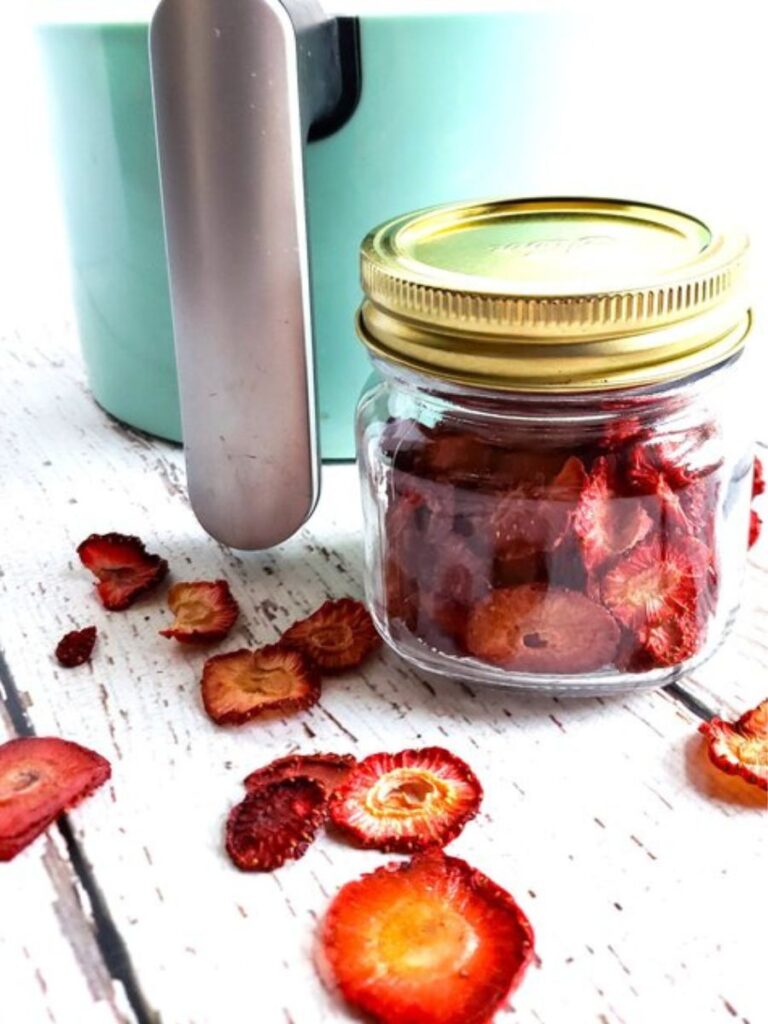
Credit: www.the-bella-vita.com
Food Safety Notes
Dehydrating fruit is generally low-risk, but drying at low temperatures means water activity remains high enough for microbes to survive if the process is cut short. Follow these guidelines from the United States Department of Agriculture and the National Center for Home Food Preservation:
- Finish the job. Partially dried berries can harbor mold and bacteria. If in doubt, keep drying.
- Store correctly. Airtight containers in cool, dark conditions are non-negotiable for long-term shelf life.
- Watch for spoilage. Mold, off-odors, or fermentation bubbles mean the batch is compromised — discard it.
- Keep dried fruit separate from raw meat and poultry in your kitchen to prevent cross-contamination.
Pregnant individuals, young children, and people with compromised immune systems should consult current food-safety guidance before consuming home-dried produce.
Frequently Asked Questions
How long does it take to dehydrate strawberries in an air fryer? Typically 2 to 5 hours at 135°F (57°C), depending on slice thickness and berry size. Thin slices of small berries can finish in under 3 hours.
What temperature is best for drying strawberries in an air fryer? 135°F (57°C) is optimal. Temperatures above 160°F cook the fruit instead of drying it.
Should strawberries be sliced before dehydrating? Yes. Uniform slices about ¼ inch thick dry fastest and most evenly. Whole berries take much longer and often end up moist inside.
Can I store air-dried strawberries at room temperature? Yes, in an airtight container in a cool, dark place. Properly stored, they keep for 6 to 12 months.
Do dehydrated strawberries lose their nutrients? Dehydration removes water and reduces some heat-sensitive vitamins like vitamin C, but it preserves most fiber, minerals, and antioxidants. Air-fried strawberries retain substantially more nutrients than cooked or canned alternatives.
Final Thoughts
Dehydrating strawberries in an air fryer is one of the easiest, most rewarding kitchen projects you can tackle. The technique takes about 15 minutes of active prep, leaves your kitchen smelling like summer, and yields a versatile, healthy snack that costs a fraction of the store-bought version.
Start with a small batch this weekend — once you taste the difference between homemade and packaged dried fruit, you’ll never buy it again. And once you master strawberries, the same method works for blueberries, raspberries, apple slices, and banana chips. Your air fryer is about to become your favorite preservation tool.