Keeping food safe is a daily challenge in every kitchen. The fridge is your best tool against spoilage and foodborne illness, but only if you use it well. Many people think their refrigerator is always cold enough, but in reality, incorrect fridge temperatures are a common cause of sickness and waste. Understanding the ideal fridge temperature for food safety is not just about following a number—it’s about protecting your health, saving money, and making your food last longer. Let’s explore why this matters, what the science says, and how you can set your fridge for maximum safety.
Why Fridge Temperature Matters
Most bacteria grow quickly in warm environments. When your fridge is too warm, dangerous bacteria like Salmonella, E. coli, and Listeria multiply on food. These bacteria cause serious illnesses, especially in children, older adults, and people with weak immune systems. On the other hand, very cold fridges can freeze delicate foods, change textures, or even waste energy.
Research from the Centers for Disease Control and Prevention (CDC) shows that nearly 48 million Americans get sick from foodborne diseases every year. Many of these cases are linked to improper food storage. Setting the right fridge temperature is a simple step that makes a big difference.
The Science Behind Safe Fridge Temperatures
Scientists have studied how bacteria react to different temperatures. The danger zone for food is between 40°F and 140°F (4°C to 60°C). In this range, bacteria multiply rapidly. The goal is to keep food out of this danger zone as much as possible.
Bacteria Growth Rates At Different Temperatures
Here’s how fast bacteria grow at various fridge temperatures:
| Temperature (°F) | Bacteria Growth Rate | Food Spoilage Risk |
|---|---|---|
| 50°F (10°C) | Very Fast | High |
| 45°F (7°C) | Fast | Medium-High |
| 40°F (4°C) | Slow | Low |
| 35°F (1.7°C) | Very Slow | Very Low |
| 32°F (0°C) | Stopped | Freezing Possible |
Notice how bacteria growth slows sharply at 40°F (4°C) and below. This is why experts recommend this level.
Credit: www.realsimple.com
What Is The Ideal Fridge Temperature?
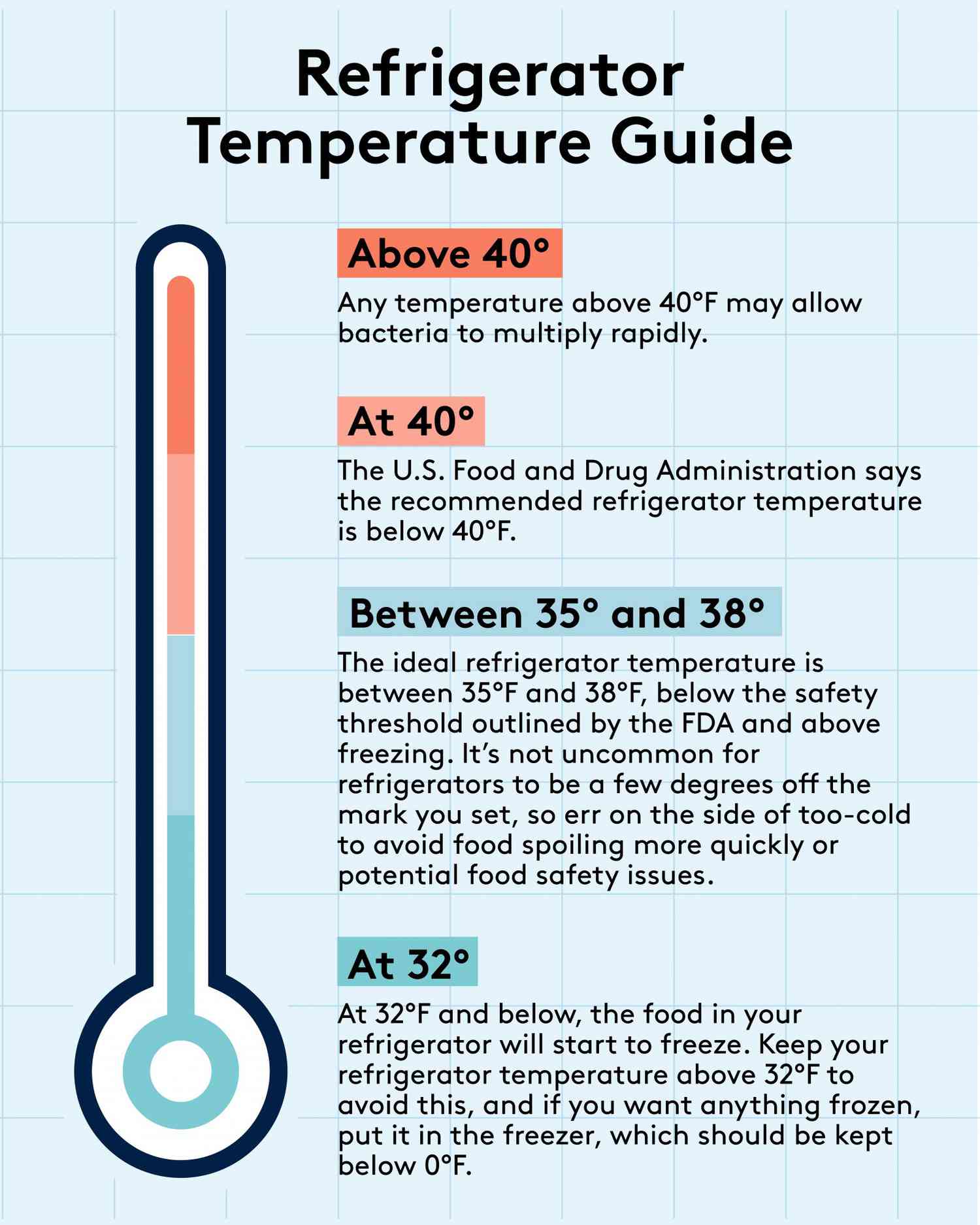
The U.S. Food and Drug Administration (FDA) recommends keeping your fridge at 40°F (4°C) or lower. This temperature slows most bacterial growth, but it avoids freezing your fresh foods. For food safety, aim for a range between 35°F (1.7°C) and 40°F (4°C).
Why Not Colder Than 35°f?
Some foods, like lettuce or eggs, can freeze and become unusable if your fridge is set below 35°F (1.7°C). Freezing damages texture and flavor. Also, colder settings use more electricity, raising your bills.
Why Not Warmer Than 40°f?
Above 40°F (4°C), bacteria can start growing again. Even if food looks fine, it may not be safe. This is especially risky for meat, dairy, and leftovers.
How To Check And Adjust Your Fridge Temperature
Many fridges have a dial with numbers, not temperatures. This can be confusing. The safest way to know your fridge’s true temperature is to use a refrigerator thermometer.
Step-by-step Guide
- Place a thermometer in the middle of the fridge—not near the door or back wall.
- Wait at least 8 hours for an accurate reading.
- Check the temperature. If it’s above 40°F (4°C), adjust the dial lower.
- Wait a few hours, then re-check. Repeat until you reach the safe zone.
If your fridge has a digital display, check it against the thermometer. Sometimes, the display is not accurate.
Common Mistakes People Make
Many people make simple errors that lead to unsafe fridge temperatures. Here are some to watch for:
- Overloading the fridge: Too much food blocks air flow, causing uneven cooling.
- Frequent door opening: Warm air enters, raising the temperature fast.
- Storing hot food: Hot items raise the internal temperature and may spoil other foods.
- Setting the dial too high: Numbers often do not match actual temperatures.
- Ignoring the freezer: If the freezer is too warm, ice melts and the fridge may not cool properly.
Even experienced cooks miss these points. Always check your fridge after adding lots of food or after power outages.
Fridge Zones And Their Temperatures
Not all parts of your fridge stay equally cold. Some areas are warmer, especially near the door or top shelf. Understanding these zones helps you store food safely.
Typical Fridge Zone Comparison
| Fridge Zone | Average Temperature | Best Foods for This Area |
|---|---|---|
| Bottom Shelf (Back) | 34–36°F (1–2°C) | Raw meat, fish, poultry |
| Middle Shelf | 37–40°F (3–4°C) | Dairy, leftovers |
| Top Shelf | 39–42°F (4–6°C) | Ready-to-eat foods |
| Door | 40–45°F (4–7°C) | Condiments, drinks |
| Crisper Drawer | 39–41°F (4–5°C) | Fruits, vegetables |
The door is usually the warmest part, so avoid storing milk or eggs there. The bottom shelf is coldest and safest for raw meat and fish.
Impact Of Temperature Fluctuations
Fridge temperature can change quickly when you open the door, add warm food, or during power outages. Even small changes can affect food safety.
How Fast Does Food Warm Up?
- Opening the door for just 30 seconds can raise the internal temperature by 2–3°F (1–1.5°C).
- Adding several warm dishes can keep your fridge above 40°F (4°C) for hours.
- During a power outage, food can start entering the danger zone in 4 hours.
What Happens To Food?
- Meat and poultry: Bacteria double every 20–30 minutes above 40°F (4°C).
- Dairy products: Milk can sour and cheese can mold.
- Leftovers: Can develop toxins even if bacteria are killed later by reheating.
To prevent these problems, always let hot food cool on the counter for 30–60 minutes before refrigeration (but never leave at room temperature for more than 2 hours).
How Temperature Affects Different Foods
Some foods are more sensitive to temperature changes than others. Here’s how:
Highly Sensitive Foods
- Raw meat, fish, poultry: Must be stored below 40°F (4°C). Spoil quickly and can cause severe illness.
- Milk and dairy: Spoils fast above 40°F (4°C). Keep near the back of the fridge.
- Cut fruits and vegetables: Can grow bacteria and mold in warm conditions.
Less Sensitive Foods
- Condiments: Most are safe up to 45°F (7°C) for short periods.
- Hard cheeses: Last longer, but can mold if kept too warm.
- Eggs: Should be kept below 40°F (4°C), but do not freeze.
Storage Life Comparison
| Food | Storage Life at 35°F (1.7°C) | Storage Life at 45°F (7°C) |
|---|---|---|
| Raw Chicken | 3–4 days | 1–2 days |
| Milk | 7 days | 3–4 days |
| Cooked Rice | 5–6 days | 2–3 days |
| Hard Cheese | 4 weeks | 2 weeks |
| Eggs | 3 weeks | 1 week |
Notice how food lasts longer at colder temperatures. This is a real money saver and reduces waste.
:max_bytes(150000):strip_icc()/RealSimple_refrigerator-temperature_01_preview-8d2cf36eb6064a3c99ed9e920010ba3c.jpg)
Credit: www.realsimple.com
How To Set Your Fridge For Maximum Safety
The ideal setting is not just about numbers—it’s about habits and awareness. Here are practical steps to ensure your fridge stays safe:
- Set your fridge to 37°F (3°C). This is a good balance—cold enough for safety, not cold enough to freeze most foods.
- Use a fridge thermometer. Check regularly, especially after adding lots of food.
- Don’t block air vents with food. Air needs to circulate to keep all areas cold.
- Store raw meat and fish on the lowest shelf, in a leak-proof container.
- Keep leftovers in shallow containers to cool quickly.
- Clean your fridge every month. Remove spills and expired food.
Non-obvious Insight
Many people forget to check the temperature after a power outage. Even if the fridge feels cold, bacteria may have grown if the temperature rose above 40°F (4°C) for several hours. When in doubt, throw out perishable foods.
Another overlooked issue: seasonal changes. In summer, your fridge works harder and may not stay as cold. Check more often during hot months.
Energy Efficiency Vs Food Safety
Some worry that setting the fridge colder uses more energy. It’s true—every degree lower increases electricity use by about 5%. But the cost is small compared to the risk of food poisoning.
If you want to save energy:
- Keep the fridge full, but not overloaded. Full fridges retain cold better.
- Clean coils behind the fridge every 6 months.
- Keep the door closed as much as possible.
Never set your fridge above 40°F (4°C) to save money. The risk is not worth it.
Signs Your Fridge Is Too Warm
Sometimes you notice signs before checking the thermometer:
- Food smells sour or has mold before the “use by” date.
- Drinks are not as cold as usual.
- Ice cream is soft in the freezer.
- You see water droplets or condensation inside.
If you notice any of these, check your fridge temperature immediately.
What To Do If Your Fridge Temperature Is Unsafe
If you find your fridge above 40°F (4°C):
- Check if the door was left open or blocked.
- Move perishable foods to a cooler with ice.
- Adjust the settings and wait for the temperature to drop.
- Toss out food that has been above 40°F (4°C) for more than 2 hours, especially meat, dairy, and leftovers.
Don’t take risks with food safety. Even if the food looks and smells fine, bacteria may be present.
The Role Of Freezer Temperature
While this article focuses on fridges, it’s worth noting that the ideal freezer temperature is 0°F (-18°C) or lower. This keeps food frozen and stops bacteria completely. Never store fresh foods in the freezer zone unless you want to freeze them.
Fridge Temperature Worldwide
Different countries have different standards, but the science is the same. For example:
- United States: 40°F (4°C) or lower.
- European Union: 41°F (5°C) or lower.
- Australia: 39°F (4°C) or lower.
No matter where you live, aim for the coldest safe setting.

Credit: www.hubert.com
Real-life Example: Food Poisoning From Warm Fridges
In 2018, a family in Texas got sick after eating leftovers stored in a fridge at 45°F (7°C). Tests showed Salmonella had multiplied during a power outage, even though the food looked normal. This is not rare—many foodborne outbreaks start at home. Keep your fridge safe, and you protect your family.
Smart Fridges And Modern Solutions
New smart refrigerators can monitor temperatures, send alerts, and even adjust settings automatically. These features help avoid mistakes, but you still need to check and clean regularly. Technology is helpful, but not a substitute for good habits.
For more science-backed tips, see the CDC’s Food Safety Guide.
Frequently Asked Questions
What Is The Safest Temperature For A Home Refrigerator?
The safest temperature is 40°F (4°C) or lower. Experts recommend keeping your fridge between 35°F and 40°F (1.7°C–4°C) for best results. This stops most bacteria from growing and keeps food fresh longer.
How Often Should I Check My Fridge Temperature?
Check at least once a week, and after adding lots of food, cleaning, or power outages. Use a refrigerator thermometer for accurate readings.
Can I Store Food At 45°f (7°c) If It’s Only For A Day?
Short periods at 45°F (7°C) are usually safe for less sensitive foods like condiments. But for meats, dairy, and leftovers, even a few hours above 40°F (4°C) can be risky.
Is It Safe To Freeze Food In The Fridge?
No. The fridge is designed for cooling, not freezing. Freezing food in the fridge can damage texture and flavor. If you want to freeze food, use the freezer set at 0°F (-18°C).
What Should I Do If My Fridge Was Above 40°f (4°c) During A Power Outage?
If the temperature was above 40°F (4°C) for more than 2 hours, throw away perishable foods like meat, dairy, and leftovers. When in doubt, it’s safer to discard.
The Bottom Line
Setting your fridge to the ideal temperature is one of the easiest ways to keep food safe and healthy. Aim for 35°F–40°F (1.7°C–4°C), check often, and build good storage habits. Your fridge protects your health every day—make sure it’s doing the job right. With a little attention, you’ll save money, reduce waste, and avoid sickness. It’s a simple step, but one that matters for every family.