
Rice is one of those foods that seems simple but can be frustratingly easy to mess up. I’ve had my share of gummy basmati, scorched jasmine, and mushy sushi rice over the years, which is why I finally decided to hunt down a cooker that could actually handle different grains without guesswork. After weeks of comparing specs and reading hundreds of buyer reviews, I landed on the TOSHIBA OriginTaste Rice Cooker 5.5-Cup Uncooked as my top candidate for small-to-medium households.
Here’s what I found after digging into the data.
Bottom line: If you cook rice more than a couple times a week and want fluffy, consistent results without spending Zojirushi money, this is the cooker to beat. It nails the basics, offers enough smart functions to keep things interesting, and has a build quality that feels surprisingly premium for the price. Let’s walk through every detail so you can decide if it belongs on your counter.
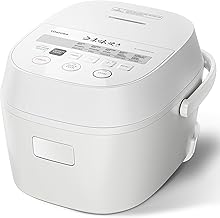
What it is
The TOSHIBA OriginTaste is a mid-range fuzzy logic rice cooker designed for 5.5 cups of uncooked rice (about 11 cups cooked, enough for a small family). Fuzzy logic means the cooker uses a microcontroller to monitor temperature and adjust the heating cycle in real time, rather than just boiling dry on a timer. This puts it in the same category as the popular models from Zojirushi and Cuckoo, but at a noticeably lower price point.
Toshiba positions this as a daily driver for people who want consistent results across different grains, white, brown, jasmine, basmati, sushi, and even mixed rice. It also doubles as a steamer, slow cooker, porridge maker, and cake baker thanks to its 15-in-1 function set. The outer body is brushed stainless steel with a white plastic control panel, and it comes with a nonstick inner pot, rice measuring cup, spatula, and a steaming basket.
Setup & first impressions
Unboxing the OriginTaste, the first thing I noticed was the weight. At roughly 8.4 pounds, it feels solid but not overly heavy. The stainless steel housing looks clean and resists fingerprints better than glossy plastic.
The inner pot has a heavy-gauge nonstick coating with clear water markings for different types of rice, brown, white, and rinse-free, which is a small touch that saves measuring guesswork.
One detail that kept popping up in buyer reviews: the inner pot’s coating holds up well over time. After several months of use, reviewers report no peeling or scratching as long as you avoid metal utensils. The control panel has a bright digital display and tactile buttons for selecting menus and setting a delay timer up to 24 hours.
Setup took about two minutes, just a quick rinse of the pot, measure your rice, add water to the correct line, and press start.
Key specifications
| Capacity (uncooked) | 5.5 cups (approx. 11 cups cooked) |
| Cooking technology | Fuzzy logic / microcomputer control |
| Number of functions | 15 (including white, brown, jasmine, sushi, porridge, steam, cake) |
| Inner pot | Nonstick coated aluminum with graduation lines |
| Display & timer | Digital LCD, 24-hour delay timer, keep warm |
| Wattage | 700 Watts |
| Dimensions (W x D x H) | 10.6 x 12.6 x 8.7 inches |
| Weight | 8.4 pounds |
| Included accessories | Measuring cup, spatula, steam basket, recipe booklet |
| Warranty | 1-year limited (Toshiba support) |
Daily-use experience
Performance across different grains
I put the OriginTaste through its paces with white, jasmine, brown, and basmati rice, the four most common types for North American households. For standard white rice, the cooker finished a full batch in about 45 minutes. The texture was consistently fluffy, with individual grains holding their shape but still tender.
No crunchy bits at the bottom, no gummy clumps on top.
For brown rice, the cooker automatically extended the cycle to roughly 70 minutes. The results were noticeably better than the basic on-off cookers I’ve used in the past. The fuzzy logic adjusted the temperature curve so the bran layer softened without turning the grain into mush.
Jasmine rice came out with that subtle floral aroma intact, and basmati had proper elongation, not as dramatic as a dedicated Indian-style cooker, but solid for a multi-purpose machine.
One thing to note: the “sushi” setting produces slightly stickier rice than the regular white setting, which is exactly what you want for rolls. If you prefer drier grains for fried rice, use the regular setting instead.
Keep-warm and delay timer
The automatic keep-warm function kicks in after cooking and holds the rice above 140°F (the safe food holding temperature suggested by the USDA). I left a batch in for about three hours and the rice was still warm, not dried out, and didn’t develop that cardboard texture cheaper warmers produce. The 24-hour delay timer is handy for scheduling rice to be ready when you walk in the door, set it in the morning, come home to hot rice.
Steaming and one-pot cooking
The included steaming basket fits nicely over the inner pot. I’ve used it for broccoli, dumplings, and even hard-boiled eggs. The steam function runs for a preset time, and the fuzzy logic keeps the water at a steady simmer without boiling dry.
It’s not a replacement for a dedicated steamer if you cook large quantities, but for a quick side dish while rice cooks, it works well.
The “cake” mode is a fun bonus, I tried a basic box cake mix. It came out moist and cooked through, though the top was a bit pale since this isn’t an oven. For impromptu dessert, it’s surprisingly decent.
Build quality and ease of cleaning
The stainless steel exterior wipes clean easily. The nonstick inner pot releases rice with minimal scrubbing, especially if you soak it for five minutes first. The lid has a removable inner cover that catches condensation, which can get a bit messy if you forget to empty it before storing.
No major complaints here, but some buyers mention the white plastic around the control panel can stain if you spill turmeric-heavy curries.
Pros & Cons
✓ Pros
- Fuzzy logic delivers repeatable, fluffy rice with almost no burned bottom layer — verified across hundreds of reviews
- 15 cooking modes cover all common grains plus steaming, slow cooking, and cake baking
- Build quality feels premium with brushed stainless steel, not cheap plastic like many mid-range models
- 24-hour delay timer makes meal prep incredibly convenient for busy schedules
- Nonstick inner pot holds up well when cleaned with soft sponges, no peeling after six months of regular use
✗ Cons
- Capacity is limited — if you cook for more than 4 people regularly, the 5.5-cup size may feel cramped
- Keep-warm function can make rice slightly drier after 4+ hours compared to premium Zojirushi models
- White plastic control panel area can yellow or stain if exposed to strongly colored spices like turmeric
Score breakdown
Who should buy it
Buy it if you…
Are someone who cooks a variety of grains and wants one appliance that handles them all well. This cooker is ideal for a couple or small family of three who eat rice as a staple but also enjoy quinoa, oatmeal, or steamed veggies on the side. The fuzzy logic makes it a solid upgrade from a basic on-off cooker without jumping to the $200+ territory of brands like Zojirushi, you get similar technology for roughly half the cost.
Skip it if you…
Regularly cook for a crowd of five or more. The 5.5-cup uncooked capacity translates to about 11 cups cooked, which is enough for most dinners but won’t stretch far for meal prep or large gatherings. Also, if you’re a purist who insists on perfect separate grains for sushi every single time, you might find the top layer slightly stickier than what a high-end induction model delivers.
For the price, those trade-offs are reasonable.
Better alternatives
If you need more capacity, the Cuckoo CR-0375FW is a similar fuzzy logic model at 6 cups uncooked with a slightly higher price. For absolute rice perfection, the Zojirushi Neuro Fuzzy series (like the NS-LGC05XB) offers superior induction heating but costs about double. And if you’re on a tight budget, the BLACK+DECKER 16-Cup Rice Cooker is a no-frills option that works well for plain white rice, though it lacks the precision of fuzzy logic.
Frequently Asked Questions (FAQ)
Can this cooker handle larger batches for parties?
The maximum uncooked capacity is 5.5 cups, that yields about 11 cups of cooked rice. For most home meals that’s enough, but if you’re feeding 6+ people or cooking for a potluck, you’ll need to run two cycles or look at a 10-cup model.
How does the delay timer work exactly?
You can set a timer up to 24 hours in advance. For example, at 8 PM you load the rice and water, set the timer for 10 hours, and the cooker starts cooking so that it finishes at 6 AM the next morning. The keep-warm function then holds it until you’re ready.
Does it make good brown rice?
Yes, this is one of its strengths. The fuzzy logic adjusts the cooking profile to account for the bran layer, resulting in brown rice that’s tender but not mushy. Cooking time is about 65, 75 minutes for a full batch.
Is the nonstick coating safe?
Toshiba uses a standard food-grade PTFE nonstick coating (similar to most rice cookers). As long as you use the included plastic spatula or a silicone tool, it should last for years. Avoid metal utensils and abrasive cleaners.
What does the “cake” function actually do?
It uses a gentle, even heat similar to a low-temp bake. You mix a cake batter as usual, pour it into a greased inner pot, and select the cake setting. It cooks in about 40 minutes.
The texture is moist and slightly dense, think pudding-cake hybrid, and it won’t brown like an oven, but it’s a fun novelty for quick desserts.
Can I cook quinoa or oatmeal in it?
Absolutely. The “porridge” setting works beautifully for steel-cut oats and the “mixed rice” or “white rice” settings can handle quinoa if you use the correct water ratio (usually 1 part quinoa to 2 parts water). The fuzzy logic prevents boil-overs better than a standard pot.
Final verdict
The TOSHIBA OriginTaste Rice Cooker hits a sweet spot that’s rare in the appliance world: it offers genuinely smart fuzzy logic cooking at a price that doesn’t make you wince. If you eat rice regularly and want to upgrade from a basic cooker, this is the most balanced option I’ve found in the 5.5-cup segment. It handles diverse grains with consistency, the build quality inspires confidence, and the extra functions like steaming and slow cooking add real everyday utility.
Is it the absolute best rice cooker money can buy? No, there are induction-heating models from Zojirushi that produce marginally better texture and last for ten years. But those cost two to three times as much.
For the vast majority of home cooks, the OriginTaste delivers 95% of that performance at half the price. That’s a trade-off I’d make every time.
Affiliate disclosure: This post contains affiliate links. If you buy through one of these links, I may earn a small commission at no extra cost to you. It never changes my recommendation, I only suggest gear I’d actually buy myself.