When you step into a modern kitchen, you’ll see technology quietly making life easier. The microwave oven is a perfect example—fast, convenient, and everywhere. But in the last few years, a new term has started appearing in microwave ads and reviews: inverter technology. What does it actually mean? Is it just marketing, or does it really change the way you cook and reheat food?
If you’ve ever reheated pizza and found the crust rubbery but the cheese still cold, you know that microwaves aren’t perfect. Inverter technology promises to fix these common issues, making microwaved food taste better and retain more nutrients. Let’s dive into what inverter technology is, how it works, and whether it’s worth your attention.
How Traditional Microwaves Work
To understand inverter technology, it helps to know how regular microwaves operate. Most microwaves use a magnetron, a special tube that creates microwaves to heat your food. Here’s what happens in a traditional microwave:
- You set the cooking time and power level.
- The magnetron turns on at full power and stays on or off in cycles.
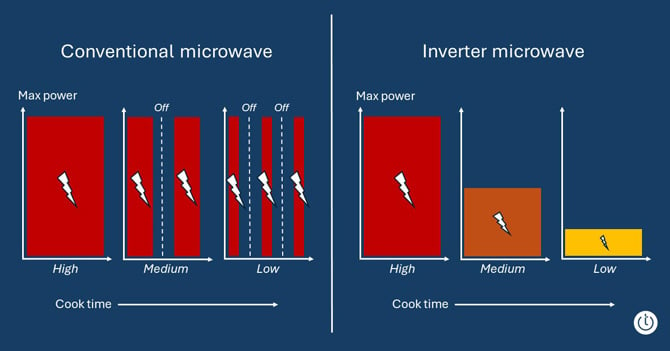
- If you set “50% power,” it doesn’t lower the actual power. Instead, the magnetron is on at 100% for half the time, then off for the other half.
This “on-off” method is called pulsed power control. For example, if you set your microwave to medium power for four minutes, it might be on for two minutes (blasting at full power) and off for two minutes (no microwaves at all). That’s why food can sometimes cook unevenly—edges get hot while the inside stays cold, or delicate foods overcook.
Why This Method Has Problems
The pulsed power approach leads to several common issues:
- Uneven heating: Some parts of food get too hot, while others are still cold.
- Overcooking edges: Foods like fish, eggs, and leftovers can become tough or rubbery at the edges.
- Poor defrosting: Meat can partially cook on the outside while staying frozen inside.
Traditional microwaves are fast, but they’re not always precise.
What Is Inverter Technology?
Inverter technology is a newer way to control microwave power. Instead of turning the magnetron on and off, an inverter microwave supplies continuous, variable power. This means the magnetron can run at, say, 60% power for the whole cooking time, not just in bursts.
The key difference lies in the control system. Inverter microwaves use an electronic circuit called an inverter. It converts the incoming electricity into a steady, adjustable current. This allows the microwave to deliver exactly the right amount of energy at all times.
How Inverter Microwaves Work
- You select a power level (for example, 30%).
- The inverter circuit adjusts the current to the magnetron, so it operates at 30% power the entire time.
- Food heats more gently and evenly, without the “on-off” cycling.
Think of it like a dimmer switch for lights: you can make the bulb glow softly or brightly. In contrast, the old way is like flipping the light on and off rapidly to “average” the brightness.
Key Benefits Of Inverter Technology
Why does this make a difference in your kitchen? Inverter microwaves offer several big advantages over traditional models.
1. Even Heating
Continuous, steady power means food heats more uniformly. Soups, casseroles, and leftovers are less likely to have hot and cold spots. This is especially noticeable with:
- Liquids (like reheating coffee)
- Dense foods (like lasagna)
- Mixed dishes (like rice with vegetables and meat)
2. Better Defrosting
Defrosting meat or fish in a traditional microwave often leaves parts cooked while the center is still frozen. Inverter microwaves can gently thaw food at a low, constant power, so the texture and taste remain better.
3. More Precise Cooking
Delicate foods like fish, eggs, and chocolate need gentle, steady heat. Inverter technology lets you cook these at exactly the right temperature, reducing the risk of overcooking or burning.
4. Energy Efficiency
Because the inverter supplies only as much power as needed, it can be more energy-efficient. There’s less wasted energy compared to the pulsed method, which can help lower your electricity bill over time.
5. Improved Food Quality
Food often retains more moisture, flavor, and nutrients when heated evenly. Vegetables stay crisper, and meats don’t dry out as quickly.
6. Quieter Operation
Many inverter microwaves are quieter because they avoid the loud clicks and buzzing from switching the magnetron on and off.
Inverter Vs. Traditional Microwave: A Side-by-side Look
To make these differences clearer, here’s a simple comparison:
| Feature | Traditional Microwave | Inverter Microwave |
|---|---|---|
| Power Delivery | Pulsed (on/off cycling) | Continuous, adjustable |
| Heating Evenness | Often uneven | Much more even |
| Defrosting Quality | Can partially cook food | Gentle, accurate thawing |
| Delicate Food Cooking | Risk of overcooking | Better control |
| Noise Level | Often noisy | Usually quieter |
| Energy Efficiency | Less efficient | More efficient |
| Price | Lower | Higher |
How Inverter Technology Works: The Science Made Simple
The heart of an inverter microwave is the inverter circuit. In traditional microwaves, a transformer provides power to the magnetron, but this transformer only delivers “all or nothing.” The inverter replaces the transformer with a high-frequency switching circuit.
Here’s a simplified explanation:
- The inverter takes normal household AC power (120V, 60Hz in the US).
- It converts it to high-voltage DC (direct current).
- Then, using electronic switches, it changes the voltage and frequency as needed—up or down, and at different strengths.
- This lets the magnetron run at any power level—10%, 30%, 70%, or 100%—smoothly and continuously.
Because of this flexibility, inverter microwaves can maintain consistent heat output, which is the main reason for their better performance.
Real-world Example
Imagine you want to melt chocolate. In a regular microwave, you set it at 30% power. The magnetron blasts at full power, then turns off, repeating this cycle. The result? Some chocolate melts, some burns, and some stays solid.
In an inverter microwave, the power stays low and steady. The chocolate melts gently and evenly, so you don’t ruin your dessert.
Common Uses And Food Types That Benefit Most
While all foods can benefit from even heating, some dishes and tasks see the biggest improvement.
Defrosting Meat And Seafood
With an inverter microwave, you can defrost:
- Chicken breasts
- Fish fillets
- Ground beef
- Shrimp
The result is less accidental cooking, so your meat is ready for the pan, not dry or rubbery.
Reheating Leftovers
Soups, stews, pasta, and rice dishes often come out better, with fewer hot and cold spots.
Cooking Delicate Foods
Foods like:
- Eggs (scrambled, omelets)
- Fish (poached or steamed)
- Cheese sauces
- Chocolate
Are less likely to overcook or separate, thanks to the gentle, steady heat.
Steaming Vegetables
Vegetables like broccoli, carrots, and beans stay bright and crisp when steamed at lower, continuous power.

Credit: shop.sharpusa.com
What To Look For When Choosing An Inverter Microwave
If you’re shopping for a new microwave, you’ll see many options. Not all microwaves with “inverter” in the name are equal. Here’s what really matters:
- True Inverter Circuit: Some brands use marketing tricks. Make sure the model uses a real inverter, not just advanced pulsing.
- Power Output: Look for at least 900–1200 watts for most kitchens.
- Size and Capacity: Pick a size that fits your counter and your cooking needs.
- Cooking Modes: Check for special features like sensor cooking, auto-defrost, and child safety locks.
- Brand Reputation: Brands like Panasonic, LG, and Samsung are known for reliable inverter microwaves.
- Warranty: A longer warranty can be a sign of better build quality.
Sample Feature Comparison
Here’s a quick look at some popular inverter microwave features:
| Brand/Model | Power (Watts) | Capacity (cu. ft.) | Key Features |
|---|---|---|---|
| Panasonic NN-SN966S | 1250 | 2.2 | Sensor cook, turbo defrost, inverter |
| LG NeoChef LMC0975ST | 1040 | 0.9 | EasyClean, compact size, inverter |
| Samsung MS14K6000AS | 1000 | 1.4 | Sensor reheat, ceramic enamel, inverter |
Are There Any Downsides?
While inverter microwaves offer many advantages, they’re not perfect for everyone.
Higher Price
Inverter models are usually more expensive than basic microwaves. Expect to pay about 20–40% more for the same size and power.
Repairs And Parts
The electronic circuits inside inverter microwaves are more complex. Repairs can be more expensive if something breaks, and finding replacement parts might be harder, especially for older or less common brands.
Not Always “faster”
Inverter microwaves don’t necessarily cook food faster. They cook more evenly, but total cooking time is similar to traditional microwaves.
Heavier Use Of Electronics
Some users report that inverter models are more sensitive to power surges or unstable electricity. Using a surge protector is a smart idea.

Credit: www.ajmadison.com
Inverter Technology And Nutrition
One claim you may see is that inverter microwaves are “healthier. ” What does this mean?
Preserving Nutrients
Studies show that overcooking can destroy vitamins and nutrients, especially in vegetables. Because inverter microwaves heat more evenly and avoid overheating, food often retains more vitamins, minerals, and moisture. For example, steaming broccoli in an inverter microwave at low power can keep it greener and higher in vitamin C than boiling or overcooking.
Better Texture And Flavor
Gentle, continuous heating means food tastes more like it should. Fish stays tender, vegetables stay crisp, and leftovers aren’t dried out.
Avoiding “hot Spots”
Traditional microwaves can create super-hot spots, which may burn or chemically alter parts of food. Inverter technology reduces this risk by keeping the temperature more consistent.
Who Should Consider An Inverter Microwave?
Not every kitchen needs the latest tech. Here’s when inverter technology really pays off:
- You cook or reheat food often and want better results.
- You care about food texture and taste, especially for delicate dishes.
- You defrost meat, fish, or poultry regularly.
- You prepare baby food or meals for children (where even heating is critical).
- You want to avoid “surprise” hot or cold spots in leftovers.
If you mostly use your microwave for popcorn or heating water, a basic model may be enough. But for families, food lovers, or anyone who values convenience and quality, inverter microwaves are worth considering.
Two Insights Beginners Miss
- Power Level Is Not Speed: Many people think setting a microwave to 50% power makes it cook slower. In traditional microwaves, this just means the magnetron pulses on and off. In an inverter microwave, 50% means true, gentle heating—great for delicate foods.
- Defrosting Is Where You See the Biggest Difference: People often judge microwaves by how they cook, but the real test is defrosting. Inverter technology can save you hours of frustration (and wasted food) by thawing evenly, not half-cooking the edges.
Is Inverter Technology The Future?
The answer seems to be yes. More manufacturers are adding inverter models, and prices are coming down as the technology becomes standard. For now, inverter microwaves are a smart upgrade for anyone who wants better food quality and more control in the kitchen.
For readers who want to dive deeper into the science, check out the Wikipedia page on microwave ovens.
Credit: www.techlicious.com
Frequently Asked Questions
What Is The Main Difference Between Inverter And Regular Microwaves?
The main difference is how they control power. Regular microwaves use on-off pulses to create “average” power levels, while inverter microwaves provide continuous, adjustable power. This leads to more even heating and better results, especially for delicate foods.
Is It Worth Paying More For An Inverter Microwave?
If you often cook or reheat food that needs gentle, even heating—like fish, eggs, or leftovers—then yes, the improved results are usually worth the higher price. If you only use your microwave for basic tasks, a regular model may be enough.
Are Inverter Microwaves Safe?
Yes, inverter microwaves are just as safe as regular microwaves. They use the same magnetron technology to create microwaves and must meet the same safety standards. Just follow the manufacturer’s instructions and use microwave-safe containers.
Do Inverter Microwaves Use Less Electricity?
They are generally more energy-efficient because they deliver only as much power as needed, without the wasteful on-off cycling of traditional models. However, the overall savings on your electric bill will be small unless you use your microwave a lot.
How Do I Know If A Microwave Has Real Inverter Technology?
Check the product specifications. Look for terms like “inverter circuit,” “true inverter,” or “continuous power.” Read user reviews and trusted guides. Brands like Panasonic, LG, and Samsung usually use real inverter tech in their higher-end models.
In today’s kitchens, the little details make a big difference. Inverter technology in microwaves is one of those quiet innovations that can change your cooking for the better—making life simpler, food tastier, and your kitchen a bit more high-tech. If you care about quality and convenience, it’s a feature worth having on your shopping list.