If you think the air fryer was born in a corporate lab in 2010, you’re only half right. The real story reaches back decades earlier, to World War II experiments and a single Dutch engineer who turned a simple idea into a global kitchen phenomenon. The surprising truth is that the air fryer’s invention wasn’t a single moment—it was a chain of innovations that finally clicked in 2005.
This article uncovers the full history, from the first hot-air ovens to the modern smart air fryer sitting on your counter. You’ll learn who really invented it, why it took five years to reach the market, and how that technology actually works. Keep reading—the answer may change how you see your favorite appliance. You can also read our guide on what to look for when buying an air fryer.
The Surprising Origins: Before the Air Fryer
Before the air fryer became a household name, several earlier cooking technologies proved that hot air could replace oil. The foundation was laid long before 2005.
The Whirlwind Oven
In the 1940s, engineers developed the Whirlwind Oven, a device that used a fan to circulate hot air around food. It wasn’t a commercial success, but it demonstrated a key principle: moving air cooks faster and more evenly than still heat. The Whirlwind Oven could crisp the surface of foods without the need for deep frying, though it was bulky and inefficient by modern standards. You can also read our guide on fried green tomatoes recipe air fryer.
Convection Oven Foundations
Convection ovens, which became common in restaurant kitchens during the 1960s and 1970s, refined the same idea. A built-in fan pushed hot air across the food, cutting cooking times by up to 25% and improving browning. Home cooks adopted them slowly, but the technology proved that forced air created a superior texture. Later, when engineers scaled down that concept into a countertop device, the air fryer was born.
 The Rapid Air system uses a fan to circulate superheated air around food, creating a crispy crust with minimal oil.
The True Inventor: Fred van der Weij
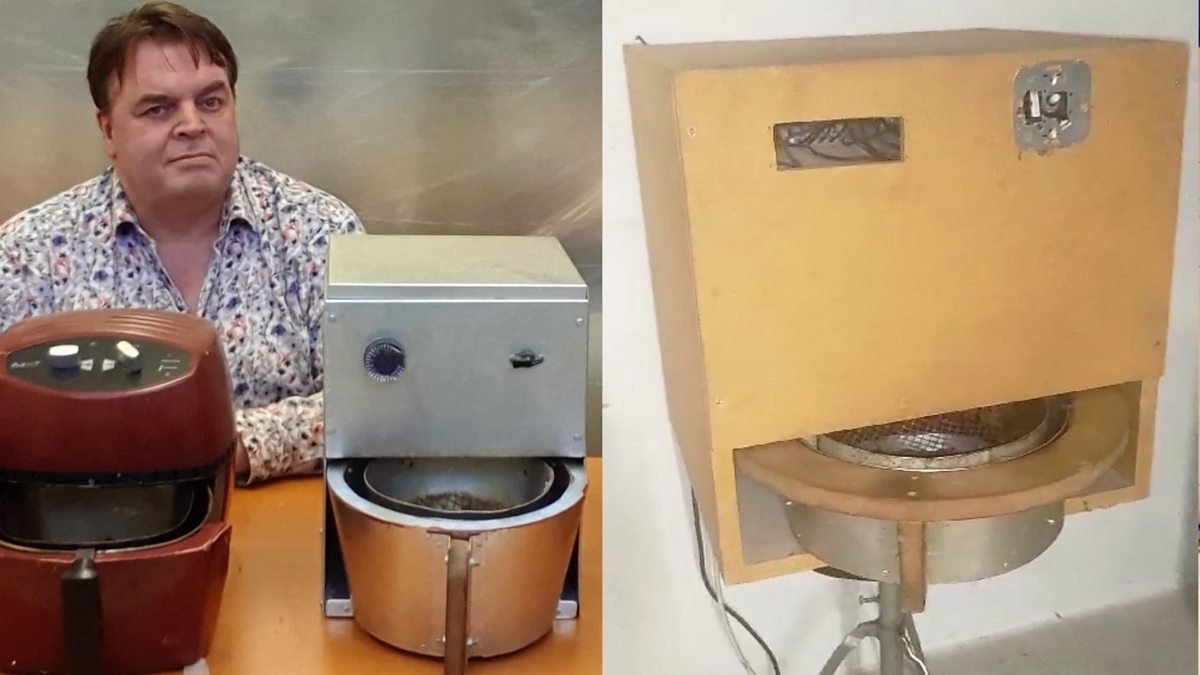
The person most responsible for the air fryer is Fred van der Weij, a Dutch mechanical engineer. In 2005, he filed a patent for a “device for preparing food” that used a high-speed fan and a heating element to fry food with almost no oil. His goal was simple: create a healthier alternative to deep frying that still delivered the same crunch and flavor. You can also read our guide on how to cook halibut in air fryer.
Van der Weij’s prototype was compact and efficient, but scaling it for mass production took years. He eventually partnered with Philips, which saw the potential. The company’s engineers refined the design, adding digital controls and a larger basket, and launched the first commercial air fryer in 2010 at the Berlin IFA trade show.
The Patent That Started It All
The 2005 patent (WO2007040522A1) described a method of circulating hot air at high speed around food, with a heating element positioned above the fan. This was the first time anyone had combined these elements into a dedicated countertop appliance. The patent explicitly stated the goal: “to obtain a fried product with a low fat content.” Van der Weij’s invention predates any other commercial air fryer by at least five years.
The 2010 Philips Launch: How It Changed Everything
When Philips introduced the air fryer in 2010, it was a gamble. The public was skeptical—could hot air really replace oil? But the device’s performance won over early adopters. The first model, the Philips Airfryer HD9220, used Rapid Air Technology to circulate superheated air at speeds up to 80 km/h. This created a Maillard reaction on the food’s surface, producing the same browning and crispiness as deep frying, but with 80% less fat.
Sold in over 40 countries within the first year, the air fryer quickly became a bestseller. Philips sold more than 1 million units by 2012. The technology was so effective that other manufacturers soon launched their own versions, flooding the market with cheaper alternatives.
How Rapid Air Technology Works
The secret behind the air fryer is a combination of intense heat, high-speed airflow, and a perforated basket. The heating element warms the air, and the fan pushes it downward onto the food. The rapid circulation strips away moisture from the surface, allowing browning to happen faster than in a still oven. The basket’s holes ensure that hot air reaches every side of the food, eliminating the need to flip most items.
Note: For a deeper look at how air fryers compare to convection ovens, see our guide on kitchen ventilation issues that can affect air circulation.
The Evolution of Air Fryer Design (2010–2026)
Since 2010, air fryers have undergone dramatic improvements. Here’s a timeline of the major milestones:
| Year | Development |
|---|---|
| 2005 | Fred van der Weij files the original patent |
| 2010 | Philips launches the first commercial air fryer |
| 2013 | Larger capacity models (5.5 quarts) appear |
| 2016 | Digital touchscreens and preset cooking programs become standard |
| 2019 | Dual-basket air fryers allow cooking two foods at once |
| 2022 | Smart air fryers with Wi-Fi and app control hit the market |
| 2026 | Most new models include self-cleaning modes and steam-assist functions |
The technology has also become more energy-efficient. Current models use about 1,400–1,700 watts, compared to the 2,000-watt first-generation units. Cooking times have shortened due to improved airflow designs, and many baskets are now dishwasher-safe for easy maintenance.
The Air Fryer’s Global Popularity Surge
Air fryer sales exploded in the late 2010s, driven by a combination of health trends and social media. The global market was valued at over $1.5 billion in 2025, with projections to exceed $2.3 billion by 2030. In North America, one in three households now owns an air fryer, according to industry surveys.
Cultural Impact and Social Media
The rise of TikTok and Instagram food videos accelerated adoption. Recipes for air-fried chicken wings, crispy Brussels sprouts, and even whole chickens went viral. Celebrity chefs like Gordon Ramsay publicly praised the appliance, calling it “a game-changer” for home cooks. The air fryer’s ability to produce restaurant-quality results quickly made it a staple in content creator kitchens.
How It Changed the Way We Cook
The air fryer didn’t just replace deep frying—it changed how people approach meal prep. Many home cooks now use it for reheating leftovers, baking small batches of cookies, and roasting vegetables. The appliance’s speed (often 20–30% faster than a conventional oven) makes it a weekday dinner hero. For those interested in health-conscious kitchen tools, the same philosophy applies to non-toxic muffin pans and other cookware.
The Science Behind the Crisp
Why does an air fryer produce such a satisfying crunch while using almost no oil? The answer lies in the Maillard reaction—a chemical reaction between amino acids and reducing sugars that occurs at temperatures above 140°C (284°F). The high-speed airflow delivers heat directly to the food’s surface, accelerating the reaction. The result is a browned, flavorful crust that seals in moisture.
A common mistake is overcrowding the basket. When too much food is packed in, the air cannot circulate properly, and the food steams instead of crisping. For best results, leave at least 25% of the basket empty. Shaking the basket halfway through cooking also helps ensure even browning.
Notable Figures and Forgotten Contributors
Beyond Fred van der Weij, several other people helped shape the air fryer’s success. Mario Zen, a Philips engineer, led the team that converted van der Weij’s prototype into a manufacturable product. Dr. Johanna Devereux, a food scientist at the University of Leeds, published early research on the nutritional benefits of air frying compared to deep frying, which helped convince health-conscious consumers.
On the marketing side, Philips’ global product manager, Jan van Houten, spearheaded the 2010 launch campaign, emphasizing the “80% less fat” message that resonated with dieters and families alike.
Frequently Asked Questions
When was the air fryer actually invented?
The air fryer was invented in 2005, when Dutch engineer Fred van der Weij filed his patent. The first commercial model launched in 2010.
Did air fryers exist before 2010?
No commercial air fryers existed before 2010, though the technology behind them—forced hot air circulation—dates back to the Whirlwind Oven in the 1940s and convection ovens in the 1960s.
What was the first air fryer model?
The first commercial air fryer was the Philips Airfryer HD9220, launched in 2010. It used Rapid Air Technology and became the template for all subsequent models.
Why did air fryers become so popular after 2015?
A combination of social media trends, rising health awareness, and falling prices made air fryers accessible to the mass market. The appliance’s versatility also helped—it could replace multiple countertop gadgets.
Can an air fryer cook everything a deep fryer can?
Most deep-fried foods can be adapted, but results vary. Wet-battered foods (like tempura) work less well, while breaded items (like chicken tenders) come out excellent. The air fryer also excels at roasting and baking, giving it a broader range than a deep fryer.
Conclusion: When Was The Air Fryer Invented?
The air fryer was invented in 2005 by Fred van der Weij, a Dutch engineer who saw a way to replicate deep frying with hot air. The first commercial unit hit shelves in 2010, and the rest is history. Today, the air fryer is a staple in millions of kitchens, thanks to its speed, health benefits, and versatility.
Understanding its origins gives you a deeper appreciation for the technology inside your countertop device. Whether you’re reheating pizza or making crispy fries, you’re using a machine that took decades of innovation to perfect. For more kitchen tips and appliance insights, explore our blog—where we cover everything from range hood cleaning to choosing the right spatula for your air fryer accessories.