Skip to content
Using a bread maker at home is convenient and fun. But many people wonder: how much electricity does a bread maker use? If you love baking fresh bread but worry about energy bills, understanding the real electricity cost is important. This article will break down the facts with clear explanations, real numbers, and easy comparisons. By the end, you’ll know exactly how much power your bread maker needs, what affects its consumption, and how you can save energy.
How Bread Makers Use Electricity
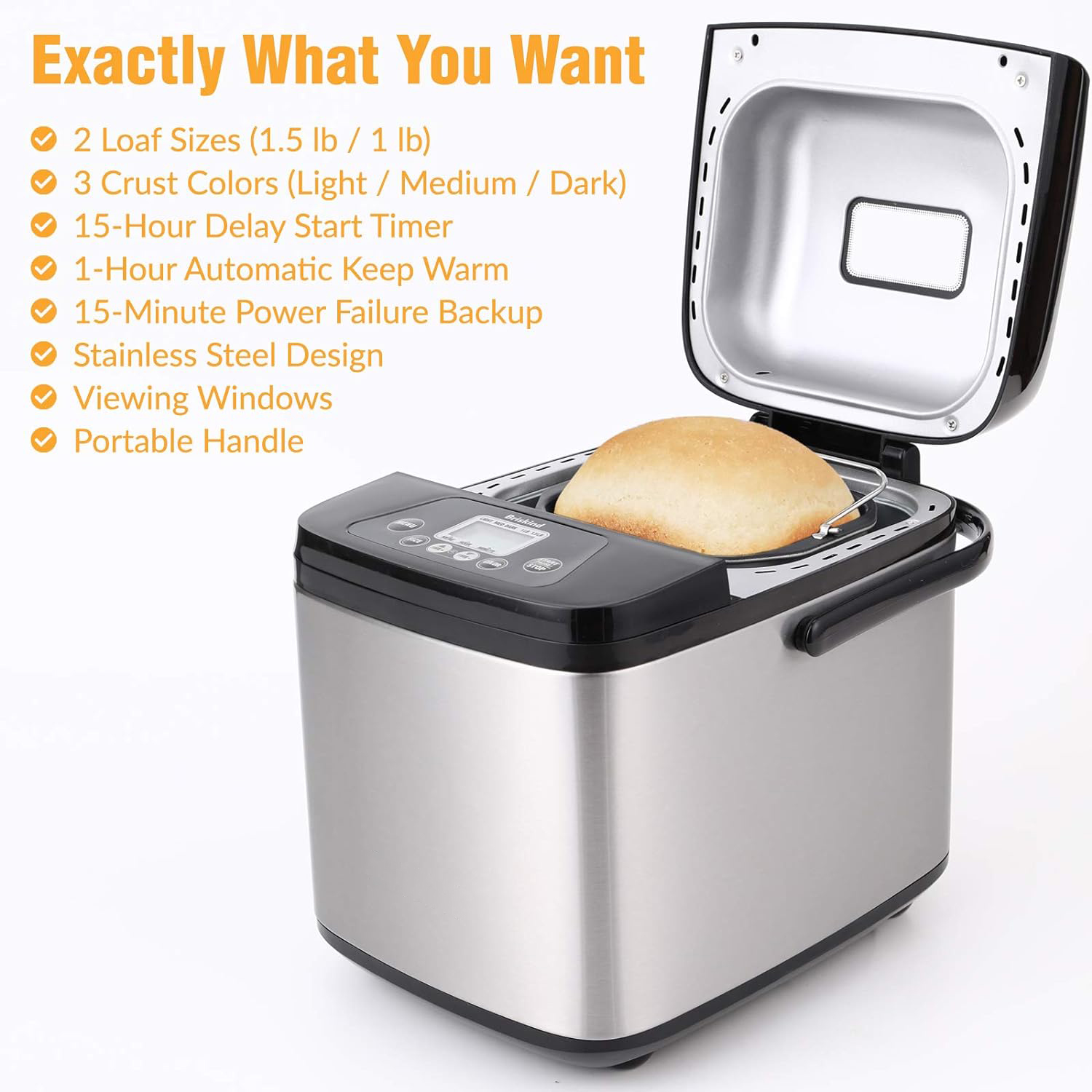
Bread makers are small kitchen appliances designed for baking bread automatically. They use electricity to mix, knead, rise, and bake. Most models plug into a standard wall outlet and use 110–120 volts in the US.
The power usage is measured in watts. A typical bread maker uses between 450 and 800 watts depending on the brand and features. For comparison, a toaster usually uses about 800–1500 watts, and a microwave can use 1000 watts or more.
Bread Maker Vs Other Kitchen Appliances
Here’s a quick comparison of the average wattage of common kitchen appliances:
| Appliance | Average Wattage |
|---|---|
| Bread Maker | 450–800 W |
| Toaster | 800–1500 W |
| Microwave | 1000–1200 W |
| Electric Oven | 2000–5000 W |
| Coffee Maker | 600–1200 W |
As you can see, a bread maker is less energy-hungry than many other appliances, especially ovens.
How Much Electricity Does A Bread Maker Use Per Cycle?
To know how much electricity your bread maker uses, you need to look at wattage and running time. Bread makers do not run at full power for the entire cycle. They have different phases:
- Mixing and kneading: Low power, usually 10–20 minutes.
- Resting/rising: Very low power or sometimes none, 40–60 minutes.
- Baking: High power, 30–50 minutes.
Most bread makers have a total cycle time of 2. 5 to 4 hours. But the actual time the heating element is on is much shorter.
Let’s use a typical model as an example:
- Wattage: 600 W
- Total cycle time: 3 hours
- Heating time: 45 minutes
To find out the energy used, multiply wattage by hours used:
Energy Used = Wattage × Hours
So, for the heating phase:
600 W × 0.75 Hours = 450 Wh (watt-hours)
For mixing and kneading:
100 W × 0.33 Hours = 33 Wh
Total for one cycle: About 483 Wh (watt-hours), or 0.483 kWh (kilowatt-hours).
Cost Of One Bread Maker Cycle
If your electricity rate is $0.15 per kWh:
0.483 Kwh × $0.15 = $0.072
So, you pay roughly 7 cents for one loaf.
This is much cheaper than using a large oven, which can cost $0. 30–$0. 50 per bake.
What Factors Affect Bread Maker Electricity Use?
Many things can change how much energy a bread maker uses:
- Wattage of the machine: Higher wattage means more power used, but it may bake faster.
- Cycle length: Longer programs (whole wheat, gluten-free) use more energy.
- Loaf size: Baking larger loaves needs more power.
- Room temperature: Cold kitchens may make the machine work harder.
- Features: Some models have extra functions (jam, cake, yogurt) that use extra energy.
Bread makers with delay timers and keep-warm functions can also add to the total energy use.
Comparing Bread Maker Models
Here’s a comparison of three popular bread makers:
| Model | Wattage | Standard Cycle (kWh) | Keep Warm (kWh) |
|---|---|---|---|
| Panasonic SD-YD250 | 550 W | 0.38 | 0.05 |
| Zojirushi BB-PDC20 | 700 W | 0.55 | 0.08 |
| Oster CKSTBRTW20 | 650 W | 0.47 | 0.06 |
Higher wattage usually means faster baking, but not always higher total energy use, because cycle times may be shorter.
Is A Bread Maker Energy Efficient?
Bread makers are generally energy efficient for baking bread at home. If you compare them to ovens, they use much less power. An oven can use 2–5 kWh for one baking session, while a bread maker uses less than 1 kWh.
For example, baking a loaf in a standard oven:
- Oven wattage: 3000 W
- Bake time: 1 hour
3000 W × 1 Hour = 3 Kwh
At $0. 15 per kWh, that’s $0. 45 per loaf.
Bread maker: 0.5 kWh × $0.15 = $0.075 per loaf.
You save money and energy, especially if you bake often.
Real-life Example
If you bake one loaf per week:
- Bread maker: 0.5 kWh × 52 = 26 kWh/year
- Oven: 3 kWh × 52 = 156 kWh/year
You save 130 kWh per year, which is about $19. 50 in electricity.
How To Calculate Your Bread Maker’s Electricity Use
To find out your actual usage:
- Check the label on your bread maker for wattage.
- Record cycle times for mixing, rising, and baking.
- Multiply the wattage by the hours used for each phase.
- Add up all phases for total energy per cycle.
If you want to be exact, you can use a power meter (like Kill-a-Watt) to measure real consumption.
Example Calculation
Imagine your bread maker is rated at 600 W, and you run a 3-hour program:
- Mixing: 20 minutes × 100 W = 33 Wh
- Rising: 60 minutes × 10 W (just the timer or display) = 10 Wh
- Baking: 40 minutes × 600 W = 400 Wh
Total = 33 + 10 + 400 = 443 Wh (0.443 kWh)
Multiply by your electricity rate for cost.
Tips To Reduce Bread Maker Electricity Use
While bread makers are already efficient, you can lower energy use even more:
- Choose faster programs: Quick bread cycles use less energy.
- Bake smaller loaves: Less dough means less baking time.
- Avoid keep-warm function: Remove bread when finished.
- Use during warmer months: Rising is faster, so less energy is needed.
- Clean regularly: Dirt can reduce heating efficiency.
Many beginners forget that running a keep-warm function after baking can add up over time. It’s easy to save energy by simply turning off the bread maker right after baking.
Credit: smartbuy.alibaba.com
Common Mistakes That Increase Electricity Use
Some users unknowingly use more power than needed:
- Running multiple cycles back-to-back
- Using keep-warm for hours
- Baking large loaves when small ones are enough
- Choosing long specialty cycles for basic recipes
- Ignoring regular cleaning and maintenance
A practical tip: Read your bread maker manual carefully. Some cycles are much longer than others, and not all recipes need extra time.
Bread Maker Electricity Use Around The World
Electricity rates and bread maker models vary worldwide. In Europe, bread makers often run on 220–240 volts and can use up to 900 watts. In some countries, electricity is more expensive, so understanding your local rates matters.
For example, in Germany:
- Average electricity price: €0.32 per kWh
- Bread maker cycle: 0.5 kWh × €0.32 = €0.16 per loaf
This is still lower than oven baking, but the cost difference is bigger in places with high electricity prices.
Credit: www.ebay.com
Should You Worry About Bread Maker Electricity Use?
For most households, the bread maker’s electricity use is not a major part of the energy bill. If you bake bread daily, it adds up, but it’s still lower than baking with a traditional oven. Most bread makers are designed to be efficient, and the cost per loaf is only a few cents.
One non-obvious insight: Even frequent bread making is unlikely to drive up your energy bill significantly unless your local rates are unusually high or you use the keep-warm function for hours.
Comparing Bread Maker Brands For Energy Use
Brand choice can affect efficiency. Here’s a final comparison of three well-known brands:
| Brand | Wattage | Typical Loaf Size | Cycle Time | Energy per Loaf (kWh) |
|---|---|---|---|---|
| Panasonic | 550 W | 2.5 lb | 4 hrs | 0.38 |
| Zojirushi | 700 W | 2 lb | 2.5 hrs | 0.55 |
| Oster | 650 W | 2 lb | 3 hrs | 0.47 |
If energy efficiency is your main concern, Panasonic models often have the lowest wattage and longest cycles, while Zojirushi offers fast baking but uses more energy per loaf.
Is Homemade Bread Worth The Electricity Cost?
Baking bread at home with a bread maker is not just about energy use. You get fresh bread, control over ingredients, and often save money compared to store-bought loaves. Even with electricity costs, homemade bread is usually cheaper and healthier.
Most bread makers pay for themselves after a year or two of regular use. The energy savings compared to oven baking are significant, especially if you bake often.
If you want to see more detailed comparisons and real-life tests, visit Cooks Illustrated.
Frequently Asked Questions
How Much Electricity Does A Bread Maker Use Per Loaf?
Most bread makers use 0.4–0.6 kWh per loaf. That’s about 6–9 cents in the US, depending on your electricity rate. Some models use less, especially for quick or small loaves.
Is A Bread Maker More Energy Efficient Than An Oven?
Yes. Bread makers use less than 1 kWh per cycle, while ovens can use 2–5 kWh. You save money and energy, especially if baking often.
Can I Reduce Bread Maker Energy Use?
Yes. Use shorter cycles, bake smaller loaves, avoid keep-warm, and clean your machine regularly. These steps can cut energy use by up to 20%.
Does Bread Maker Wattage Affect Baking Quality?
Higher wattage can bake bread faster, but it doesn’t always mean better quality. Baking quality depends more on the recipe and machine design than power alone.
Will Using A Bread Maker Increase My Electricity Bill?
The impact is usually small. Baking once a week adds about 26 kWh per year to your bill—less than $4 in most places. Frequent use or high electricity rates may increase costs, but still less than oven baking.
Using a bread maker is a smart and energy-efficient way to enjoy fresh bread at home. With the right habits, you can keep electricity costs low and get great results every time.

Credit: www.amazon.com