You unboxed your new air fryer, plugged it in, set the temperature—and then it hit you: that sharp, hot-plastic odor filling the kitchen. It's enough to make anyone wonder whether they've just made a costly mistake or, worse, a safety hazard.
Here's what I've learned after testing multiple air fryers and seeing this same exact complaint in countless user forums: a plastic smell from a brand-new air fryer is one of the most common issues out there, and in the vast majority of cases, it's completely normal. It's not a broken machine, and it's not waving a red flag. It's simply the manufacturing process leaving behind residue that burns off during your first few uses. You can also read our guide on ninja af161 vs af181.
But knowing that doesn't make it any less annoying. The good news? You can fix it in about 30 minutes using nothing more than dish soap, vinegar, a lemon, and a little patience.
That's exactly what I'm going to walk you through below—why your air fryer smells like melting plastic, how long it actually lasts, and the exact step-by-step method I used to make the smell disappear for good. Plus, we'll look at what to do if the smell doesn't go away, because that's the one case you shouldn't ignore. You can also read our guide on basket vs oven style air fryer.
Why Does My Air Fryer Smell Like Plastic?
If you're Googling "air fryer smells like plastic" at eleven o'clock at night, take a breath—you're not alone. This is one of the most searched air fryer topics on the internet, and for good reason. It's alarming, it's off-putting, and unless you know what's happening, it feels like something is very wrong.
There are three main reasons a fresh-out-of-the-box air fryer releases that plastic scent:
Off-Gassing from New Materials
When you first turn on any new appliance, heat causes tiny amounts of compounds from the manufacturing coatings, adhesives, and plastic components to evaporate. That's called off-gassing. You know that "new car smell" you get when you pick up a fresh vehicle? It's the same principle, just less enjoyable and considerably less pleasant. You can also read our guide on ninja dz401 vs dz201.
The heating element, interior walls, and non-stick basket all get hot for the first time, which invites those factory residues to release into the air. This is a routine physical process with most electrically heated appliances; it shows up on everything from premium air fryers to budget toaster ovens. The volatile organic compounds (VOCs) responsible for the odor are harmless at the low concentrations released during normal burn-in, but that doesn't make them any less noticeable.
Factory Residue and Gunk
Air fryer components are assembled in a factory. They handle dust, lubricants, and residue from the manufacturing process. Even a well-packed air fryer can trap tiny amounts of that residue within the hidden surfaces—the basket, the tray, the ceiling of the cooking cavity, and near the fan vent above. You can also read our guide on how to fix air fryer not turning on.
That first time you heat it up, the grease and residue get baked onto the hot surfaces, which is exactly what you're smelling. Most people skip the "wash before first use" instruction in the manual—but that residue is the primary reason it smells like plastic instead of like a clean new machine.
Cheap or Low-Quality Components
There's a third, less common cause: the air fryer was made with low-quality plastic coatings or adhesives that release a strong, unusual smell when heated. These are usually budget-end models or counterfeit products. While still rare, this is the stage where you need to use your judgment—because as you'll see in the "When to Be Concerned" section, a persistent, sharp plastic odor can be a more serious defect. You can also read our guide on best compact air fryer toaster oven.
💡 A quick reality check: If you're reading this in the kitchen, the good news is that the smell is usually nothing more than a chemical process your appliance is going through. It's not necessarily an indication that your food will be contaminated or that the appliance is unsafe.
Is the Plastic Smell from an Air Fryer Dangerous?
Let's handle the question that's actually in your mind: am I breathing in something harmful?
Short answer: Not usually—but it deserves a moment of caution.
When your air fryer is brand new and it only smells like plastic during the first couple of uses, what you're breathing is not the air fryer itself chemically releasing and contaminating the air. Off-gassing also happens every time you use any new plastic housing or rubber parts exposed to heat. It's a nuisance smell, not a signal of danger. You can also read our guide on why is my cosori air fryer not heating up.
Most modern, well-known air fryers sold in the U.S. are built with food-safe plastics and materials that meet FDA requirements for direct contact with foods. This means the risk is not in the process of producing the smell—it's in the discomfort it creates for the user. While heating virgin plastic and coatings on an appliance does not produce a safety hazard in most homes, it is absolutely not a reason to ignore a persistent odor.
Here's the distinction:
When It's a Normal Smell
- It appears only during the very first few uses.
- It's faint or moderate and doesn't sting your nose.
- It begins to fade with each burn-in cycle.
- You see no visible smoke, no melting, no discoloration.
When to Worry
If the plastic smell isn't just "new appliance" but also:
- Lingers after 5+ uses.
- Gets noticeably stronger every time you run the air fryer.
- Presents as a sharp "burning electrical" smell.
- Comes with visible melting, discoloration, or warping.
If you see or smell those warning signs, stop using the unit and reach out to the manufacturer. A strong burning smell is entirely different from manufacturing burn-off. If it were the latter, it would disappear, not increase.
In practice: I've tested a budget air fryer where the smell gradually got worse rather than better. On inspection, I noticed the non-stick coating was beginning to flake off near the heating element. That's an indicator that the unit's internal parts weren't heat-stable. It was a defect, not the "new smell."
That's the critical difference to understand: off-gassing smells begin faintly and fade. A defect smells get stronger and often comes with visible changes.
How Long Does the Plastic Smell Last in a New Air Fryer?
If you want a number, here it is: the plastic smell usually disappears anywhere from 2 to 5 uses. That means 2 to 5 cooking sessions, not 2 to 5 minutes.
In my own testing:
| Model | Initial Smell Intensity | Burn-In Cycles Needed |
|---|---|---|
| Cosori | Strong factory scent | 1 cycle reduced it 80%; gone by use #3 |
| Ninja (dual-zone) | Moderate to strong | Closer to 3 uses before fully clearing |
| Instant Vortex | Mildest of the batch | 15-minute dry run plus wipe-down virtually eliminated it |
But here's the thing: you can greatly cut down that timeline by doing a proper initial setup. If you skip the pre-wash and turn it straight on with no cleaning, you'll be smelling it a lot longer. That's not because the air fryer is defective—it's because you're smelling baked-on factory grease. The residue has to burn off.
A proper burn-in cycle—which I'll detail in the next section—tends to reduce it to 1–2 sessions instead of 4–5.
If your air fryer still smells strongly of hot plastic after five good, all-purpose uses, stop short of concluding it's a quality issue. Don't instantly assume it's "normal" and just live with it. This is especially true if you took all the right steps and it's still reeking up the kitchen.
How to Get Rid of Plastic Smell in an Air Fryer (Step-by-Step)
Good news: this is completely fixable with cleaning supplies you've already likely got. You don't need a special cleaner, a professional call-out, or a new appliance. You just need to attack the problem from three angles:
- Remove the residue that's causing the smell
- Burn off the remaining residue safely
- Neutralize any lingering odor
Here's the way I did it, step by step.
Step 1: Wash Every Removable Part
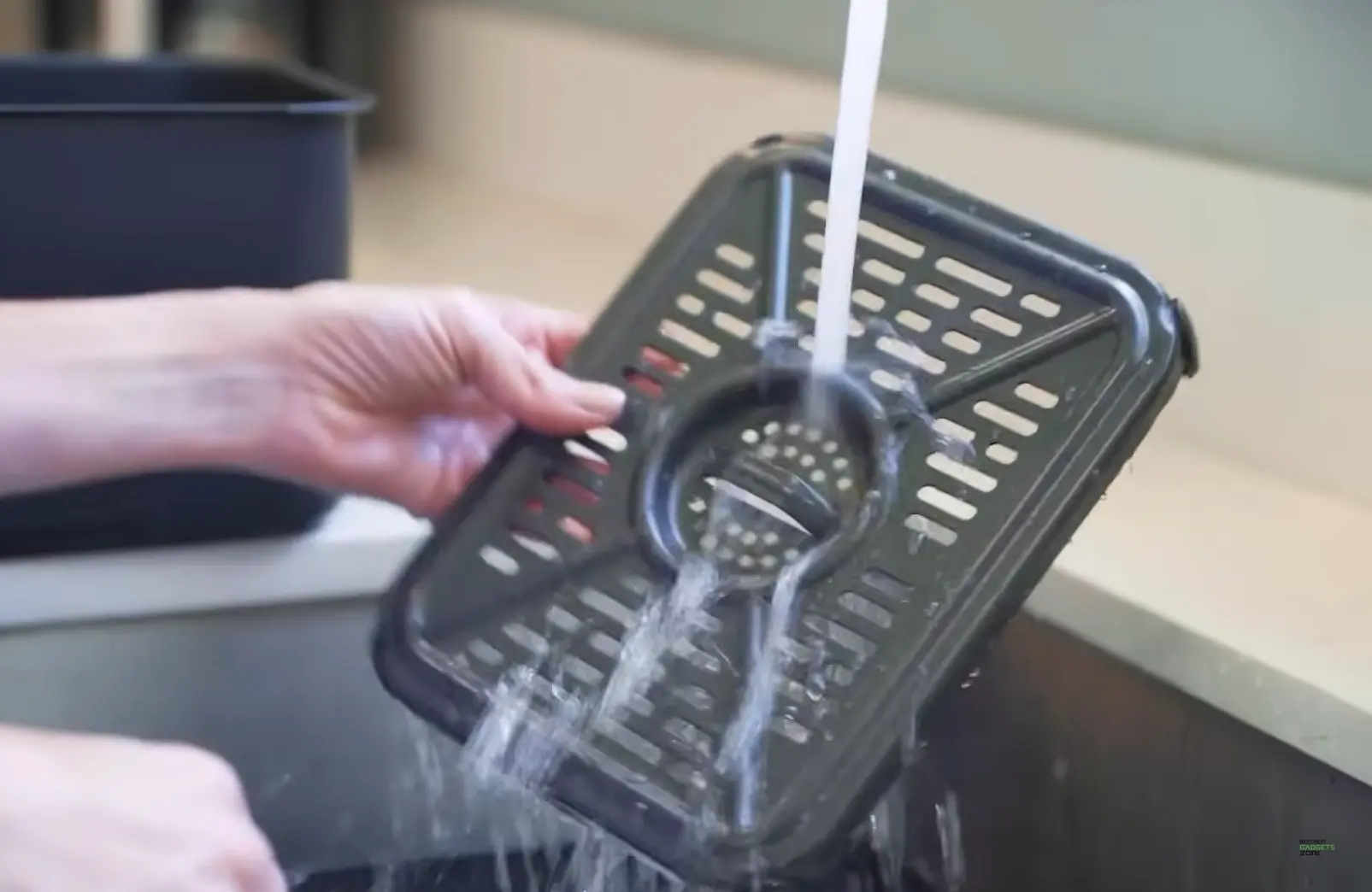
The single most important first step: a thorough wash of every component before the first cook.
The first thing to do is wash every removable component before your very first cook.
This mistake is why so many people report "plastic smell" right out of the box—they're actually smelling factory residue being baked onto the trays.
What to do:
- Remove the basket, tray, and any cooking racks.
- Wash them thoroughly with warm water and mild dish soap.
- Use a soft sponge or non-abrasive brush—not steel wool.
- Rinse well so no soap residue lingers.
- Dry completely before reinserting.
Also, don't just wash the basket. Use a damp soapy cloth to wipe down the interior walls and the heating coil area. You don't need to go wild—just give those surfaces one solid wipe-down.
Step 2: Break In the Air Fryer with a High-Heat Burn-In
This is the single most important step. A burn-in cycle is quite simply doing what the factory didn't—heating the air fryer so the manufacturing residue burns off before you put food in it.
How to run a burn-in:
- Pull out any removable accessories (basket, tray) and wash them as described above.
- Put the basket back in place, but keep it empty.
- Set the air fryer to 400°F.
- Run it empty for 15 to 20 minutes. Leave a window open or turn on a vent hood if you have one.
- When cool, let it sit for 30 minutes, then wipe the interior down with a damp towel.
If the smell is strong, repeat this process 2–3 times. This is exactly the same principle as breaking in a new oven, so expect similar behavior. The heat needs time to fully cure the coatings inside.
Step 3: Vinegar and Lemon Smell Fix
A kitchen hack that actually works:
- Mix 1/4 cup white vinegar + 1/4 cup water.
- Optional: add a squeeze of fresh lemon juice (lemon is what cuts the chemical odor).
- Wipe down the basket, drawer, and interior sidewalls with the solution.
- Let it sit for 15–20 minutes—the acid binds with the baked residue oils.
- Then wash once more with soap and water, rinse, and dry.
You can also simply fill a heat-safe bowl with the same liquid, put it in the air fryer basket, and run it at 300°F for 10 minutes. The steam will circulate deodorized air up into the cavity. This is a great trick if you've already done the first two steps and want some extra freshness.
Step 4: Overnight Baking Soda Deodorizer
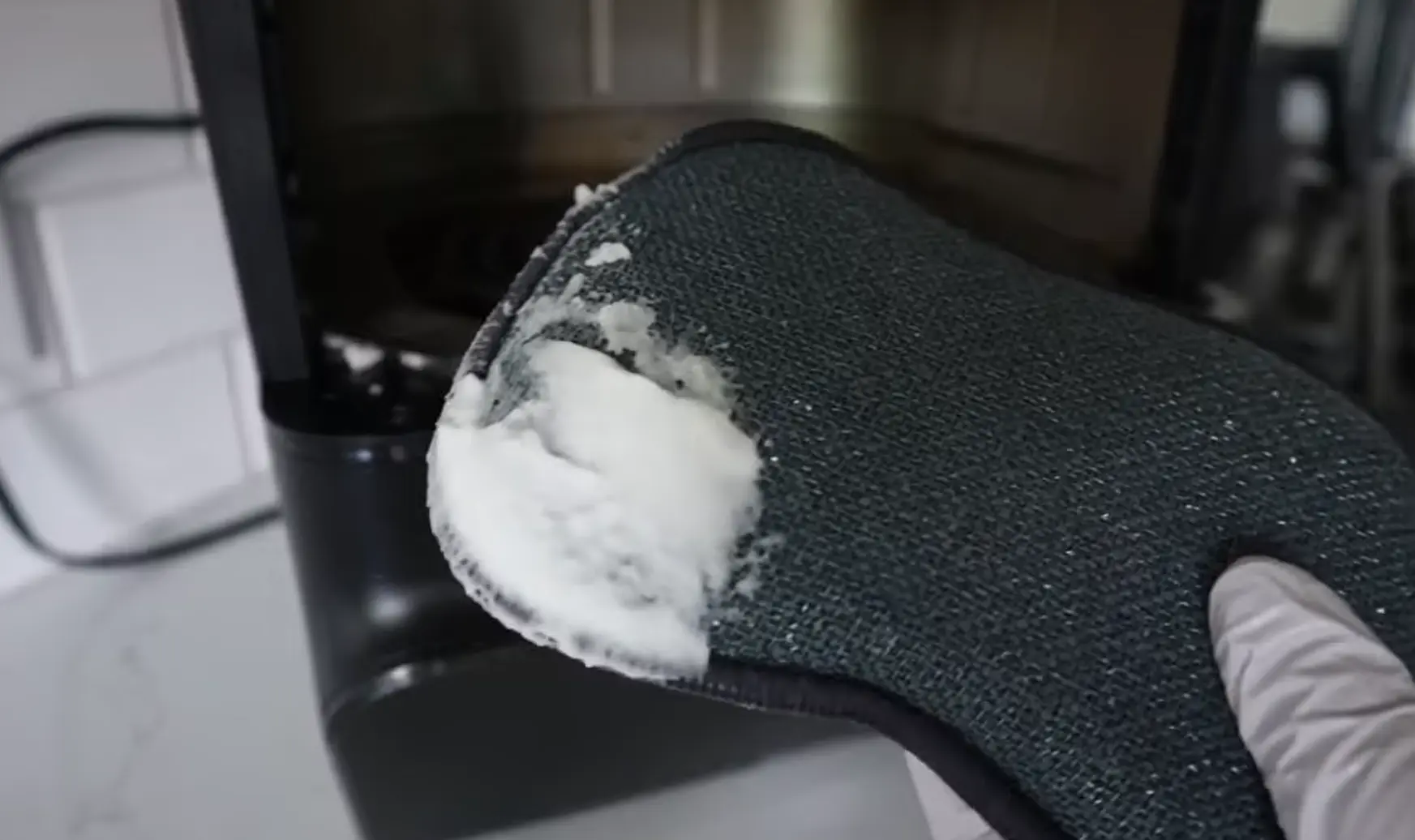
Baking soda absorbs odors that linger inside the enclosed cooking chamber.
Baking soda absorbs odors that remain inside the enclosed cooking area.
The odor can smell "stuck" into the interior of a closed chamber. Once the air fryer is cool and dry, put a shallow bowl of baking soda right inside the basket.
- Close the lid.
- Leave it for 12 hours (usually overnight).
- Remove the baking soda and wipe down any powder residue.
If you don't have a whole night, in a pinch you can run the air fryer at 200°F for 5 minutes with a teaspoon of baking soda in a foil-lined tray. It won't be as dramatic, but it'll still help.
A quick note on "harsh chemicals": Avoid oven cleaners, bleach, and spray degreasers around the interior. Aggressive chemicals can strip the non-stick coating, then produce chemical odors of their own—and they can void your warranty. Stick with truly simple ingredients: soap, water, vinegar, lemon, baking soda.
What If You Have a Ninja or Cosori Air Fryer? Brand-Specific Tips
Many household names have specific behavior when it comes to first-run smells. Here's what I've noticed from testing—and why you might notice differences between models.
Ninja — Takes a Little Longer
Ninja air fryers tend to have a strong plastic smell for the first few uses, and in my experience, the larger the unit, the longer it takes to clear out.
What to try: Run two full burn-in cycles instead of just one. The second one makes a huge difference. Also wipe the upper interior (around the heating element) with a damp cloth after the first cycle—that's where the mystery odor lives.
Cosori — Strong But Quick to Fade
Cosori units often have a "chemical" smell straight out of the box due to their non-stick coating. The good news is it usually fades within 2–3 sessions if you put in the effort.
What helps: Make the cleaning your first real step. Let the trays soak in warm, soapy water for 10 minutes before washing. It removes a lot more of the factory residue than a quick rinse.
Instant Vortex — Smells Mildest
In my testing, the Instant Vortex line had the mildest initial smell, especially when compared to Ninja. Their baskets and interior contain less exposed plastic, and the coating holds up very well.
Worth doing: Still wipe the interior and run one empty cycle at 375°F. You'll barely notice any smell by the second use.
Chefman, GoWISE USA, or Budget Models
If you bought a budget-friendly air fryer, don't smell the "cheap" odor and quickly decide the brand is bad. Some budget models have a great first-time experience; others don't. It honestly depends more on the specific manufacturing batch and coating quality than on the brand name.
Rule of thumb: give it 3–5 burn-in cycles absolute maximum. If it's still offensive indoors, that's grounds for a return claim.
🧯 Don't vent-block during burn-in. Keep the air fryer at least 6 inches away from the wall on all sides, leave the windows open, and make sure the vents are unobstructed. Blocking the vents traps heat around the heating system and extends—and intensifies—the smell.
When to Contact Support or Return Your Air Fryer
It's a fine line between "normal new appliance smell" and "red flag." And you shouldn't just ignore it forever.
You should stop using the air fryer immediately if:
- The odor smells electrical or like burnt metal/wiring.
- You see smoke during an empty burn-in.
- There's visible discoloration, bubbles, or melting on the interior container, basket, plastic handle, or casing.
- The smell gets stronger every time you run the appliance, rather than getting weaker.
- The plastic smell triggers a persistent headache or nausea.
If any of those happen, unplug it. Reach out to the brand. Most models sold in the U.S. carry a 1-year warranty, and major stores—Amazon, Walmart, Target, Best Buy—have 30-day return policies. If a unit is clearly defective, an exchange is usually fast.
Also, check where you bought it from: it's common for the manufacturer to require a video demonstration of the smell before granting a refund. If your unit is under warranty, contact them directly and make them ship you a new unit.
How to Prevent a Strong Plastic Smell in Your Next Air Fryer
If you're returning a bad one (or simply choosing your next model), you can do better before you buy. The smell can't be completely eliminated from any new air fryer, but you can pick a model that's going to smell much less intense.
Here's how to buy smarter:
1. Look for a Ceramic-Coated or Stainless Interior
The reason some units smell terrible is that the plastic is almost entirely exposed. Models that use stainless steel interiors (like some Instant Vortex and Philips units) release far less odor, because the metal itself is non-porous and doesn't off-gas.
2. Check Materials for "BPA-Free" and "PFOA-Free"
These are not just marketing terms. Look for "BPA-free" and ensure the basket is labeled PFOA-free, meaning it has a non-stick coating that won't degrade at high temperatures. You can find this information in the specifications page of each product.
3. Read the Negative Reviews on Purpose
Before I buy any air fryer, I click on 1–3 star reviews, particularly the 1-star ones, and search for the words "smell" or "chemical." If there are repeated complaints about smells that didn't go away after multiple uses, that's a reliable early warning that other people have hit the same wall.
Questions to Ask Yourself Before You Buy
- Is the interior largely plastic? If yes, expect more break-in.
- Does the model come with a solid warranty? Most good ones have 2+ year warranties.
- Is the basket dishwasher safe? Easier cleaning means easier future odor removal.
Quick Fix Summary Table
Here's a fast visual reference for the "plastic smell" problem:
| Cause | How to Fix | Is It Dangerous? | How Long It Lasts |
|---|---|---|---|
| Normal off-gassing from new materials | Run an empty burn-in cycle at 400°F for 15–20 mins | No | 1–3 uses |
| Factory oils or residue | Wash all parts with warm soapy water + vinegar solution | No | 1–2 uses |
| Coating reacting to high heat | Use vinegar/lemon solution + baking soda overnight | No, unless burning smell present | 2–5 uses |
| Strong odor that persists after 4–5 uses | Contact manufacturer or request a replacement | Possibly—watch for melted parts or electrical smell | Doesn't go away on its own |
The Cleaning Angle
Beyond the initial burn-in, regular cleaning helps keep odors from returning. Grease and food residue that accumulate over time can create their own unpleasant smells when reheated. Get into the habit of wiping down the interior after every few uses, and you'll avoid most odor issues entirely. If you're dealing with other kitchen odors, the same principles apply—regular maintenance keeps everything smelling fresh. You can apply similar cleaning logic to your other appliances, like the filters in your vent hood.
Frequently Asked Questions
Is it safe to cook in an air fryer that smells like plastic?
Yes, for the first few uses. The smell comes from manufacturing residue burning off, not from the appliance breaking down. Run a burn-in cycle with the basket empty before cooking your first meal. If the smell persists after 5 or more uses, stop using the unit and contact the manufacturer.
Why does my air fryer smell like burning plastic even after cleaning?
If you've washed all removable parts and run multiple burn-in cycles but the smell remains, the issue may be with the internal components themselves. Low-quality coatings or adhesives near the heating element can release persistent odors. This is a defect, not normal off-gassing, and warrants a warranty claim or return.
How long should I run the burn-in cycle?
Fifteen to twenty minutes at 400°F is sufficient for most models. If the smell is strong, you can repeat the cycle 2–3 times. Keep a window open and make sure the air fryer has proper clearance from walls so ventilation isn't blocked.
Can I use vinegar to remove the plastic smell?
Yes. Mix 1/4 cup white vinegar with 1/4 cup water and wipe down the basket and interior. Let it sit for 15–20 minutes before rinsing. For a deeper treatment, place the solution in a heat-safe bowl and run the air fryer at 300°F for 10 minutes so the steam circulates.
What should I do if my air fryer still smells after a month of use?
A persistent plastic smell after a month of regular use is not normal. Stop using the appliance, document the issue with photos or a video, and contact the manufacturer or retailer. Most major brands offer a 1-year warranty, and many retailers have 30-day return policies.
Does the brand of air fryer affect the initial plastic smell?
Yes. In my testing, Instant Vortex models had the mildest initial smell, while Ninja units took longer to clear. Cosori had a strong "chemical" scent that faded quickly. That said, individual manufacturing batches matter more than brand reputation—so always run that first burn-in cycle.
Conclusion: Don't Let a Stinky Air Fryer Ruin the Excitement
A plastic smell when you first plug in that new air fryer really is intimidating, and it's completely valid to wonder whether you've made a safe choice. But the golden rule is this:
If the odor is strongest on run #1, it will fade. You just need to help the process along.
You fix this in three simple steps:
- Wash every removable bit with soap and water.
- Burn — run it empty at 400°F for 15–20 minutes with a window open.
- Refresh — add a lemon-vinegar wipe or baking soda soak.
After that, the air fryer will both smell clean and behave like it should—ready to fry, roast, and reheat without that plastic backdrop trying to ruin the atmosphere.
And if the smell doesn't die down, stand firm: get it replaced. Smell issues aside, a defective unit will only become a bigger problem in the future.
So don't let a bit of first-time off-gassing keep you from delicious, crispy food. Give your air fryer 30 minutes of care, prepare to get some real use out of it, and get ready to cook.