Walk into any appliance aisle and you will see air fryers stacked beside toaster ovens, each one promising crispy food with little to no oil. Read the fine print, though, and you will notice many manufacturers quietly describe their air fryers as "compact convection ovens." So is an air fryer really just a small convection oven?
The short answer is yes — but with important differences in fan power, cooking speed, capacity, and how each appliance browns food. Those differences determine whether dinner takes 12 minutes or 40, whether you cook for two or for six, and whether your fries come out shatter-crisp or merely golden. Below are 12 practical insights to help you decide which appliance deserves a place in your kitchen. You can also read our guide on does air fryer save electricity.
The Short Answer: Yes, With Real Caveats
Both appliances rely on a fan to circulate hot air around food, which strips surface moisture and triggers browning. In that sense, every air fryer is a convection oven — just a much smaller, more aggressive one.
The reverse is not true. A standard convection oven does not behave like an air fryer because its fan is gentler relative to the size of the cavity. Understanding where the two overlap — and where they diverge — is the key to choosing the right tool for the meals you actually cook. For more on this, see our guide on how is air fryer different from convection oven.
How an Air Fryer Actually Works
An air fryer is a countertop appliance with a heating element positioned above the food and a high-speed fan directly behind it. The fan forces hot air down through a perforated basket, allowing heat to reach the food from multiple angles at once.
Because the cooking chamber is small, the volume of air that needs heating is tiny. Most models preheat in 2 to 4 minutes and operate between 180°F (82°C) and 400°F (204°C). The intense airflow pulls moisture from the food's surface quickly, which is what produces that crunchy exterior without a deep fryer. For more on this, see our guide on what does the inside of an air fryer.
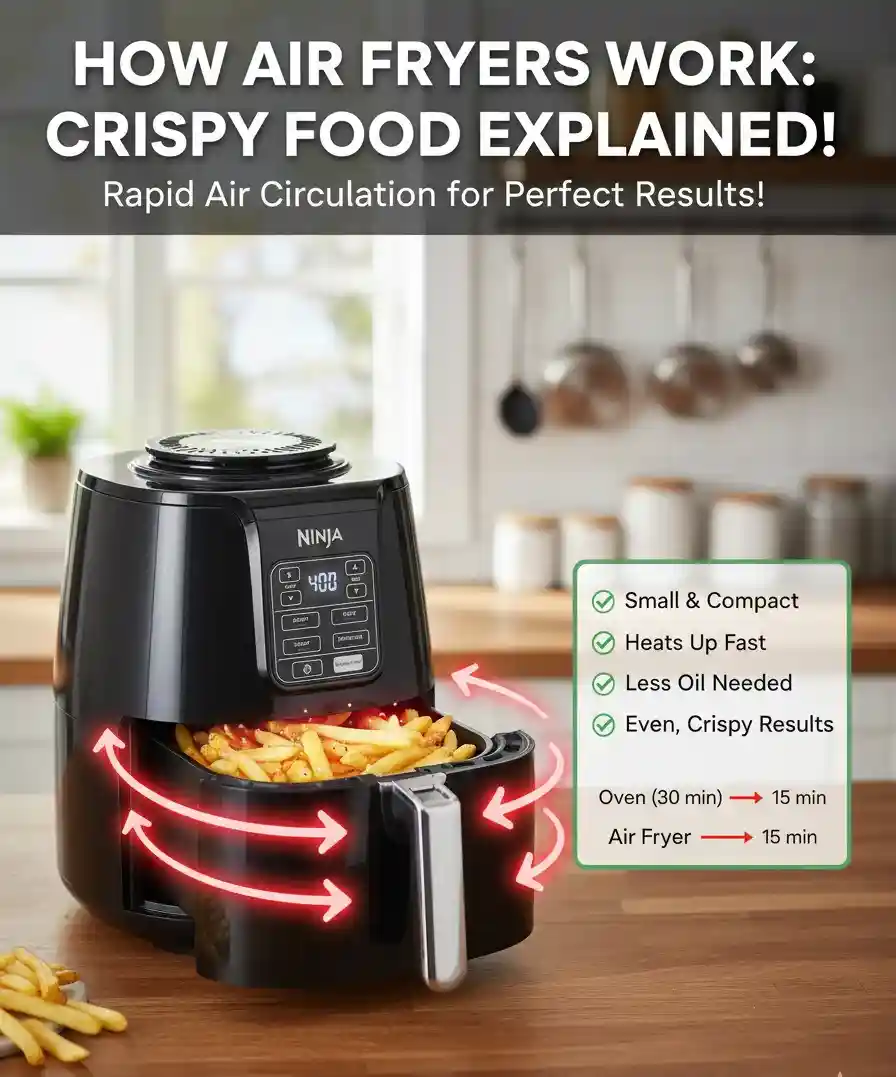 This cutaway shows how an air fryer drives hot air through a small, perforated basket.
One misconception worth clearing up: the name "air fryer" is marketing shorthand. No oil bath is involved — the machine simply bakes food so aggressively that it mimics fried texture. The name sells the result, not the method.
How a Convection Oven Works
A convection oven — whether built into a range, mounted in a wall, or sitting on a countertop as part of a toaster oven — also uses a fan, but it heats a much larger cavity. One or two fans push air past the heating elements and circulate it around racks of food. For more on this, see our guide on frozen cheese sticks in air fryer.
Because the chamber is bigger, the fan moves air at comparatively lower velocity, and preheating typically takes 8 to 15 minutes. Convection ovens usually span 150°F (65°C) to 500°F (260°C), which makes them capable of slow roasting, dough proofing, and high-heat searing. They also hold multiple racks, which matters when you want a tray of roasted vegetables and a casserole cooking at the same time.
12 Smart Insights to Help You Decide
1. Both Use the Same Core Mechanism: Hot Air Circulation
At their heart, the two appliances share one principle. A fan moves hot air across food to speed evaporation and promote the Maillard reaction — the chemical process that gives roasted food its color and deep flavor. That is why frozen fries come out crispy in an air fryer and also work well on a convection setting.
The distinction is not in the method, but in how aggressively the air moves and how much food fits inside at once.
2. Fan Strength Is the Biggest Differentiator
Manufacturers rarely advertise fan speed, but it is the most important variable between the two. Air fryers use a high-output fan relative to their small chamber size, creating a cyclonic effect that browns food much faster. Standard home convection ovens use a gentler fan that distributes heat evenly across large batches.
In practice, this means an air fryer can turn a batch of chicken thighs shatteringly crisp in 18 minutes, while a convection oven needs closer to 30 minutes to reach a similar — though slightly less intense — result.
3. Small Chamber Means Faster Cooking
A 4-quart air fryer holds only a few liters of air. Heating that tiny volume takes a fraction of the time needed to heat a 4-cubic-foot oven cavity.
Expect an air fryer to cut cook times by roughly 20 to 30 percent compared with a convection oven for the same quantity of food — and that is after skipping the preheat cycle entirely. On a busy weeknight, this difference is what makes an air fryer feel dramatically faster.
4. Crispiness Goes to the Air Fryer
Think of the difference between a strong gust and a gentle breeze. Air fryers generate the former, driving so much hot air over the food's surface that moisture evaporates in seconds.
This produces a crunch on frozen waffles, breaded chicken, and hand-cut fries that a convection oven can only approximate. The trade-off? Vigorous airflow can dry out delicate baked goods. Air frying works best on foods with a protective outer layer — batter, breading, or skin — rather than soft pastries.
5. Capacity: Small Batches vs. Full Meals
Here is the honest trade-off. Most countertop air fryers hold 2 to 6 quarts — enough for 1 to 3 portions. Convection ovens, even compact ones, fit an entire baking sheet, a whole chicken, or two trays of cookies at once.
| Feature | Air Fryer (Countertop) | Convection Oven (Built-In) |
|---|---|---|
| Typical capacity | 2–6 quarts | 4–6+ cubic feet |
| Portions per cook | 1–3 | 4+ |
| Footprint | Small, portable | Large, fixed install |
| Batch flexibility | Limited | High |
If you regularly cook for more than four people, an air fryer will force you into multiple batches, which quickly eats into its time and energy advantages.
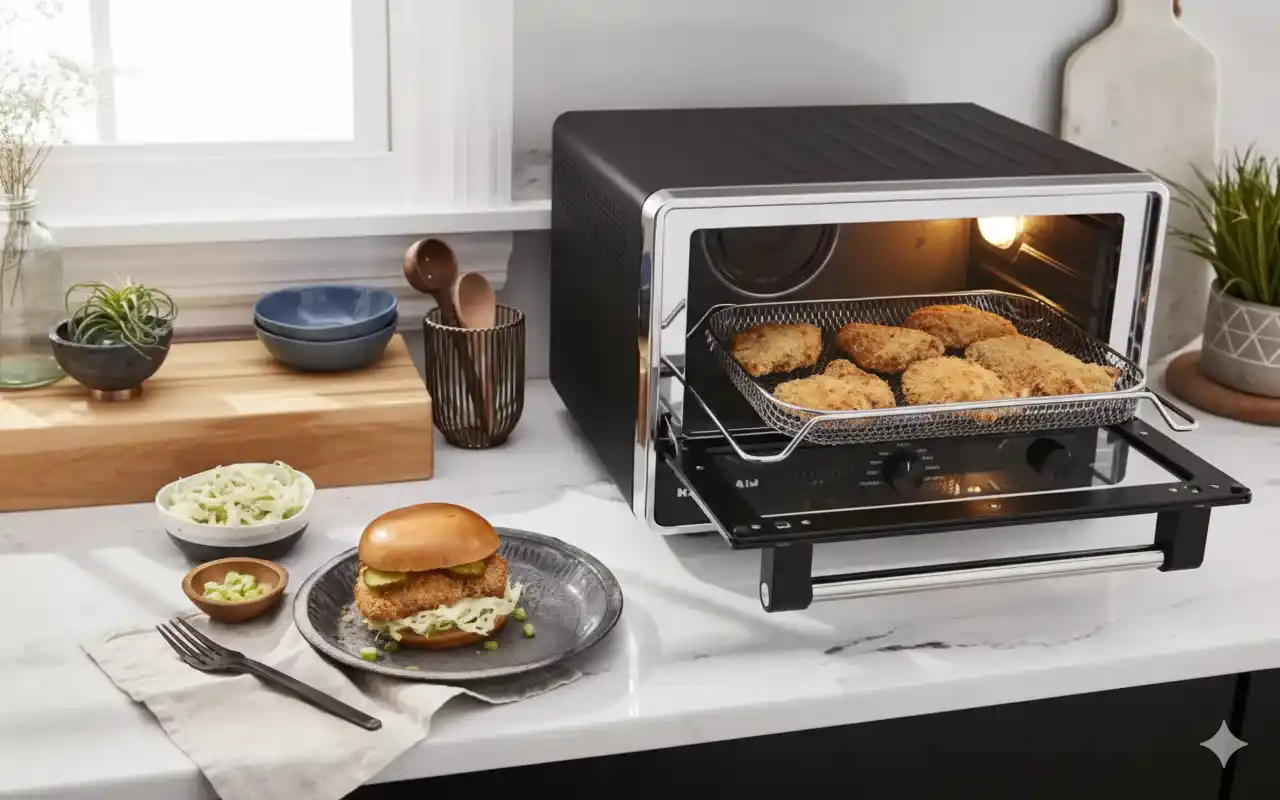 The size and airflow differences between a compact air fryer and a full convection oven.
6. Preheating Is Nearly Instant in an Air Fryer
A typical air fryer is ready to cook in under 3 minutes. A standard convection oven takes 8 to 15 minutes to stabilize at the same temperature. That may not seem like much, but on a weeknight it decides whether dinner takes 15 minutes or 30.
This is the air fryer's biggest practical advantage: it eliminates the "wait for the oven to warm up" hesitation that pushes many people toward takeout.
7. Air Fryers Use Less Energy — Usually
Because air fryers heat a smaller volume and run for shorter periods, their total energy draw is lower. A 1,400 to 1,800 watt air fryer running for 15 minutes uses noticeably less electricity than a 2,000 to 2,500 watt oven running for 40 minutes.
| Appliance | Typical Power Draw | Typical Cook Time | Relative Energy Cost |
|---|---|---|---|
| Air Fryer | 1,400–1,800 W | 10–30 min | Lower |
| Convection Oven | 2,000–2,500 W | 20–60 min | Higher |
Over a month of daily use, the savings add up — but only if you are cooking small quantities. The moment you need a second air fryer batch to feed the family, energy and time savings evaporate.
8. Temperature Range Favors the Convection Oven
Convection ovens cover a much wider band — often 150°F to 500°F — which matters for low-and-slow tasks like proofing dough, dehydrating fruit, or keeping food warm, and for high-heat finishing like searing a thick steak.
Air fryers typically top out around 400°F (204°C) and rarely go below 180°F (82°C). They cannot replace every oven function. If your recipes rely on very low temperatures or very high heat, the full oven is essential.
9. Baking and Roasting: Convection Takes Over
Your air fryer can bake a few muffins or a small sheet of cookies, but a convection oven is the real workhorse for pastry. Rack space allows even, gentle heat across a full baking sheet, so cakes rise properly and cookies spread the way they should.
The air fryer's tight chamber makes browning uneven on larger items, and its intense airflow can deflate delicate batters. For serious bakers, the cookware itself matters as much as the appliance — choosing safe bakeware options helps avoid warping and flaking coatings at high heat, and pan size substitutions can make or break a recipe if you are adapting from a typical oven.
10. Cleaning and Maintenance: Air Fryer Wins on Simplicity
Most air fryer baskets and trays are removable and dishwasher safe. The cooking chamber is small, with smooth surfaces that wipe down in seconds. Convection ovens, by contrast, have racks, trays, and interior walls that collect grease and baked-on spills — cleaning them takes real time and effort.
Self-cleaning settings help, but they run at high heat for over an hour and can produce strong odors. If you want an appliance that is genuinely low-maintenance, the air fryer wins this round. It also helps to stay on top of regular kitchen upkeep — including cleaning the vent hood — to keep grease from lingering in the air you breathe.
11. How to Choose for Your Kitchen
Start by being honest about your cooking patterns:
- Cook for 1–3 people, value speed, and love crispy textures? Choose an air fryer. It preheats fast, uses less energy, and delivers crunch that an oven cannot match.
- Cook for a family, bake regularly, or need a full range of temperatures? Choose a convection oven. Capacity, even heat, and versatility make it the better long-term investment.
- Have the counter space and budget for both? Many kitchens end up with both, using the air fryer for quick sides and snacks while saving the oven for bigger meals and baking projects.
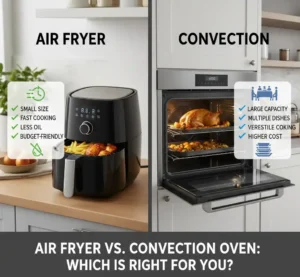 A typical countertop air fryer setup for quick, crispy meals.
12. Many Kitchens Eventually End Up With Both
The two appliances are not strict rivals — they serve different meal sizes and moods. An air fryer shines for weeknight convenience, while a convection oven earns its keep on weekends and holidays. If you have the space, owning both gives you the speed of an air fryer and the capacity of a real oven, each doing what it does best.
Health and Safety Considerations
Air frying is generally a healthier alternative to deep frying because it requires little to no oil while still achieving crisp texture. The U.S. Food and Drug Administration (FDA) has flagged that deep frying starchy foods at high temperatures forms acrylamide, a potential carcinogen; air frying produces far less of this compound because it uses minimal oil and shorter cook times.
That said, air fryers still reach temperatures high enough to scorch food. Always follow cook times, avoid overcrowding the basket, and use an instant-read thermometer for meats. The U.S. Department of Agriculture (USDA) recommends cooking poultry to a minimum internal temperature of 165°F (74°C) regardless of the appliance used.
Frequently Asked Questions
What is the main difference between an air fryer and a convection oven?
An air fryer cooks faster because of its compact chamber and more intense fan-driven airflow. Both use the same hot-air circulation principle, but an air fryer applies it far more aggressively.
Can I use an air fryer like a convection oven?
Yes, for small batches. An air fryer can roast vegetables, bake muffins, and cook frozen foods just like a convection oven. The main limitations are capacity and temperature range — you cannot proof dough at 150°F or fit a full baking sheet inside.
Do air fryers and convection ovens use the same cooking method?
Both use hot air circulation, but air fryers employ a stronger fan relative to chamber size, which produces faster browning and crispier exteriors.
Which produces crispier food: an air fryer or a convection oven?
Air fryers generally produce crispier results because the higher-velocity airflow removes surface moisture more quickly and effectively.
Are air fryers more energy-efficient than convection ovens?
Yes, for small meals. Air fryers use less energy because they heat a smaller space and run for shorter periods. For large family meals, the difference narrows considerably.
Can a convection oven replace an air fryer for all recipes?
No. A convection oven can cook most air-fryer recipes, but it takes longer and produces slightly less crispy results. Fine pastry and low-temp tasks like proofing are also out of reach for an air fryer.
Is the cooking space different between the two?
Yes. Air fryers hold 2 to 6 quarts, enough for 1 to 3 portions. Convection ovens hold significantly more and fit multiple racks for cooking several dishes at once.
Final Verdict: Should You Buy an Air Fryer or a Convection Oven?
Both appliances use hot air to cook food quickly and create appealing browning. The air fryer is faster, more energy-efficient, and easier to clean, making it ideal for small households that value crispy textures and quick weeknight meals. The convection oven offers capacity, temperature range, and genuine baking performance, making it the better all-rounder for families and serious home cooks.
Choose based on your kitchen space, how many people you feed, and what you cook most often. If you can afford both, you will use each regularly — the air fryer for snacks and sides, the convection oven for the big jobs.
Looking for more ways to get the most from your kitchen appliances? Explore the latest kitchen guides for practical comparisons, maintenance tips, and buying advice.