If you’ve ever heard the term “automatic knife” and wondered what makes it different from a regular pocket knife, you’re not alone. People often confuse them with assisted-opening knives, and that mix-up can cause real legal trouble. So here’s the straight answer: what is an automatic knife is a knife that opens its blade via an internal spring when you press a button or switch on the handle.
The Federal Switchblade Act of 1958 defines these knives at the federal level, but state laws vary widely. A knife that’s perfectly legal in Texas can land you in hot water in New York. That’s why understanding the basics isn’t just a curiosity, it’s a necessity if you’re thinking about buying or carrying one.
Let’s break down the key facts you need to know.
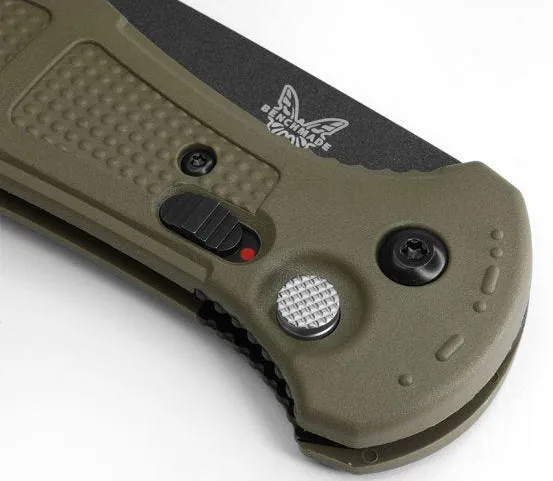
Image source: Bing (Web (fair-use with source credit))
Quick Answer
An automatic knife is a folding knife with a spring-loaded blade that opens automatically at the push of a button. It is not the same as an assisted-opening knife, which requires manual force to start the blade. Automatic knives are regulated by the Federal Switchblade Act and many state laws.
The One-Line Answer
If you push a button and the blade snaps open on its own, it’s an automatic knife. No wrist flick, no manual start needed.
Automatic vs. Assisted-Open: The Confusion That Causes Legal Trouble
This is where most people get tripped up. An assisted-opening knife has a spring that helps the blade open once you push it past a certain point. But you still have to manually start the blade with your thumb or a stud.
A true automatic knife needs no manual start, just the button. Legally, that distinction matters. Assisted-open knives are generally not treated as switchblades under federal law, but automatics are.
So if you’re carrying an assisted-open, you’re in a safer legal spot, but only if it’s truly assisted and not automatic.
Automatic Knife vs. Switchblade: Are They the Same?
Yes. In everyday use, automatic knife and switchblade usually refer to the same basic type of knife. Both describe a knife designed to deploy its blade automatically when you activate a button, lever, or similar mechanism.
The term switchblade is more common in laws and regulations, while automatic knife is often used by manufacturers and knife owners. This is why you may see both terms when researching the same knife.
The important point is how the blade opens. If a spring-powered mechanism deploys the blade without you manually starting it, it generally falls into the automatic or switchblade category. That distinction can matter when checking local laws.
How an Automatic Knife Works: Types, Springs, and Blades
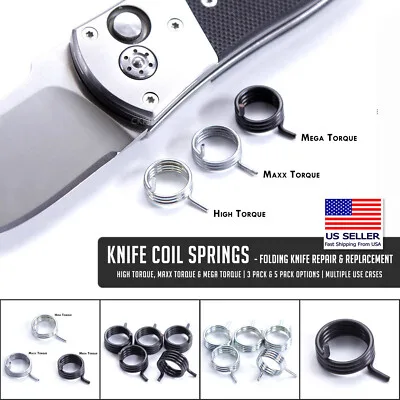
Image source: Bing (Web (fair-use with source credit))
Out-the-Front (OTF) vs. Out-the-Side (OTS)
The two main designs are out-the-front (OTF) and out-the-side (OTS). OTF knives have the blade deploy straight out of the front of the handle. They’re popular for one-handed use and a clean look.
OTS knives open from the side of the handle, like a traditional folding knife but with a spring. OTS designs are often more robust and have less blade play than OTF models.
Single-Action vs. Double-Action Mechanisms
Single-action OTF knives only use the spring for deployment. You have to manually retract the blade back into the handle. Double-action OTF knives use the spring for both deployment and retraction.
You press the button forward to open and back to close. Single-action is simpler and cheaper, but double-action is more convenient.
Blade Steel and Handle Materials That Matter
Blade steel matters for edge retention and durability. Common steels include 440C (good for the price), D2 (better edge retention), and CPM-S35VN (high-end). Handle materials range from G-10 (grippy, lightweight) to titanium (strong, premium).
Aluminum is a middle ground. Your choice depends on how you plan to use the knife.
Are Automatic Knives Legal? Federal Law, State Laws, and Real Risks
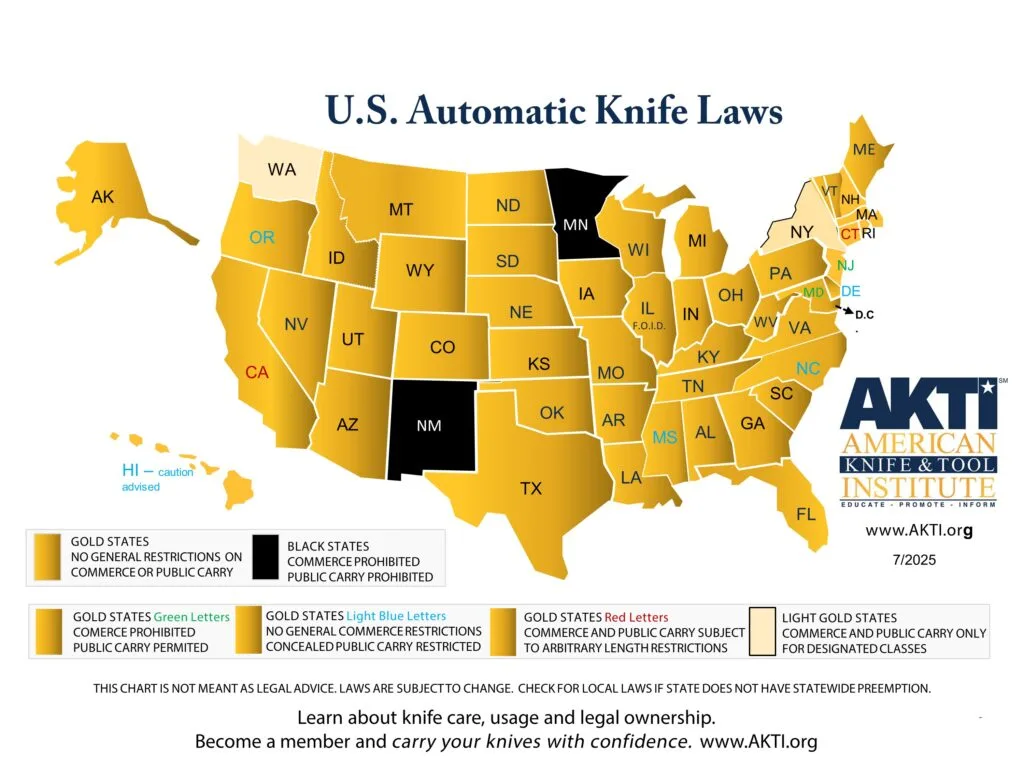
Image source: Web (Bing) / akti.org
What the Federal Switchblade Act Actually Says
The Federal Switchblade Act (15 U.S.C. § 1241, 1244) prohibits the manufacture, sale, or transportation of switchblades across state lines. But there are exceptions. The law allows interstate sales to military, law enforcement, and government agencies.
It also allows interstate sales to individuals if the state where they live permits it. So federal law sets the floor, but state law is the ceiling.
State-by-State Differences You Can’t Ignore
State laws vary dramatically. Texas legalized automatic knives for general carry in 2017. California allows ownership but restricts carry.
New York and Washington, D.C. have strict bans. Some states have blade length limits, others don’t. You need to check your specific state and local laws before buying.
A knife that’s legal in your state might be illegal in the next county.
Who’s Legally Allowed to Carry One Anyway
As of 2026, the general rule is: if your state permits it, any adult can possess an automatic knife. But concealed carry laws may apply. Some states require a permit.
Others prohibit carrying in certain places like schools or government buildings. Military and law enforcement officers often have broader exemptions under federal law. Always confirm with your state’s official resources.
The American Knife & Tool Institute provides state-by-state guides that are a good starting point.
Mistakes to Avoid When Buying or Carrying an Automatic Knife
Image source: Web (Bing) / wish.com
Buying Before Checking Your Local Laws
This is the biggest mistake. People see a cool automatic knife online, buy it, and then find out it’s illegal in their state. The seller might not check, and you could face serious fines or even misdemeanor charges.
Always check your state and local laws before purchasing.
Misidentifying Assisted-Open Knives as Automatics
Many knives are marketed as “assisted opening” but are actually true automatics under the law. If a knife opens with a button and a spring, it’s a switchblade. If it requires manual pressure to start the blade, it’s assisted.
The law looks at the mechanism, not the marketing. Don’t assume a knife is legal just because the label says “assisted.”
Ignoring Maintenance: Dirt, Lint, and Spring Failure
Automatic knives have intricate springs and mechanisms. Pocket lint, dust, and dirt can jam the action. Over time, springs can weaken or break.
Regular cleaning with compressed air and light oil keeps the mechanism working. If you ignore maintenance, your knife might fail when you need it most.
Common FAQs About Automatic Knife
Are Automatic Knives Good for Self-Defense?
An automatic knife opens quickly, which can be an advantage in a defensive situation. But a knife is a tool, not a weapon. Legal restrictions and deployment reliability matter.
For self-defense, a fixed-blade knife or a proven folder might be a better choice. Always check your local laws first.
Can I Ship an Automatic Knife Across State Lines?
Federal law generally prohibits shipping automatic knives across state lines unless you’re an exempted party or the recipient’s state allows it. For an individual, it’s risky. Many online retailers won’t ship to states with restrictive laws.
If you’re buying, confirm the seller’s shipping policy.
What’s a Good Budget for a Reliable Automatic Knife?
Reliable automatic knives start around $50 to $80 for entry-level models. Mid-range options from $100 to $200 offer better steel and tighter tolerances. High-end models can exceed $500.
You get what you pay for. A cheap knife might have a weak spring or poor lockup. Invest in a reputable brand.