Skip to content
Many people buy air purifiers hoping for cleaner air at home, but few know how important size is. Picking the wrong size can mean your purifier won’t work well, and you might waste money. The right size depends on room dimensions, pollution levels, and how much you care about air quality. This guide will help you find the best air purifier for your needs, using clear steps and practical advice. By the end, you’ll understand how to choose confidently, avoid mistakes, and get real results.
Why Air Purifier Size Matters
An air purifier’s size isn’t about physical dimensions—it’s about how much air it can clean. If you buy a unit that is too small, it won’t capture enough dust, pollen, or smoke. Too big, and you waste energy and money. The most important number is Clean Air Delivery Rate (CADR), which tells you how fast the purifier removes particles from the air.
For example, if your living room is 300 square feet and you buy a purifier rated for only 150 square feet, it won’t keep up. You’ll notice lingering smells, more dust, and allergy symptoms. Right-sizing means matching the purifier’s power to your room.
Key Factors To Decide Air Purifier Size
Several factors help you choose the right air purifier. Let’s break down what matters most.
Room Size
Measure your room’s length and width. Multiply them to get square feet. For example, a room 12 feet by 15 feet is 180 square feet. If your room has high ceilings (over 8 feet), consider the volume (cubic feet).
Cadr Ratings
CADR shows how quickly the purifier removes smoke, pollen, and dust. Higher numbers mean faster cleaning. Most purifiers list CADR for each particle type. Experts recommend a CADR at least two-thirds of your room’s area. For a 180-square-foot room, look for a CADR of 120 or higher.
Air Changes Per Hour (ach)
ACH means how many times the purifier cleans all the air in your room each hour. Allergies or asthma? Aim for 4-5 ACH. For general air quality, 2-3 ACH is fine. The higher the ACH, the better for sensitive people.
Pollution Source
Homes near busy roads, smokers, or pets need stronger purifiers. More pollution means you should choose a unit with higher CADR and ACH.
Placement
Purifiers work best in one room. If you move it between rooms, you’ll compromise performance. Pick a size for each main room or get multiple units.
Credit: www.wayfair.com
How To Calculate The Right Air Purifier Size
Let’s walk through a simple calculation. You want to clean a 200-square-foot bedroom with an 8-foot ceiling. You want at least 4 ACH.
- Find room volume: 200 sq ft x 8 ft = 1,600 cubic feet.
- Multiply by desired ACH: 1,600 x 4 = 6,400 cubic feet per hour.
- Divide by 60 to convert to cubic feet per minute (CFM): 6,400 / 60 = about 107 CFM.
Look for a purifier with a CADR of 107 or higher for smoke, dust, or pollen. If your ceilings are higher, increase the number.
Here’s a quick comparison for common room sizes:
| Room Size (sq ft) | Ceiling Height (ft) | Volume (cu ft) | ACH Target | Required CADR (CFM) |
|---|---|---|---|---|
| 100 | 8 | 800 | 4 | 53 |
| 200 | 8 | 1,600 | 4 | 107 |
| 300 | 9 | 2,700 | 4 | 180 |
| 400 | 10 | 4,000 | 4 | 267 |
Many people skip the ACH step, but if you have allergies, it’s crucial. It’s a common mistake to buy based only on square footage.
Comparing Small, Medium, And Large Air Purifiers
Air purifiers come in different sizes. Here’s how they compare:
| Type | Recommended Room Size | Typical CADR | Best For |
|---|---|---|---|
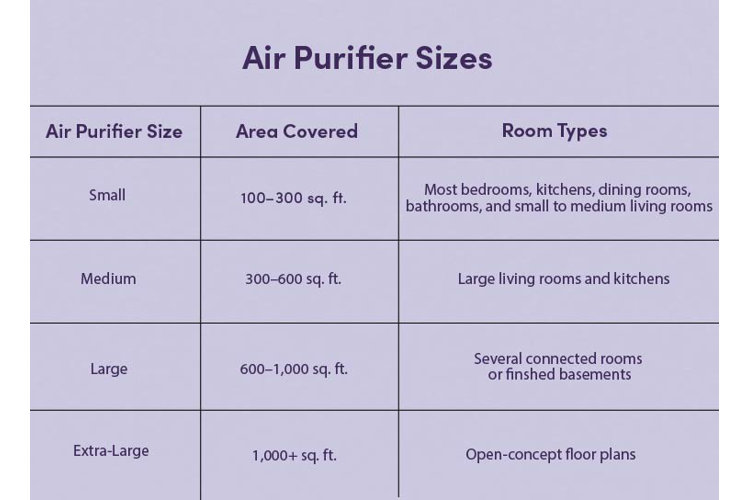
| Small | Up to 150 sq ft | 50–100 | Bedrooms, offices |
| Medium | 150–300 sq ft | 100–200 | Living rooms |
| Large | 300+ sq ft | 200+ | Open spaces, basements |
Small purifiers are fine for tiny rooms but struggle in larger spaces. Medium units fit most living rooms. Large purifiers are needed for open-plan homes or areas with heavy pollution.
Credit: coway.co.uk
Common Mistakes When Choosing Air Purifier Size
Many buyers make simple mistakes that lead to poor air quality.
- Ignoring CADR: Some buy based on price or brand, not CADR.
- Wrong Room Size: Guessing room size without measuring leads to errors.
- High Ceilings: Forgetting to account for ceiling height.
- Multiple Rooms: Using one purifier for several rooms at once—performance drops.
- Underestimating Pollution: Not considering pets, smokers, or urban air.
- Buying Too Big: Oversized purifiers waste energy and money.
- Skipping ACH: If you have allergies, low ACH means air stays dirty.
A good tip: Write down your room’s exact size before shopping. Don’t just eyeball it. This step alone can prevent most mistakes.
Real-life Examples
Let’s look at some practical cases.
Example 1: Small Bedroom
A 10×12 bedroom (120 sq ft) with an 8-foot ceiling needs a purifier with a CADR of about 64 for 4 ACH. Many popular models are rated for this size.
Example 2: Large Living Room
A 20×20 living room (400 sq ft) with a 10-foot ceiling needs a CADR of 267 for 4 ACH. Few purifiers handle this—consider two medium units if needed.
Example 3: Open-plan Apartment
If your apartment is 600 sq ft with a 9-foot ceiling, you need a CADR of 360 for 4 ACH. Most units can’t handle this. Either buy a commercial-grade purifier or use several smaller units.
Example 4: Allergy Sufferer’s Home
If you have severe allergies, aim for 5 ACH. This increases the CADR needed, so check the math. Don’t settle for less—your health depends on it.
How Room Shape And Furniture Affect Purifier Size
Not all rooms are simple rectangles. If your room is L-shaped or has lots of furniture, airflow is harder. Air may not circulate well, so consider a slightly bigger unit or place two smaller purifiers in opposite corners.
Purifiers need space around them—at least two feet on all sides. If you hide your purifier behind furniture, it won’t work well. This is a detail many people miss.
Portable Vs. Whole-house Air Purifiers
There are two main types:
- Portable air purifiers: Designed for single rooms. Easy to move, less expensive, but only work in one space.
- Whole-house air purifiers: Built into HVAC systems. Clean air everywhere, but cost more and require professional installation.
For most people, portable units are best. But if you have a large home or want complete coverage, whole-house systems are an option. Just make sure to check their CADR and ACH ratings.
Here’s a quick comparison:
| Type | Coverage | Cost | Maintenance | Installation |
|---|---|---|---|---|
| Portable | Single room | Low–Medium | Easy | No setup |
| Whole-house | Entire home | High | Professional | HVAC required |
How Often Should You Run Your Air Purifier?
The purifier’s size affects run time. A unit with correct CADR cleans the air faster, so you don’t need to run it all day. If your unit is undersized, you’ll need to run it longer.
- For allergy sufferers: Run purifier 24/7.
- For general use: 8–12 hours per day is enough.
- For heavy pollution: More time is better.
Some purifiers have auto mode—they adjust speed based on air quality. This saves energy and keeps air clean.
Additional Features That Impact Performance
Size isn’t the only factor. Consider these features:
- HEPA filters: Capture most particles, but not gases.
- Activated carbon filters: Remove odors and chemicals.
- Smart sensors: Adjust speed automatically.
- Noise level: Larger units can be noisy—check decibel ratings.
- Energy efficiency: Larger purifiers use more power.
If you want to learn more about filter types and standards, visit the EPA official site.
Non-obvious Insights Most Beginners Miss
- Ceiling Height Is Critical: Many guides ignore ceiling height. Always use room volume, not just floor area.
- Airflow Matters: Don’t block your purifier. Keep it away from walls and corners.
- ACH Is More Important Than CADR Alone: For allergies, aim for higher ACH, not just a big CADR number.
Buying Tips For The Best Results
- Measure your room carefully, including ceiling height.
- Choose a purifier with the right CADR and ACH.
- Check noise level and energy use—big units may be loud.
- Place purifier in a central, open spot for best airflow.
- Don’t expect one unit to clean multiple rooms.
- For large spaces, consider two medium purifiers instead of one massive unit.
You might find this helpful: Best Air Purifiers for Home Use
Frequently Asked Questions
How Do I Measure My Room For An Air Purifier?
Use a tape measure. Multiply length and width for square feet. If you have high ceilings, multiply by height to get cubic feet. Write down the numbers before shopping.
What Is A Good Cadr Rating For Allergies?
Aim for a CADR that matches at least two-thirds of your room’s area. For allergies, get a unit that delivers 4–5 ACH. Example: For a 200-square-foot room, look for a CADR of 133 or higher.
Can One Air Purifier Clean The Whole House?
Usually not. Portable purifiers work in one room at a time. For whole-house cleaning, you need a system built into your HVAC. Otherwise, use multiple units.
How Important Is Air Changes Per Hour (ach)?
ACH is very important if you have allergies, pets, or sensitive lungs. Higher ACH means cleaner air faster. For general air quality, 2–3 ACH is fine. For health concerns, aim for 4–5 ACH.
Do I Need A Bigger Purifier If I Live Near A Busy Road?
Yes. Outdoor pollution increases the need for a stronger purifier. Choose a unit with a higher CADR and ACH, and consider activated carbon filters to remove gases and odors.
Choosing the right size air purifier makes a big difference in how clean your home feels. Measure carefully, match CADR and ACH to your room, and avoid common mistakes. With this guide, you can breathe easy—knowing you’ve made the best choice for your health and comfort.