Skip to content
How Does A Juicer Work
Fresh juice is more popular than ever. People want healthy drinks made at home, and juicers make this possible. But if you’ve ever looked at a juicer and wondered, “How does a juicer work? ” you’re not alone. The process inside a juicer is more interesting than it first appears.
Understanding how juicers work helps you pick the right machine, get the most juice, and enjoy better flavor and nutrition.
Let’s look closely at how different juicers extract juice, what happens inside the machine, and what you should know before using or buying one.
The Basic Principle Behind Juicing
Every juicer, no matter the type, has one main job: to separate liquid juice from the solid pulp of fruits or vegetables. Juicers do this by:
- Breaking down the cell walls of produce
- Applying force to squeeze out the juice
- Filtering out the pulp
While the main goal is the same, different juicer types use different methods to get the job done.
Types Of Juicers And How They Work
You’ll find several types of juicers on the market. Each has its own design, speed, and technique. The three most common are centrifugal, masticating, and citrus juicers. Let’s break down how each works.
Centrifugal Juicers
Centrifugal juicers are the most common in homes. They work fast and are easy to use. Here’s what happens inside:
- Feeding: You place fruits or vegetables into a chute.
- Shredding: A spinning blade or disc shreds the produce at high speed (up to 15,000 RPM).
- Spinning: The shredded pieces are thrown against a fine mesh filter by centrifugal force.
- Separation: Juice passes through the mesh, while the pulp is pushed aside into a separate container.
The high speed makes quick work of most produce. However, the process can create some heat, which may reduce certain nutrients and cause juice to oxidize faster.
Example
When you juice an apple in a centrifugal juicer, it’s shredded into tiny bits instantly. The juice is spun out and collected, while the dry pulp is left behind.
Masticating Juicers
Masticating juicers are also called slow juicers or cold press juicers. They work at a much slower speed, typically 80-120 RPM. The process is:
- Feeding: Pieces of produce go into a chute.
- Crushing: An auger (a spiral-shaped gear) slowly grinds and crushes the produce.
- Pressing: The crushed produce is pressed against a filter, squeezing out the juice.
- Ejecting: The pulp is pushed out separately.
This slow, gentle process keeps more nutrients and produces less foam. The juice also lasts longer because less heat and air are introduced.
Example
If you juice spinach in a masticating juicer, the auger slowly crushes the leaves, squeezing out every drop of green juice, leaving dry pulp behind.
Citrus Juicers
Citrus juicers are made just for citrus fruits like oranges, lemons, and grapefruits. There are two main types: manual and electric.
- Manual citrus juicers: You cut the fruit in half and press or twist it on a ribbed cone. Juice flows down while seeds and pulp are left behind.
- Electric citrus juicers: You press the fruit onto a spinning reamer, which extracts juice quickly.
These juicers are simple and efficient for citrus but not designed for other fruits or vegetables.
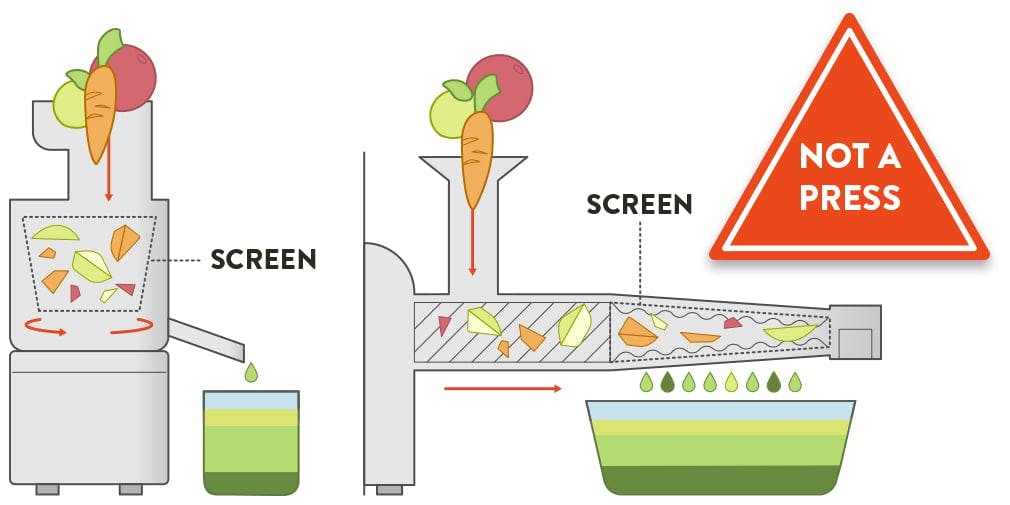
Credit: www.goodnature.com
What Happens Inside A Juicer?
The inner workings of a juicer can be fascinating. Here’s a step-by-step look at what happens from the moment you add produce to the final glass of juice.
- Preparation: Wash and cut produce to the right size for your juicer’s chute.
- Feeding: Insert the pieces into the machine.
- Extraction: The juicer’s core technology (blade, auger, or reamer) breaks the produce apart.
- Separation: Juice is separated from pulp using mesh filters or screens.
- Collection: Juice flows out a spout, and pulp is collected in a separate bin.
Some juicers also have foam separators or filters to reduce bubbles in the juice.
Comparison: Centrifugal Vs. Masticating Juicers
Choosing between centrifugal and masticating juicers can be confusing. Here’s a quick comparison:
| Feature | Centrifugal Juicer | Masticating Juicer |
|---|---|---|
| Speed | Fast (5,000–15,000 RPM) | Slow (80–120 RPM) |
| Juice Yield | Moderate | High |
| Noise Level | Loud | Quiet |
| Nutrient Retention | Lower | Higher |
| Cleaning | Easy to moderate | Moderate to hard |
Insight: Many beginners think faster juicers are always better, but slow juicers often give more juice and nutrients, especially with leafy greens.

Credit: www.huromslowjuicer.co.nz
Key Parts Of A Juicer
Understanding the main parts of a juicer helps you use and clean it better.
- Feed chute: Where you place fruits and vegetables.
- Blade or auger: The part that cuts or crushes the produce.
- Filter basket: Separates juice from pulp.
- Juice spout: Where juice flows out.
- Pulp container: Collects leftover pulp.
- Motor (electric models): Powers the blade or auger.
Some juicers also have extra features like foam separators or multiple speed settings.
How Pulp And Juice Are Separated
Separation is key to juicing. Here’s how it works:
- The juice is smaller and more liquid, so it passes through a fine screen or mesh.
- The pulp (fiber and solids) cannot pass, so it’s pushed into a container.
Some juicers let you adjust how much pulp you want in your juice. Others have self-cleaning screens.
Efficiency: Juice Yield And Dry Pulp
A good juicer should get the most juice with the least waste. Here’s a comparison of juice yields for different types of produce:
| Produce | Centrifugal Yield (%) | Masticating Yield (%) |
|---|---|---|
| Carrots | 45–55 | 60–70 |
| Spinach | 30–40 | 50–60 |
| Apples | 55–65 | 65–75 |
| Oranges | 60–70 | 70–80 |
Tip: Check the pulp after juicing. If it’s very wet, you’re losing juice—especially true with cheap centrifugal juicers.
Oxidation And Juice Quality
One thing many people miss is how juicers affect oxidation. The more air that mixes into the juice, the faster it loses nutrients and changes taste.
- Centrifugal juicers introduce more air, leading to faster oxidation and shorter shelf life.
- Masticating juicers produce less foam and air, so juice stays fresh longer—often up to 72 hours if refrigerated.
If you want to store juice, use a slow juicer and airtight containers to keep it fresh.
Cleaning And Maintenance
Many give up on juicing because cleaning takes too long. Here’s what you should know:
- Centrifugal juicers have fewer parts and larger openings, so they’re faster to clean.
- Masticating juicers have more pieces and smaller screens, which need careful brushing.
Rinse parts right after juicing so pulp doesn’t dry and stick. Some juicers are dishwasher safe; check your manual.
What Foods Can You Juice?
Not all juicers handle every fruit or vegetable equally well.
- Centrifugal juicers: Best for hard fruits and vegetables like apples, carrots, and cucumbers. Struggle with leafy greens and wheatgrass.
- Masticating juicers: Great for soft fruits, leafy greens, and even nuts (for making nut milk).
- Citrus juicers: Only for citrus fruits.
Trying to juice the wrong foods in a juicer often leads to clogging, poor juice yield, or even damage.
Common Mistakes When Using A Juicer
Beginners often run into the same problems. Here are mistakes to avoid:
- Overloading the chute: Feed produce slowly. Jamming too much at once can clog the machine.
- Ignoring the manual: Each juicer is different. Read instructions for best results.
- Not cleaning immediately: Dried pulp can be hard to remove and may cause mold.
- Using the wrong foods: Some juicers can’t handle nuts, seeds, or very soft fruits.
- Forgetting to cut produce: Large pieces can block the feed chute or damage the blade.
Insider tip: Alternate soft and hard produce (like apple, then spinach) for smoother juicing and better extraction.
Safety Features And Tips
Juicers spin or crush at high speed and can be dangerous if misused. Modern machines usually have:
- Safety locks: Prevent operation unless assembled correctly.
- Non-slip feet: Keep the machine stable.
- Automatic shut-off: Stops the motor if it overheats.
Always keep hands and utensils out of the feed chute while the machine runs. Use the pusher tool provided.
:max_bytes(150000):strip_icc()/JuicerinAction-b422480f4ab74024b9165b2a2d8db42a.jpg)
Credit: www.seriouseats.com
Juice Vs. Blending: What’s The Difference?
Juicing and blending both make drinks from fruits and vegetables, but the results are very different.
| Process | Juicing | Blending |
|---|---|---|
| Fiber Content | Little to none | All fiber remains |
| Texture | Thin, smooth juice | Thick, smoothie-like |
| Nutrient Density | Higher per ounce | Lower per ounce |
| Speed of Absorption | Fast | Slower |
Note: Juicing removes most fiber, making nutrients quicker to absorb but less filling. Blending keeps fiber for more lasting fullness.
Why Understanding Juicer Mechanics Matters
Knowing how a juicer works is more than just curiosity. It helps you:
- Choose the right machine for your needs and budget
- Avoid common mistakes
- Get more juice and nutrients from your produce
- Make cleanup and maintenance easier
If you’re serious about juicing, consider visiting Wikipedia’s page on juicers for even more details and history.
In the end, the best juicer is the one you’ll use often and clean easily.
Frequently Asked Questions
What Is The Difference Between A Juicer And A Blender?
A juicer separates juice from the fiber, making a thin, clear drink. A blender mixes everything together, so you get a thicker drink with all the pulp and fiber.
Can I Juice Leafy Greens In Any Juicer?
No. Masticating juicers handle leafy greens much better than centrifugal models. Centrifugal juicers often leave most of the juice in the pulp.
How Long Does Fresh Juice Last?
Juice from centrifugal juicers is best within 24 hours. Masticating juicer juice lasts up to 72 hours if kept in an airtight container in the fridge.
Is Cleaning A Juicer Difficult?
It depends on the design. Centrifugal juicers are usually easier and quicker to clean. Masticating juicers have more parts and need more time, but cleaning right after use makes it easier.
Is Homemade Juice Healthier Than Store-bought?
Usually, yes. Homemade juice has no added sugars or preservatives. It also keeps more vitamins and enzymes, especially if made with a slow (masticating) juicer.
Juicers turn fresh produce into delicious, nutrient-rich drinks. Knowing how they work helps you get the best results, avoid waste, and enjoy juicing for years to come.