If you’ve ever stood in a cookware aisle and wondered what does a saucepan look like, you’re not alone. It’s one of those kitchen basics people assume they know until they’re staring at a wall of pots. The good news?
Once you know what to check, the silhouette is easy to spot.
Manufacturer specifications show that a typical 2-quart saucepan stands roughly 4 inches tall with a diameter around 6 to 7 inches. That compact, straight-sided profile is what separates it from every other pan in the set. As of 2026, the design hasn’t changed much, because it simply works.
Let’s walk through what makes it easy to spot.
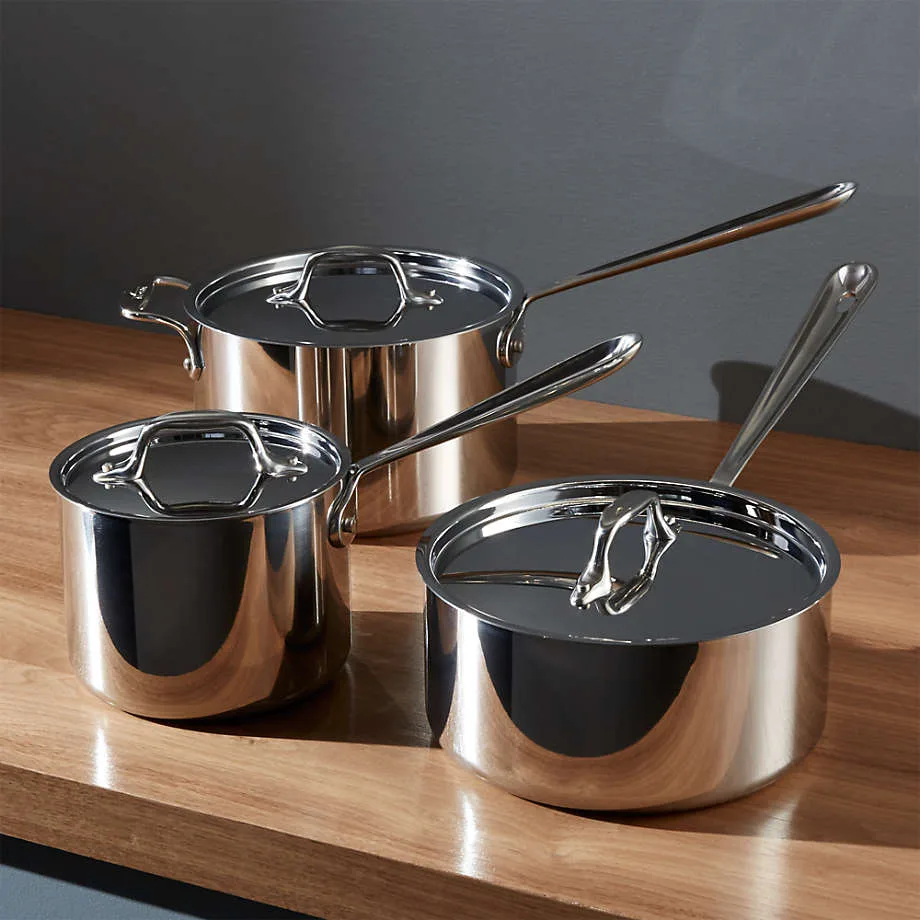
Image source: Web (Bing) / crateandbarrel.com (Web image (fair-use with source credit))
Why a Saucepan’s Shape Matters More Than You Think
Before you start memorizing sizes, it helps to understand why the shape exists. Those straight walls aren’t there for looks. They control how heat, liquid, and food behave.
A saucepan’s tall sides keep liquid inside and slow evaporation. That’s exactly what you want when simmering a sauce, boiling small portions, or reheating soup. A wide, sloped pan like a sauté pan spreads the liquid out and cooks it down much faster.
The geometry is so consistent that manufacturer spec pages show the same basic profile across sizes. All-Clad’s lineup, for instance, lists saucepans with straight sides and one long handle from 1.5 quarts all the way up to 4 quarts.
The Quick Answer: A Saucepan in One Sentence
A saucepan looks like a small, straight-sided pot with one long handle. The base is flat. The sides rise straight up.
A fitted lid usually finishes the look. It’s shorter than a stockpot and taller than a skillet.
Breaking Down the Silhouette: Straight Sides, Long Handle, Flat Base
Look at a saucepan from the side and three parts stand out: the body, the handle, and the base. Each one has a distinct visual character.
| Part | What it looks like | Why it matters | | Body | Straight vertical sides, about as tall as its diameter is wide | Holds liquids and prevents splashing | | Handle | Long, slender, attached at one side | Keeps your hands away from heat | | Base | Flat, wide, sometimes with a visible layered disc | Makes even contact with the burner |
The ratio between height and width is your biggest clue. A 2-quart saucepan has a diameter around 6 inches and a height around 4 inches. That makes the body look noticeably taller and more cylindrical than a skillet.
To measure a saucepan, don’t trust the sticker. Run a tape measure across the top rim, not the base. That gives you the true diameter.
You’ll also notice the top edge. Many saucepans have a slightly rolled rim and two small pouring lips, one on each side. Those lips are a practical tell.
If a pot has them, it’s designed for pouring liquids without spilling down the side.
In our research, the most common capacities are 1.5, 2, 3, and 4 quarts. The 2 and 3 quart versions are what most people picture when they think about a standard saucepan.
The Handle Tells You a Lot: Length, Angle, and Material
The handle is where shape and safety meet. Most saucepan handles run 7 to 9 inches long. That length keeps your hand a comfortable distance from the burner.
Pay attention to the angle. Some handles sit perfectly horizontal. Others angle upward slightly toward the grip.
That upward tilt looks subtle. It shifts the pan’s center of gravity toward the handle, making the pan feel lighter in your hand.
Material matters too. Here’s what you’ll typically see:
Stainless steel handles look sleek and are oven-safe, but they get hot. A silicone sleeve helps.
Cast stainless handles feel sturdier in the hand and stay cooler, though they add noticeable weight.
Riveted handles create a visible metal bulge where they attach. Welded handles leave a clean, flush line.
Silicone-coated handles look matte and grippy. They protect your palm but can discolor over time.
Short handles on a deep pot are a red flag. An 8-inch handle on a 3-quart body puts your hand awkwardly close to the steam. If the handle looks out of proportion, walk away.
The Lid: Flat or Domed, and What That Means
Most saucepans come with a lid, and that lid is a visual clue. Flat lids sit flush against the rim. Domed lids curve upward to trap more steam and create a tight seal.
Glass lids show what’s happening inside, but they add weight. Metal lids, usually stainless, are lighter and more durable. You’ll see a knob on top, either metal or plastic.
Hot glass lids with plastic knobs are safe at medium heat but not in the oven.
Saucepan vs. Sauté Pan: The Side Profile Test
This is the confusion that never ends. Both have one long handle. Both nest on a burner.
Look from the side and it’s over in seconds.
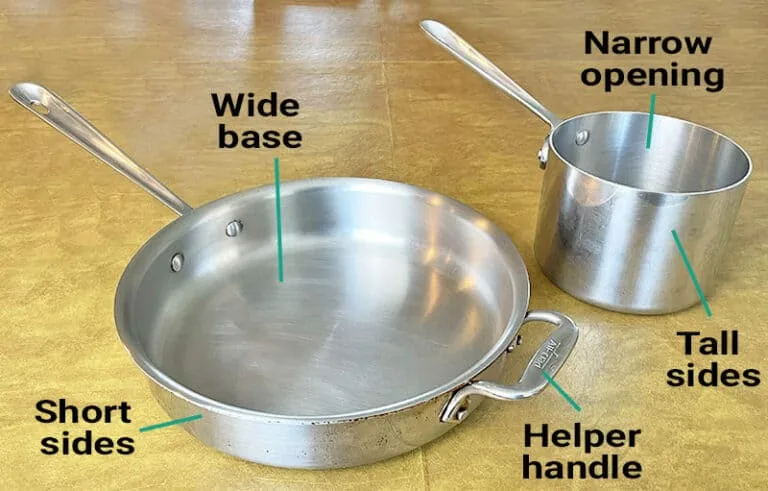
Image source: Web (Bing) / prudentreviews.com (Web image (fair-use with source credit))
A sauté pan has low, sloped walls that flare outward. A saucepan has straight, vertical walls that stay parallel to the center. Put them next to each other at eye level and the difference is unmistakable.
Here’s the practical tell: sauté pans are wide and shallow for searing meats. Saucepans are tall and narrow for liquid cooking. If a pan’s depth is less than half its diameter, it’s a sauté pan.
If the depth approaches the diameter, it’s a saucepan.
Saucepan vs. Stockpot: The Height and Handle Rule
A stockpot is basically a saucepan that grew up. Both have straight sides. Both handle liquids well.
The difference is height and handles.
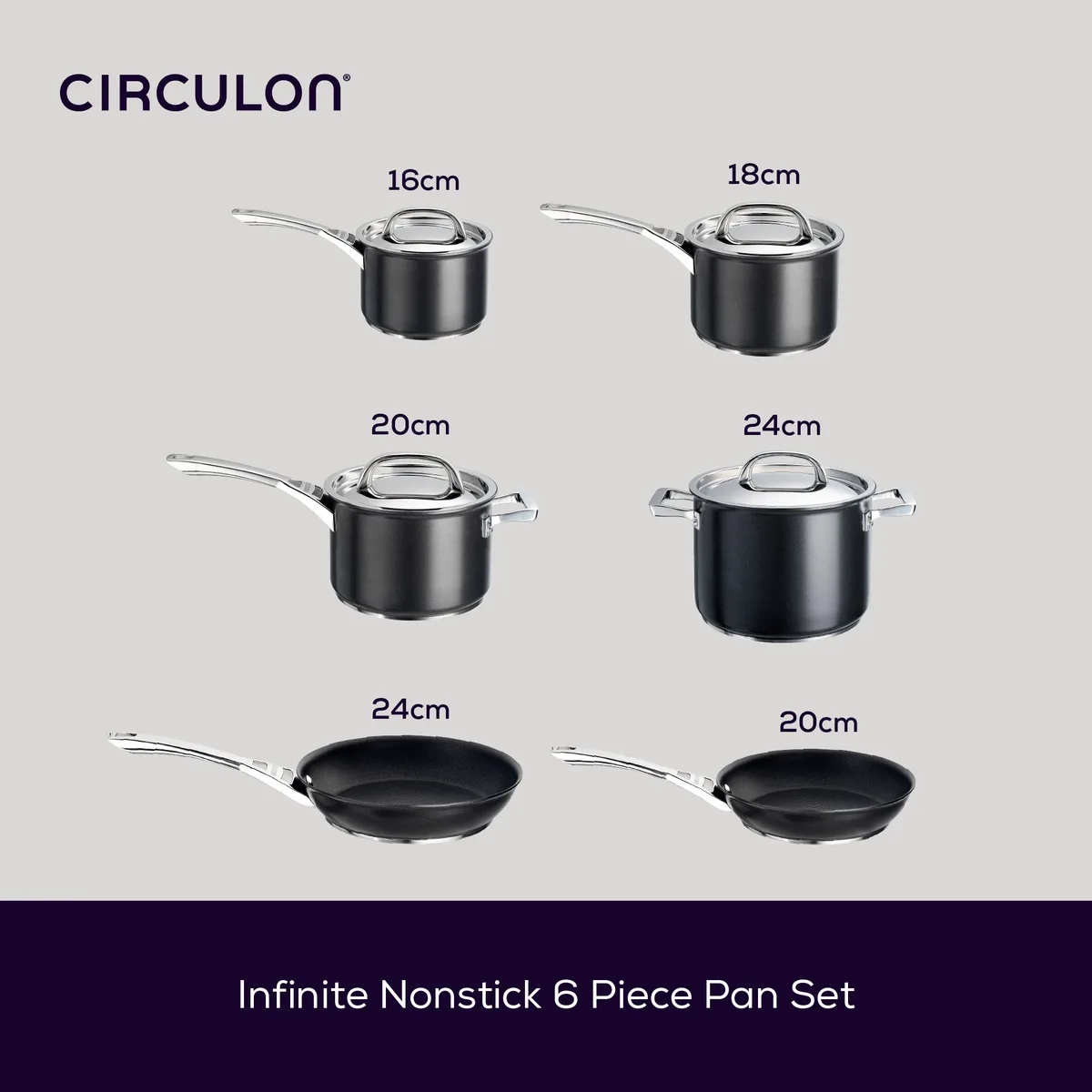
Image source: Web (Bing) / circulon.uk.com (Web image (fair-use with source credit))
Saucepans come in at 4 to 6 inches tall. Stockpots run 8 to 12 inches or more. You can spot the stockpot from across the kitchen.
The handles seal the deal. Saucepans have one long handle, always. Stockpots have two loop handles, one on each side, because they’re too heavy to lift one-handed.
If you see two stubby side loops, it’s a stockpot or a Dutch oven, not a saucepan.
Saucepan vs. Saucier: Straight vs. Curved Walls
This one trips up visual learners. A saucier looks close to a saucepan, but the walls curve inward toward the base. A saucepan keeps its walls straight from rim to bottom.
The cause is the cooking action. Sauciers are built for stirring and whisking sauces, so the rounded corners let a whisk reach every bit of the pan. Saucepans keep straight walls for boiling grains and simmering liquids.
Common Visual Mistakes: What People Confuse With a Saucepan
The most frequent mix-ups come down to proportions. Short and wide pans confuse people who shop by instinct. Here are the usual suspects.
| Pan | Wall shape | Handle | Likely confusion | | Milk pan | Straight, shorter | Long, thin | “Is this a tiny saucepan?” | | Sauté pan | Sloped | Long | “It has one handle too” | | Stockpot | Straight, tall | Two side loops | “It’s just a huge saucepan” | | Saucier | Curved | Long | “Nearly identical” |
If you’re standing in a store and can’t tell, check the height-to-width ratio. A saucepan looks like a cylinder. Anything that flares out or stands too tall belongs to a different category.
How to Spot a Quality Saucepan by Sight Alone
You don’t need to lift a pan to guess its quality. A few visual checks point you in the right direction.
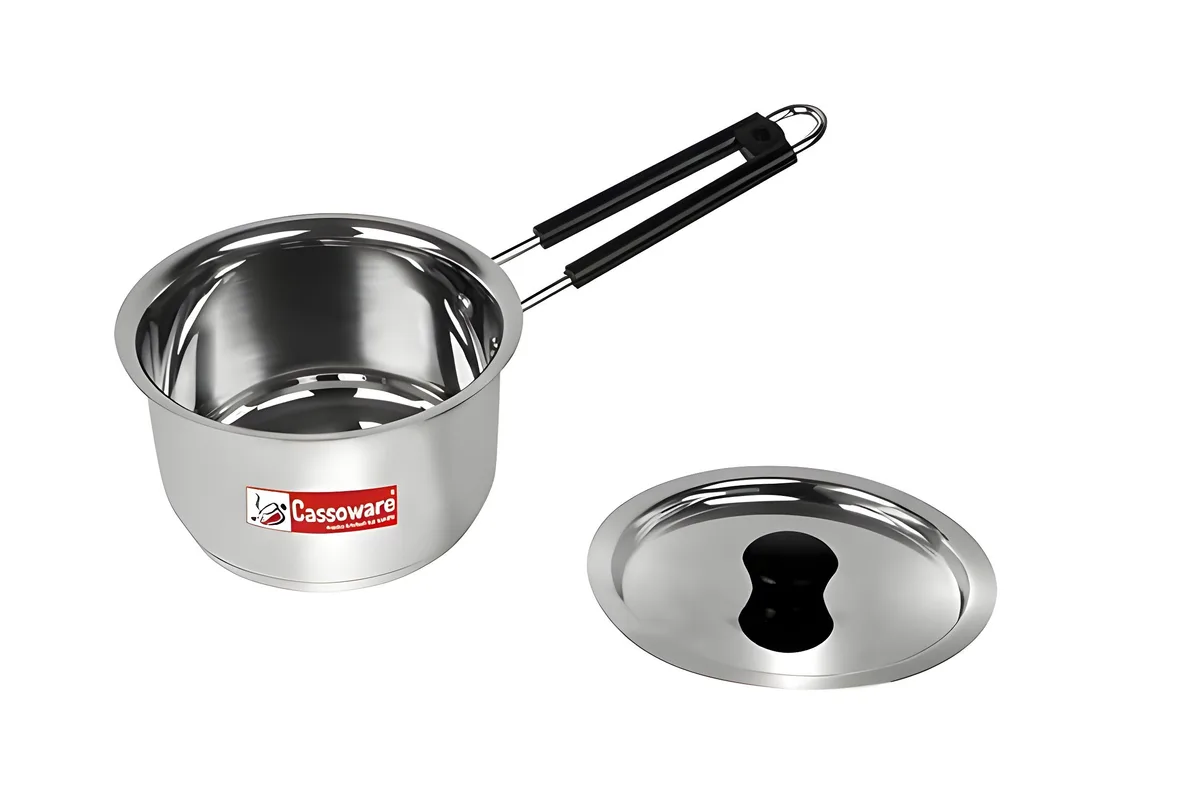
Image source: Bing (Web (fair-use with source credit))
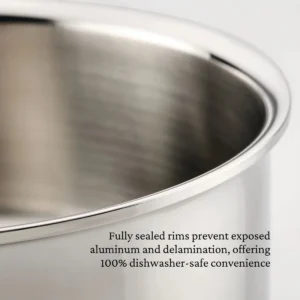
Flip the pan over. Look at the base. Quality pans show a clear sandwich layer: a thick aluminum or copper core between two sheets of stainless steel.
This is the encapsulated base. It spreads heat evenly across the bottom.
Check the rim. A raw, sharp edge means lower-end manufacturing. A rolled edge means more care and easier cleaning.
Check the lid fit by eye. Set it on the pan and look for gaps. An uneven gap at the rim wastes heat and spatters sauce.
Visual Reference Guide: Saucepan Dimensions by Capacity
Here’s the quick visual cheat sheet for capacity and size.
| Capacity | Approx. diameter | Approx. height | What it looks like | | 1.5 qt | 5.5–6 in | 3.5–4 in | Low and snug | | 2 qt | 6–7 in | 4–4.5 in | Classic cylinder | | 3 qt | 7–8 in | 4.5–5 in | Taller, heavier | | 4 qt | 8–8.5 in | 5–6 in | Stockpot territory |
The bigger the pan, the heavier the base needs to be. A 4-quart saucepan with a flimsy body warps over time. Look for at least a 2.5 mm base thickness on larger sizes.
What to Look For When Buying Your First Saucepan
Choose a 2-quart or 3-quart size. That’s the sweet spot for rice, sauces, oatmeal, and reheating soup.
Stainless steel with an aluminum core is the strongest visual pick. It shows the shiny steel exterior with a visible base layer underneath. A 2.5 mm to 3 mm base on a 2-quart pan is solid.
Nonstick versions look lighter with dark interiors. They’re easier to clean, but the coating fades. If you see flaking on a display model, skip it.
Quick FAQ: Shapes You’ll See in the Store
Why does my saucepan have two pouring lips?
The small spouts on each side make it easier to pour without dribbling down the side. Not all saucepans have them, but they’re a common visual feature.
Are all saucepans the same shape?
No. Some have slightly curved walls, but the defining shape is straight-sided with a long handle. Sauciers and milk pans bend that rule.
Is a saucepan the same as a pot?
No. A pot is taller and wider, with two handles. A saucepan is smaller, single-handled, and built for smaller liquid cooking tasks.
How do I know if a pan is a saucepan or a stockpot?
Look at the handles and the height. One long handle plus a height under 6 inches means saucepan. Two side handles plus a height over 8 inches means stockpot.
The Lid: Flat or Domed, and What That Means
Most saucepans come with a lid, and that lid is a visual clue. Flat lids sit flush against the rim. Domed lids curve upward to trap more steam and create a tighter seal.
Glass lids show what’s happening inside, but they add weight. Metal lids, usually stainless, are lighter and more durable. You’ll see a knob on top, either metal or plastic.
Hot glass lids with plastic knobs are safe at medium heat but not in the oven.
A lid that doesn’t sit flat is a red flag. Place it on the pan and look for gaps. An uneven gap at the rim wastes heat and spatters sauce.
Saucepan vs. Sauté Pan: The Side Profile Test
This is the confusion that never ends. Both have one long handle. Both nest on a burner.
Look from the side and it’s over in seconds.
Image source: Web (Bing) / prudentreviews.com (Web image (fair-use with source credit))
A sauté pan has low, sloped walls that flare outward. A saucepan has straight, vertical walls that stay parallel to the center. Put them next to each other at eye level and the difference is unmistakable.
Here’s the practical tell: sauté pans are wide and shallow for searing meats. Saucepans are tall and narrow for liquid cooking. If a pan’s depth is less than half its diameter, it’s a sauté pan.
If the depth approaches the diameter, it’s a saucepan.
A quick measurement settles it. Use a ruler across the top rim and down the side. That ratio decides what you’re holding.
Saucepan vs. Stockpot: The Height and Handle Rule
A stockpot is basically a saucepan that grew up. Both have straight sides. Both handle liquids well.
The difference is height and handles.
Image source: Web (Bing) / circulon.uk.com (Web image (fair-use with source credit))
Saucepans come in at 4 to 6 inches tall. Stockpots run 8 to 12 inches or more. You can spot the stockpot from across the kitchen.
The handles seal the deal. Saucepans have one long handle, always. Stockpots have two loop handles, one on each side, because they’re too heavy to lift one-handed.
If you see two stubby side loops, it’s a stockpot or a Dutch oven, not a saucepan.
Saucepan vs. Saucier: Straight vs. Curved Walls
This one trips up visual learners. A saucier looks close to a saucepan, but the walls curve inward toward the base. A saucepan keeps its walls straight from rim to bottom.
The cause is the cooking action. Sauciers are built for stirring and whisking sauces, so the rounded corners let a whisk reach every bit of the pan. Saucepans keep straight walls for boiling grains and simmering liquids.
Spot the difference by tracing the side with your finger. If it slants inward at the bottom, it’s a saucier. If it stays perfectly vertical, it’s a saucepan.
Common Visual Mistakes: What People Confuse With a Saucepan
The most frequent mix-ups come down to proportions. Short and wide pans confuse people who shop by instinct. Here are the usual suspects.
| Pan | Wall shape | Handle | Likely confusion | | Milk pan | Straight, shorter | Long, thin | “Is this a tiny saucepan?” | | Sauté pan | Sloped | Long | “It has one handle too” | | Stockpot | Straight, tall | Two side loops | “It’s just a huge saucepan” | | Saucier | Curved | Long | “Nearly identical” |
If you’re standing in a store and can’t tell, check the height-to-width ratio. A saucepan looks like a cylinder. Anything that flares out or stands too tall belongs to a different category.
How to Spot a Quality Saucepan by Sight Alone
Flip the pan over. Look at the base. A quality saucepan shows a clear sandwich layer: a thick aluminum or copper core between two sheets of stainless steel.
This is the encapsulated base. It spreads heat evenly across the bottom.
Image source: Bing (Web (fair-use with source credit))
Check the rim next. A raw, sharp edge means lower-end manufacturing. A rolled edge means more care and easier cleaning.
Inspect the handle attachment. Riveted handles create a visible metal bulge. Welded handles leave a clean, flush line.
Both work fine, but the visual difference tells you about the build quality.
Gauge the weight by lifting it. A 2-quart stainless saucepan with an encapsulated base runs about 2.5 to 3.5 pounds. If it feels hollow and light for its size, the base is thin.
Visual Reference Guide: Saucepan Dimensions by Capacity
Here’s the quick visual cheat sheet for capacity and size.
| Capacity | Approx. diameter | Approx. height | What it looks like | | 1.5 qt | 5.5–6 in | 3.5–4 in | Low and snug | | 2 qt | 6–7 in | 4–4.5 in | Classic cylinder | | 3 qt | 7–8 in | 4.5–5 in | Taller, heavier | | 4 qt | 8–8.5 in | 5–6 in | Stockpot territory |
To measure a saucepan at home, run a tape measure across the top rim. Don’t measure the base. The rim gives you the standard size that brands list.
The bigger the pan, the thicker the base needs to be. A 4-quart saucepan with a thin body warps over time. Look for at least a 2.5 mm base on larger sizes.
What to Look For When Buying Your First Saucepan
Choose a 2-quart or 3-quart size. That’s the sweet spot for rice, sauces, oatmeal, and reheating soup.
Stainless steel with an aluminum core is the strongest visual pick. You’ll see the shiny steel exterior with a visible base layer underneath. A 2.5 mm to 3 mm base on a 2-quart pan is solid.
Check the handle before you buy. It should feel balanced in your hand and stay cool enough to grip during a simmer. If the handle is angled too steeply, the pan tips forward when empty.
Nonstick versions look lighter with dark interiors. They’re easier to clean, but the coating fades. If you see flaking on a display model, skip it.
Quick FAQ: Shapes You’ll See in the Store
Why does my saucepan have two pouring lips?
The small spouts on each side make it easier to pour without dribbling down the side. Not all saucepans have them, but they’re a common visual feature on newer sets.
Are all saucepans the same shape?
No. Some have slightly curved walls, but the defining shape is straight-sided with a long handle. Sauciers and milk pans bend that rule.
Is a saucepan the same as a pot?
No. A pot is taller and wider, with two handles. A saucepan is smaller, single-handled, and built for smaller liquid cooking tasks.
How do I know if a pan is a saucepan or a stockpot?
Look at the handles and the height. One long handle plus a height under 6 inches means saucepan. Two side handles plus a height over 8 inches means stockpot.