Making a great cup of coffee at home starts with the right grind. You may have heard about burr grinders and blade grinders—but which one is actually better? This decision affects your coffee’s taste, aroma, and even how much you enjoy the process. While both grinders turn whole beans into grounds, they work very differently, and each has strong points and weaknesses. If you want to get the most flavor from your beans, or you’re just looking for the best value, understanding these differences is key.
Let’s dive deep into how burr and blade grinders work, what separates them, and which one might be the perfect match for your coffee habits.
How Coffee Grinders Work
Before comparing burr and blade grinders, it helps to know their main job: turning whole beans into evenly ground coffee. The grind size matters because it controls how water extracts flavor from the beans. A grinder that produces consistent particles helps you get smooth, balanced coffee. If the grind is uneven, you get bitter or weak flavors.
What Is A Burr Grinder?
A burr grinder uses two abrasive surfaces (the burrs) to crush and grind the beans. You can adjust the burrs closer or farther apart to control the grind size. There are two main types: flat burrs and conical burrs. Both work in a similar way, but conical burrs are often quieter and less messy.
Main Features Of Burr Grinders
- Uniform grind size: Burr grinders make grounds that are all about the same size, leading to better flavor extraction.
- Adjustable settings: You can easily switch between fine (for espresso) and coarse (for French press) by turning a dial or knob.
- Less heat: They grind slowly, so beans stay cool and keep their natural oils and aromas.
- Built for consistency: Good burr grinders last longer and keep their settings steady over time.
Types Of Burr Grinders
- Manual burr grinders: You turn a handle by hand. They’re affordable, quiet, and portable, but take more effort.
- Electric burr grinders: These use a motor to spin the burrs. They’re faster and easier, but usually cost more.
What Is A Blade Grinder?
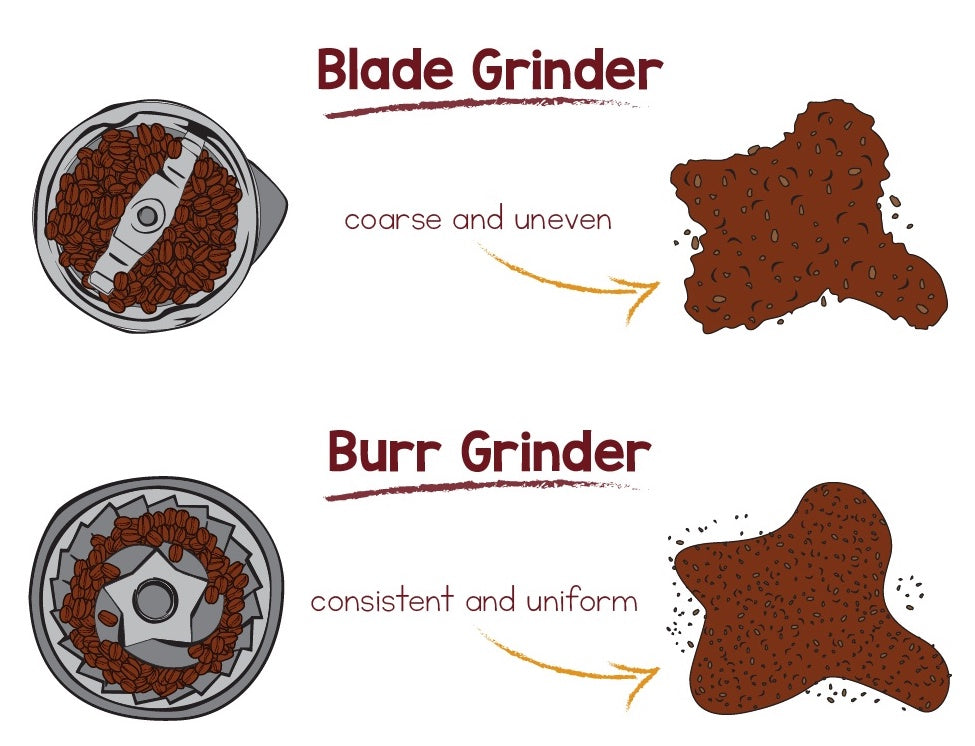
A blade grinder uses a spinning metal blade, like a tiny blender, to chop the beans. The blade spins fast, breaking beans into smaller pieces until you stop the machine.
Main Features Of Blade Grinders
- Simple design: Usually just a button and a lid.
- Inexpensive: Most blade grinders are cheaper than burr grinders.
- Fast grinding: They can grind beans in seconds.
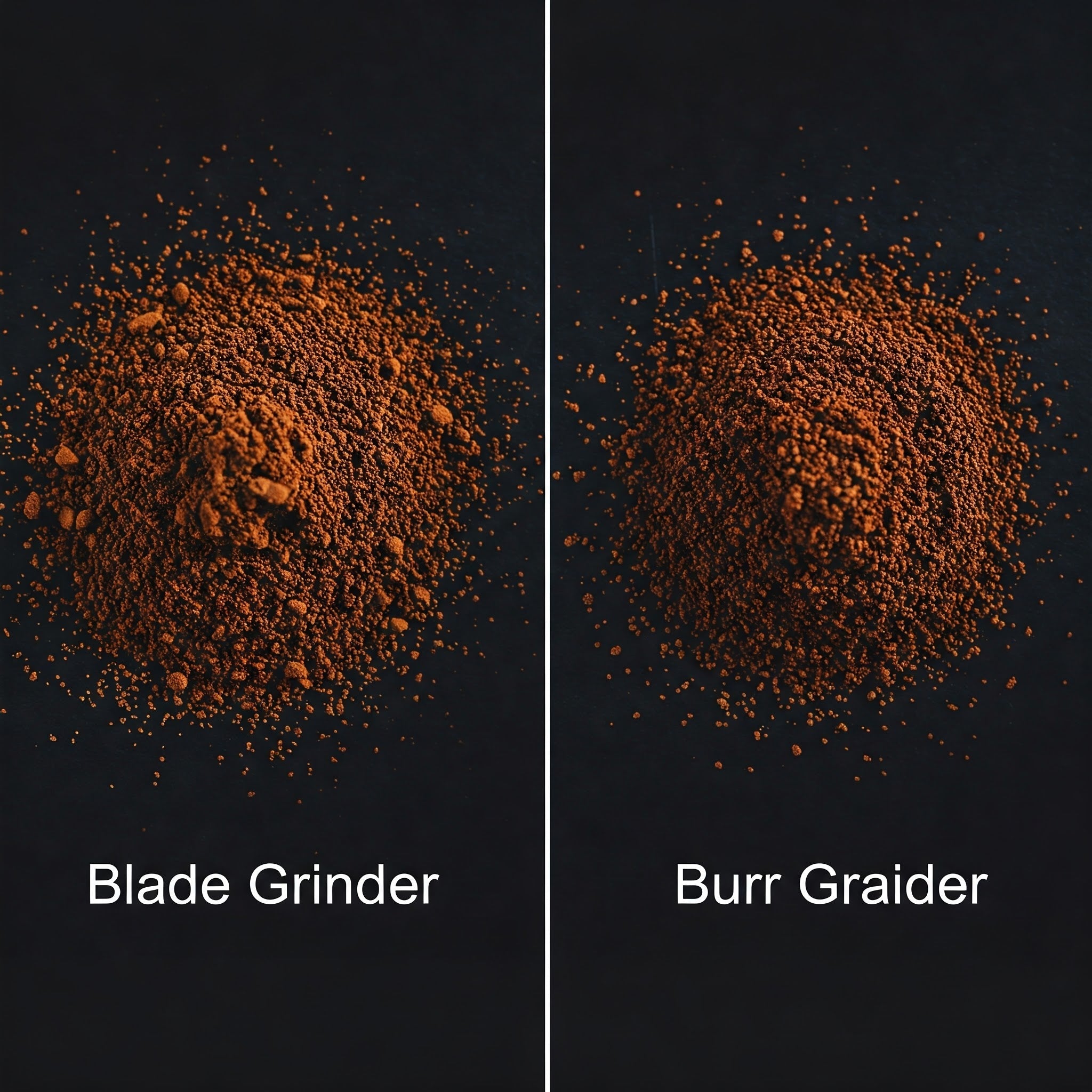
- Inconsistent grind: The blade cuts unevenly, creating both fine powder and large chunks.
- Heat build-up: Fast spinning can heat the beans, changing their flavor slightly.
Burr Grinder Vs Blade Grinder: Side-by-side Comparison
Let’s look at how these grinders stack up on the most important points for home coffee lovers.
| Feature | Burr Grinder | Blade Grinder |
|---|---|---|
| Grind Consistency | Very uniform | Uneven, mixed sizes |
| Adjustable Grind Settings | Easy, precise settings | No true settings |
| Heat Generation | Low | High |
| Price Range | $40–$500+ | $15–$40 |
| Noise Level | Quieter (esp. manual) | Louder |
| Durability | Longer-lasting | Can wear quickly |
How Grinder Choice Affects Coffee Taste
The grinder you pick changes how your coffee tastes. Here’s why:
Uniform grind = better flavor. Burr grinders create even particles, which helps water extract flavor evenly. This means your cup tastes smooth, rich, and balanced.
Uneven grind = mixed results. Blade grinders make some grounds too fine (over-extracted and bitter) and some too coarse (under-extracted and sour). This mix leads to flat or confusing flavors.
Heat can spoil aroma. High heat from blade grinders can burn off delicate oils in the beans. Burr grinders avoid this, keeping more of the original aroma and taste.
Example: If you use a French press with blade-ground beans, you’ll notice more “sludge” at the bottom and a muddier taste. With a burr grinder, the cup is cleaner and more flavorful.
Who Should Choose A Burr Grinder?
If you care about the taste and quality of your coffee, a burr grinder is usually the better choice. Here’s who benefits most:
- Home baristas: If you brew espresso, pour-over, or French press, burr grinders let you match the grind to your method.
- Specialty coffee fans: If you buy fresh, single-origin beans, a burr grinder helps you taste the difference.
- People who want control: Adjustable settings give you more power over your cup.
- Anyone making large batches: Burr grinders handle bigger amounts without overheating or getting stuck.
A Non-obvious Insight
Manual burr grinders, though slower, offer more control and can be taken when traveling. They’re also a great way to learn how grind size affects taste, because you adjust it yourself and notice the results cup by cup.
Credit: zeroherocoffee.com
Who Should Choose A Blade Grinder?
Blade grinders can still be a good option for some situations:
- People on a budget: If you’re just starting or don’t want to spend much, blade grinders are the cheapest way to grind fresh beans.
- Busy mornings: They’re fast and easy—just push a button and you’re done.
- Making drip coffee: If you’re brewing with a basic drip machine, the difference in grind consistency matters less.
- Spices and other uses: Blade grinders can also chop spices or nuts, so they’re more versatile in the kitchen.
Another Non-obvious Insight
Many people use blade grinders for coffee, but only fill them halfway or less. This actually gives a slightly more even grind than overloading the chamber. Shaking the grinder gently while running can also help even out the grind size.
Real-world Examples And Data
Coffee experts agree that grind consistency is key. According to a study by the Specialty Coffee Association, uneven grind size can reduce extraction efficiency by up to 20%. This means you’re wasting both beans and flavor.
Professional cafes always use burr grinders, even for decaf or secondary blends. Home users who switch from blade to burr grinders often notice a dramatic improvement in taste—sometimes even more than upgrading their coffee maker.
Here’s a quick look at how grinder type affects different brewing styles:
| Brewing Method | Ideal Grinder | Why |
|---|---|---|
| Espresso | Burr | Needs very fine, even grounds |
| Pour-over | Burr | Uniformity brings out subtle flavors |
| French Press | Burr | Prevents muddy texture |
| Drip Machine | Either | Less sensitive to uniformity |
| Cold Brew | Burr (coarse) | Reduces bitterness |
:max_bytes(150000):strip_icc()/__opt__aboutcom__coeus__resources__content_migration__serious_eats__seriouseats.com__2019__02__20190206-coffee-grinder-vicky-wasik-grinds-comparison-1500x1125-b2d47dd44c0d408cabae9d91b262a533-72acbe342c714d41aa3febf61b65ad69.jpg)
Credit: www.seriouseats.com
Price And Value Considerations
Cost is often the deciding factor. Burr grinders start at around $40 for a basic manual model and can go up to $500 or more for high-end electric units. Blade grinders, on the other hand, are usually under $40.
But think about long-term value. Burr grinders last longer, save beans (due to better extraction), and can even improve cheaper beans. Blade grinders may need replacing sooner, especially if you grind daily.
If you’re unsure, try a manual burr grinder first. You’ll learn a lot about grind size and coffee taste without spending too much.
Common Mistakes When Choosing A Coffee Grinder
- Ignoring grind size control: Many buyers grab the cheapest grinder and later regret the lack of options.
- Expecting espresso from a blade grinder: Blades can’t grind fine or consistent enough for good espresso.
- Overloading the grinder: Filling the grinder to the top leads to a more uneven grind.
- Not cleaning regularly: Old grounds and oils can go stale and spoil fresh coffee, especially in burr grinders.
- Assuming more power is better: High-wattage blade grinders can overheat beans quickly.
Cleaning And Maintenance
Burr grinders need regular cleaning to keep working well. Old coffee particles and oils can get stuck between the burrs. Most burr grinders can be taken apart for easy cleaning. Brush out the burrs every few weeks, and deep-clean once a month.
Blade grinders are simpler—wipe with a dry cloth and occasionally grind some rice to absorb oils. However, cleaning does not solve the uneven grind issue.
Environmental And Health Factors
Both grinders use electricity (unless you pick a manual burr grinder). Manual grinders have a smaller carbon footprint. Also, because burr grinders are more efficient, you may use fewer beans per cup over time.
For health, uniform grinding means fewer fine particles, which reduces the risk of over-extraction and bitterness—especially important if you drink coffee black.
Final Thoughts: Which Grinder Is Right For You?
Choosing between a burr grinder and a blade grinder depends on your coffee goals, budget, and daily habits. Burr grinders win for flavor, flexibility, and consistency. Blade grinders are quick, cheap, and simple for casual coffee drinkers. If you want to experiment and grow as a home barista, a burr grinder is worth the investment.
If you just want a fast cup and don’t want to fuss over details, a blade grinder will do the job.
If you’re curious about detailed grinder mechanics and want more technical comparisons, check out the Wikipedia Coffee Grinder page.
Frequently Asked Questions
What Grind Size Should I Use For Different Brewing Methods?
Different brewing styles need different grind sizes. Espresso uses a fine grind, pour-over and drip coffee use a medium grind, and French press or cold brew need a coarse grind. Burr grinders make it easy to adjust for each style.
Can I Use A Blade Grinder For Espresso?
Technically, you can try, but it’s hard to get the fine, even grind needed for good espresso. The shot may taste weak or bitter. For best results, use a burr grinder.
How Often Should I Clean My Coffee Grinder?
For burr grinders, brush out loose grounds weekly and deep clean monthly. Blade grinders should be wiped clean after each use, and you can grind a bit of rice to absorb leftover oils.
Is A Manual Burr Grinder Better Than An Electric Blade Grinder?
Manual burr grinders are slower but give better grind consistency and control. They’re quieter and cheaper than electric burr grinders, but need some effort. For flavor, a manual burr grinder is usually better than any blade grinder.
Why Does My Coffee Taste Bitter Or Weak?
Bitterness can come from over-extracted fine particles (common with blade grinders), while weak coffee can be from under-extracted large chunks. Using a burr grinder and matching the grind size to your brewing method helps solve both problems.
Credit: torque.coffee